
By Alan Goldstein
Devonian rugose corals from near Samara, West Sahara, Morocco, show remarkable similarities with genera found in eastern North America. The guide illustrates and identifies species purchased from Moussa Fossils and Minerals.
Background
As Pangea developed, the Rheic Ocean, which separated Laurentia (North America) from Gondwana (including Africa), began to close. (The two continents came together about 335 million years ago, during the Middle Mississippian.) While the ocean circulated, genera of marine invertebrates, including corals, could disperse their planktonic embryos with the current to settle and thrive where conditions were compatible.
In the fossil record, this is revealed by the distribution of similar fossils. Corals like the genera Favosites and Thamnopora are cosmopolitan, that is, they are found in rocks of similar age across the globe. Genera of rugosa corals aren’t distributed as widely. (More research on my part to verify this statement is needed.)
Mollwiede’s map1 and Scotese’s map2 of the Middle Devonian, 390 million years (Eifelian Stage), show some important differences. That isn’t unexpected as paleogeography work continues. However, Mollweide shows a complete land bridge blocking the Laurentian interior seaway from the Rheic Ocean, while Scotese shows a peninsula that would accommodate open circulation.
Based on the similarities in coral (as well as trilobite) genera between the eastern U.S. and West Sahara, Morocco, it is apparent that Scotese’s version matches the fossil evidence. Although corals could have circumnavigated the continent of Laurentia following ocean currents, eventually making their way southeast to Moroccan waters, but not the other way around.
Corals and Stratigraphy
Evaluating over 100 solitary horn corals, I have found genera abundant in our area and those unfamiliar. Without precise locality and stratigraphic information, the data obtained are incomplete. The purpose of this web page is to share photographs of corals – both identified and unknown, so that collectors and dealers may examine their specimens and benefit by being able to assign a name to fossils at some level.
Paleontologists today use techniques where the fossil is sliced at various angles to study the internal structure. Corals like these make up a small percentage of those found. The rest don’t expose the septa or other external features, and are not marketable to collectors who have sufficient interest, much less the resources to identify these coral “lumps.”
The corals appear to be a blend of Eifelian and Givetian stages. The Boyle Limestone in central Kentucky has a similar mix; the question of why has yet to be answered.
The geology of the West Sahara region is sparse and difficult to access. I have reviewed several studies3 to learn about the geology of the Samara area. Western Sahara was a Spanish territory when the French controlled the rest of Morocco.4
.png)
2) http://scotese.com/newpage3.htm
3) Jobst Wendt, Bernd Kaufmann, 2005, Middle Devonian (Givetian) coral-stromatoporoid reefs in West Sahara (Morocco), Journal of African Earth Sciences 44 (2006) 339–350. (From www.sciencedirect.com).
4) This Wikipedia page has background on Western Sahara.
Coral Gallery
Order Rugosa
Aulacophyllum
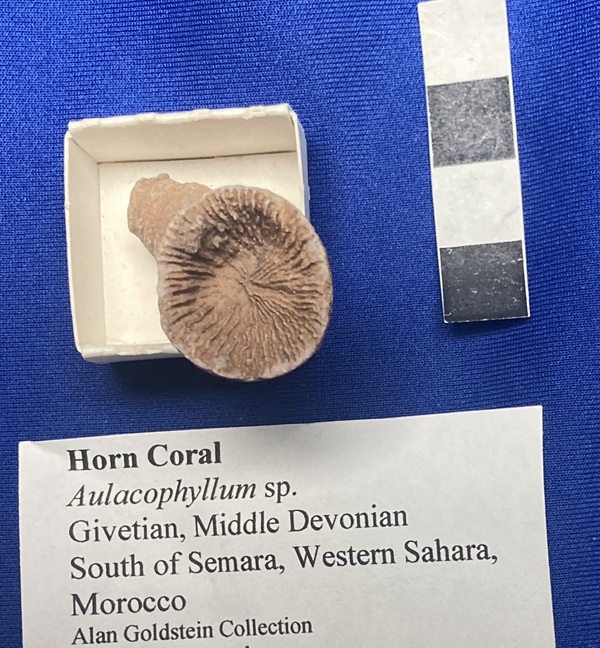
Aulocophyllum septa have four-fold symmetry.
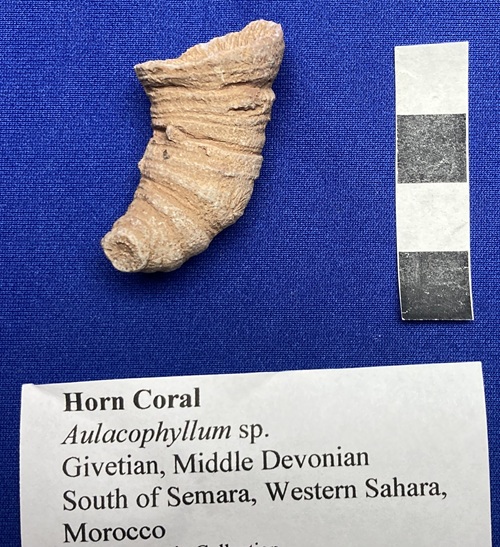
Typical growth form for many horn corals, called ceratoid.
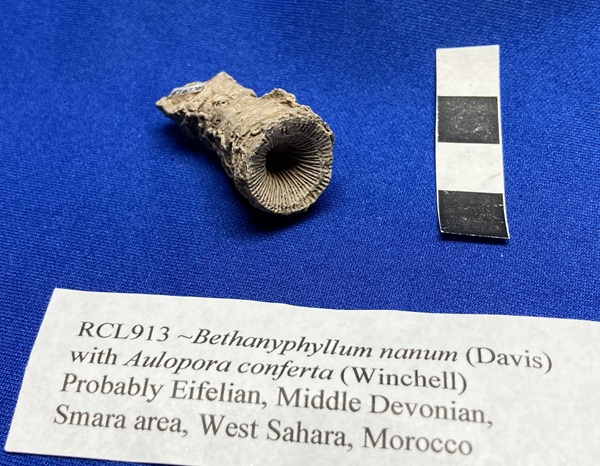
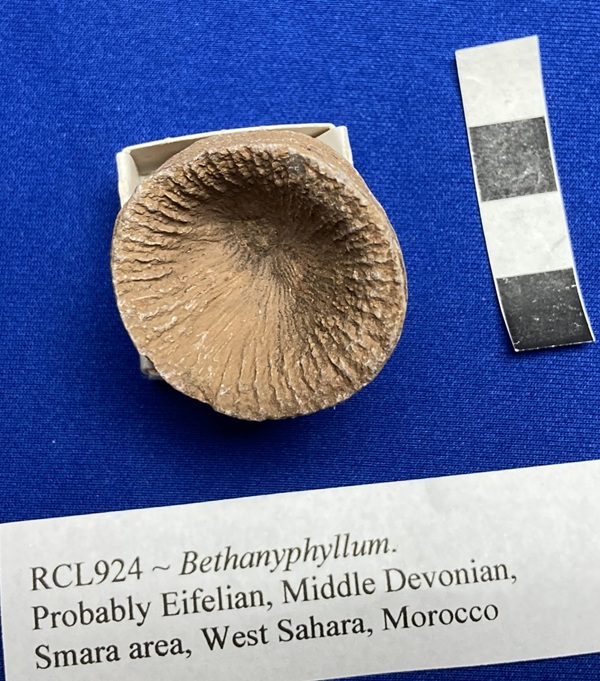
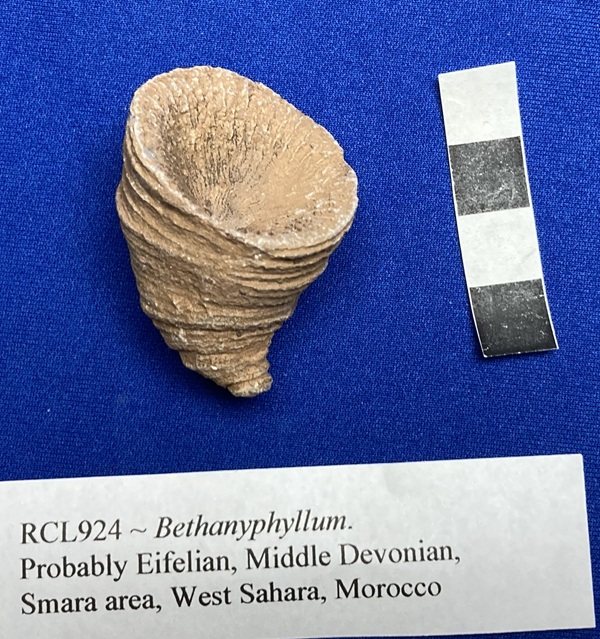
Bethanyphyllum
.
.
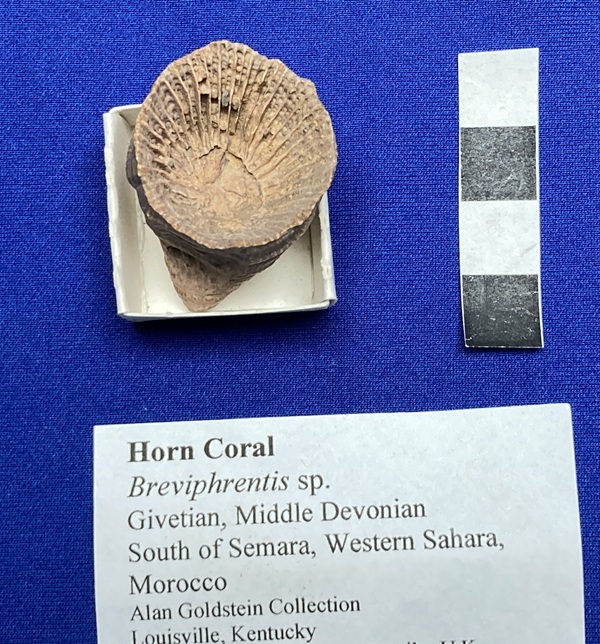
Breviphrentis?
Possible Breviphrentis, though the pattern between the septa indicate in may be something else. Needs more study.
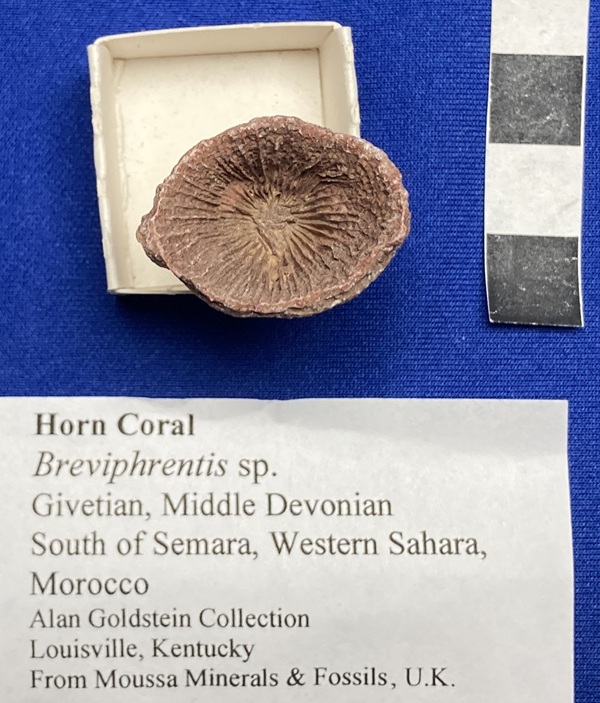
Same species as above. Maybe Breviphrentis. Or not.
Cystiphylloides
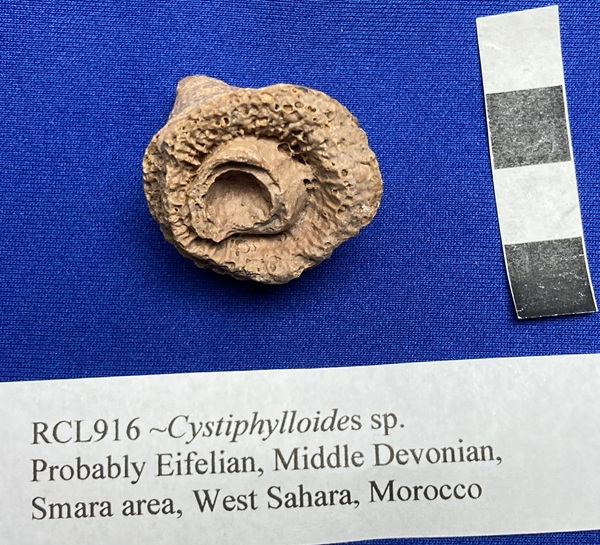
Shows dissepimentaria, cyst-like structures, typical for this genus.
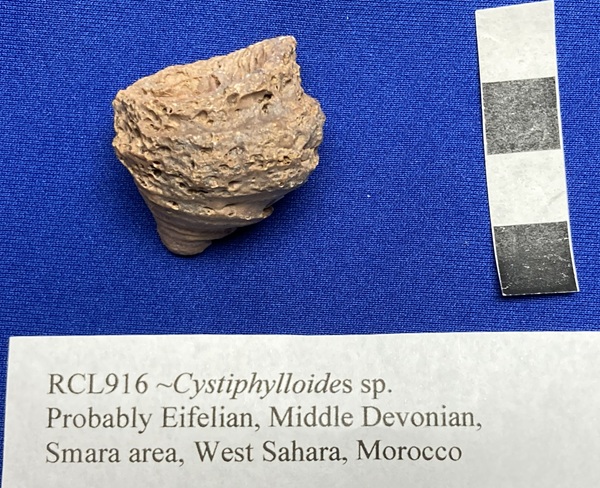
.
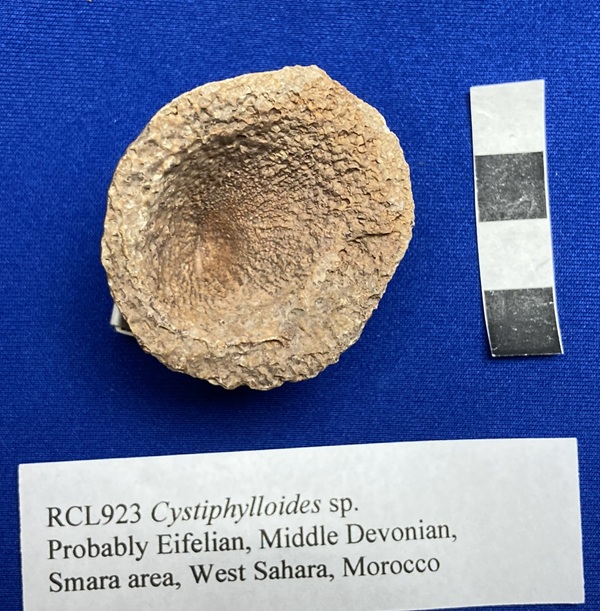
Deep calyx.
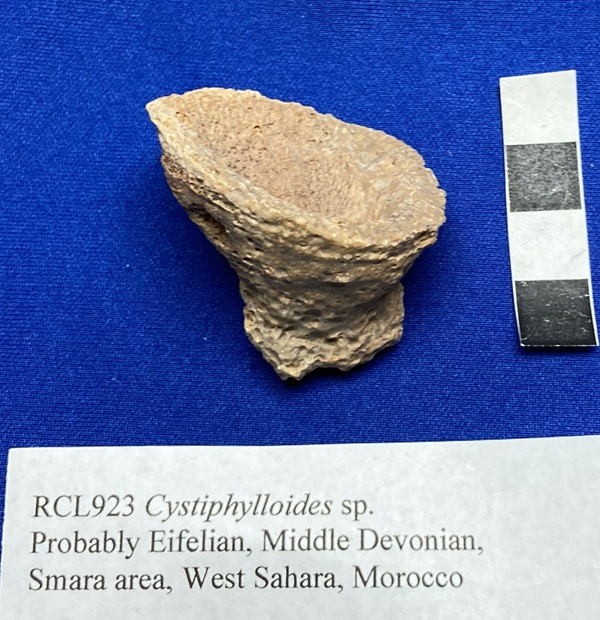
A distinct funnel shape is common in soft sediment.
Enallophrentis
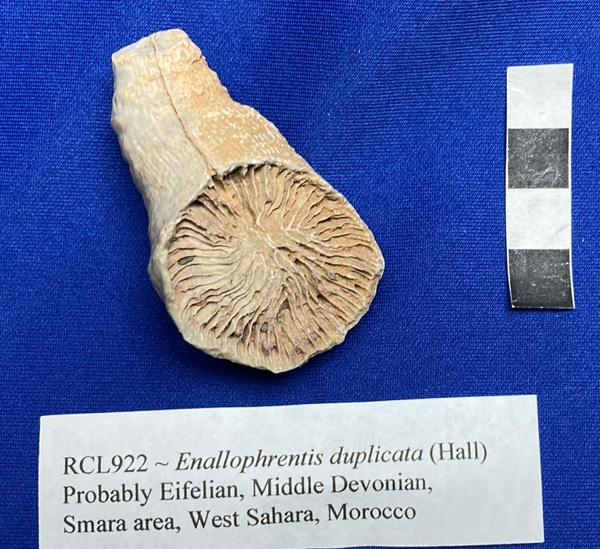
Enallophrentis duplicata is a common horn coral in the Jeffersonville Limestone in Indiana and Kentucky.
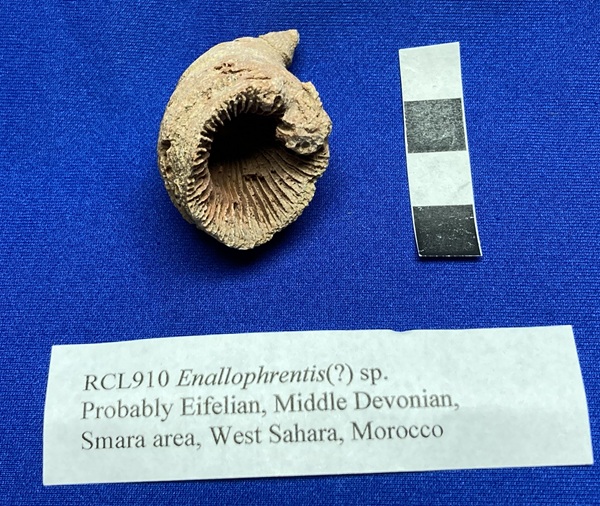
Resembles Enallophrentis.
Heliophyllum
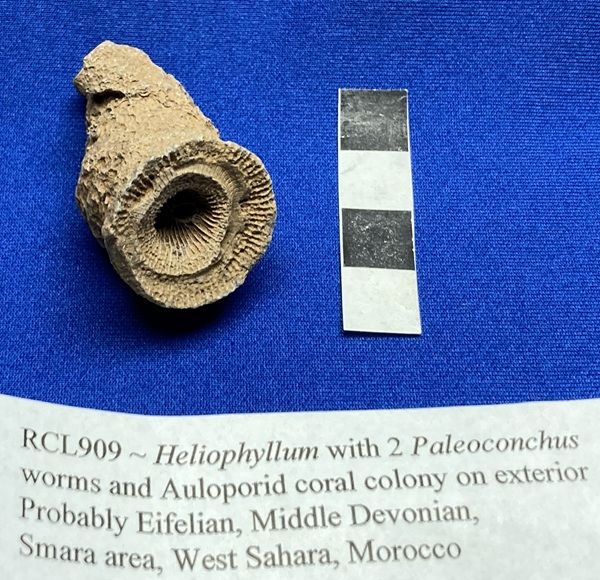
Heliophyllum is a common American genus with numerous yard-arm carina on each septum.
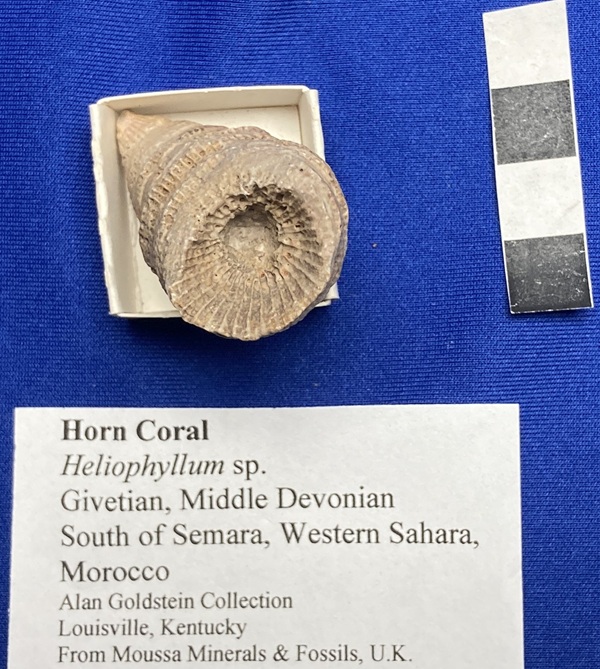
Distinct yard-arm carina on septa, typical for genus.
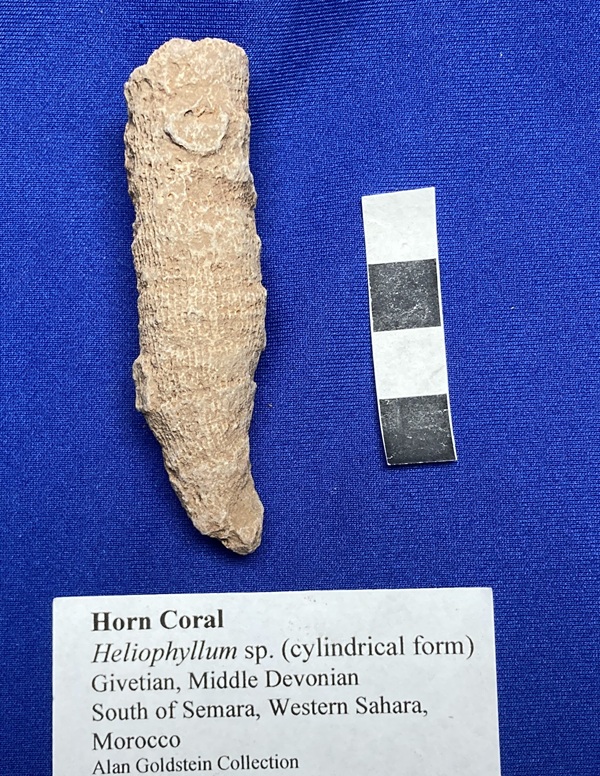
Heliophyllum is one genus that has a variety of growth habits. This one is cylindrical. The ring may be a juvenile rugose coral attached.
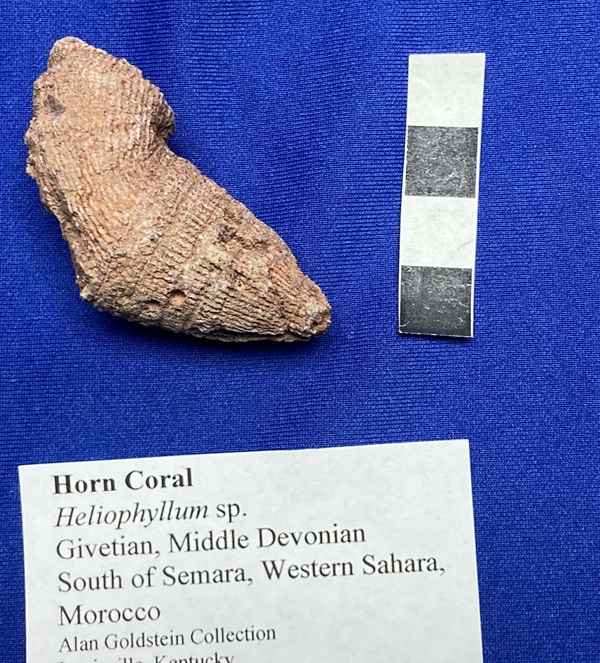
This Heliophyllum shows a common J-shape. It occurs when the coral topples during a storm and continues upward growth afterwards. Note the circular borings. An informative report about the genus Heliophyllum can be found in this Buffalo Geological Society publication.
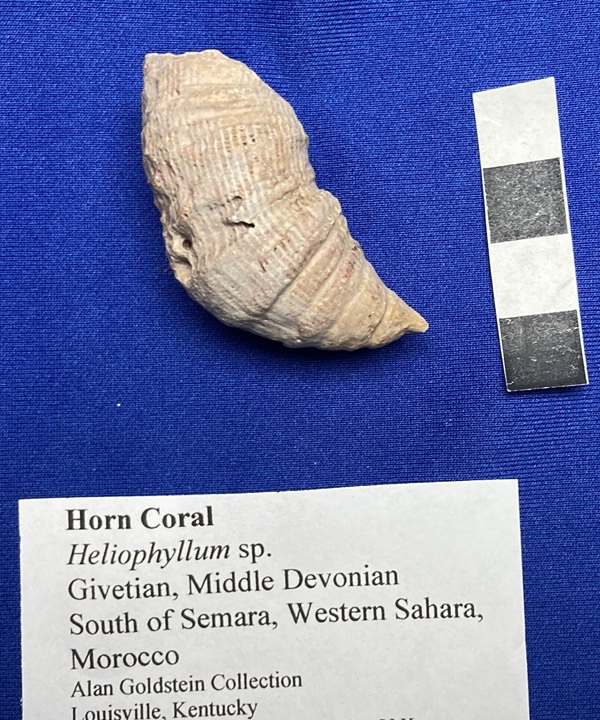
Note the borings, called Trypanites, in the exterior of this Heliophyllum coral. See this Wikipedia page for more information.
Unidentified Genera

Two buds are in the calyx of this horn coral. A common methods of reproduction in Heliophyllum.
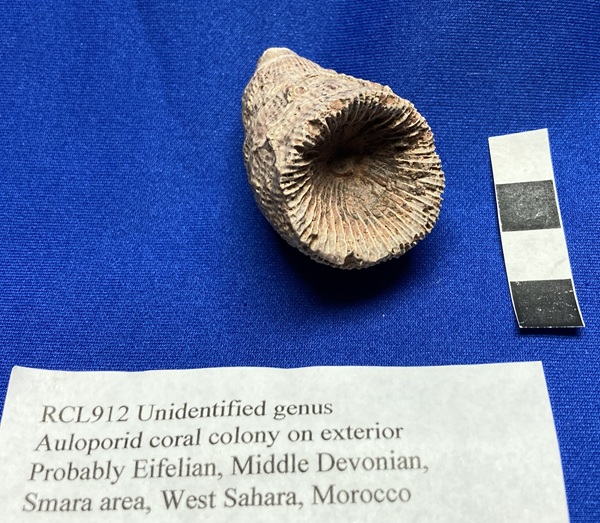
.
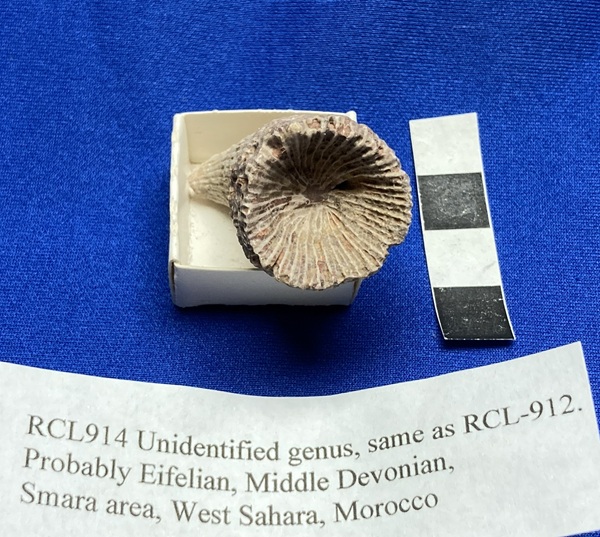
.
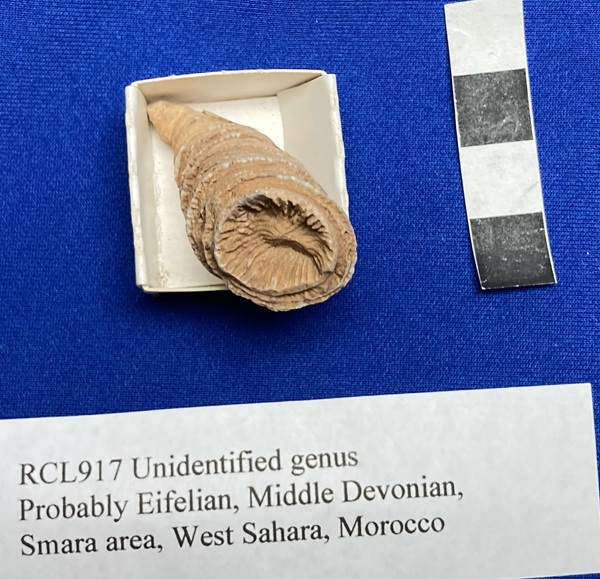
A narrow ceratoid growth form. Resembles Tabulophyllum.
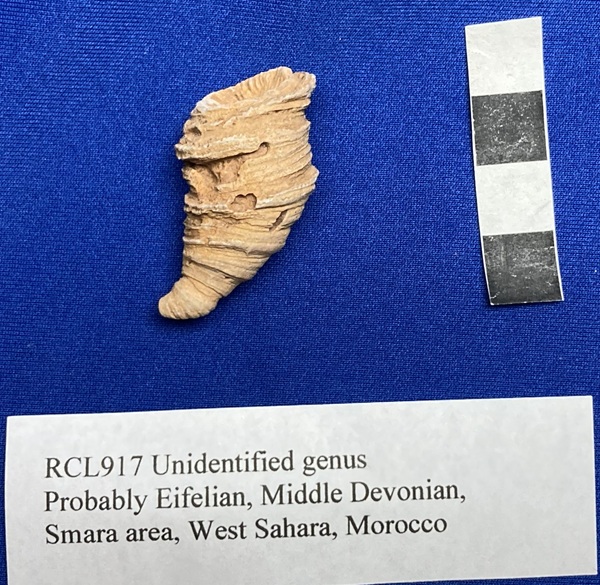
Note the distinct growth lines in the side view.
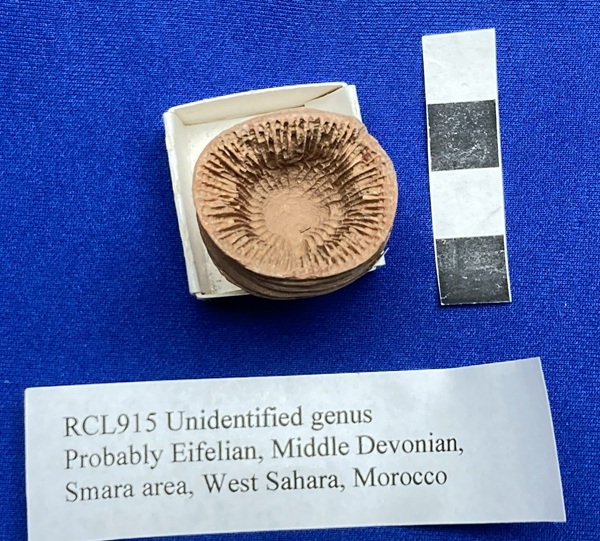
Resembling Acrophyllum, but needs further study.
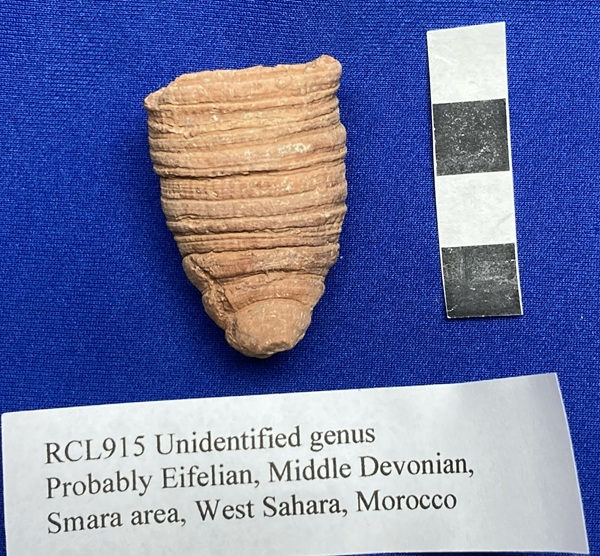
Rugose means wrinkled, as the exterior of this horn coral shows.
Colonial Rugose Corals
Phillipsastraea (Upper Devonian)
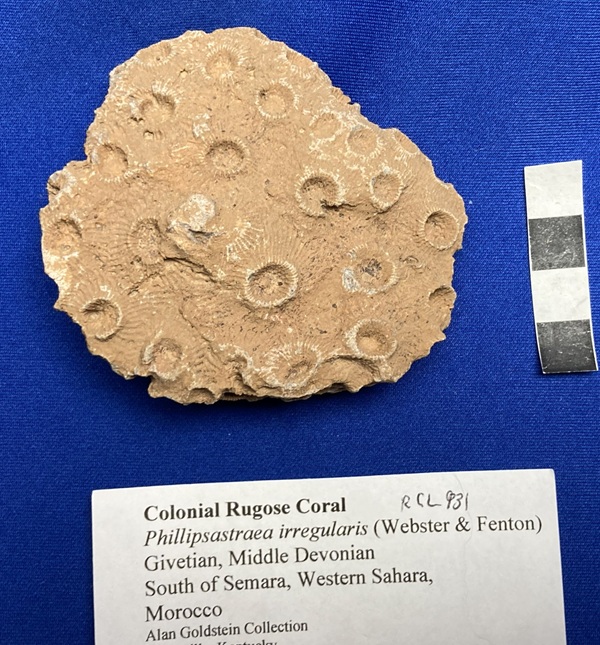
Phillipsatraea irregularis was described in Moroccan Devonian but was originally described in the Upper Devonian of Iowa.
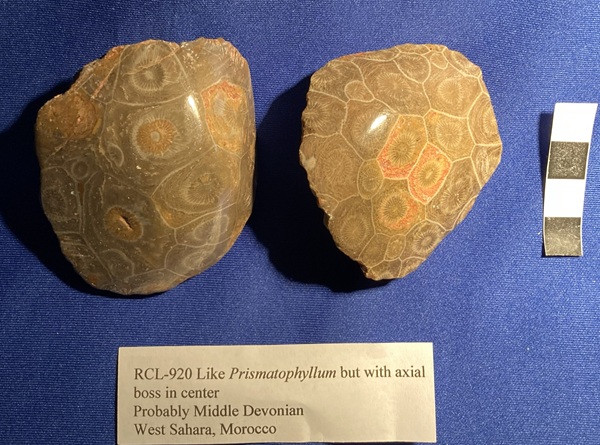
These polished Devonian corals are often sold labeled “Arachnophyllum.” That genus is restricted to the Silurian. These are closer to Hexagonaria and Prismatophyllum.
Order Tabulata
Aulopora
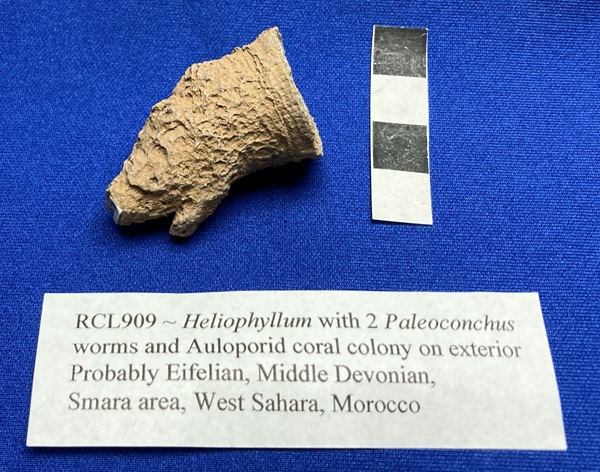
A small form that might be the bryozoan Hederella.
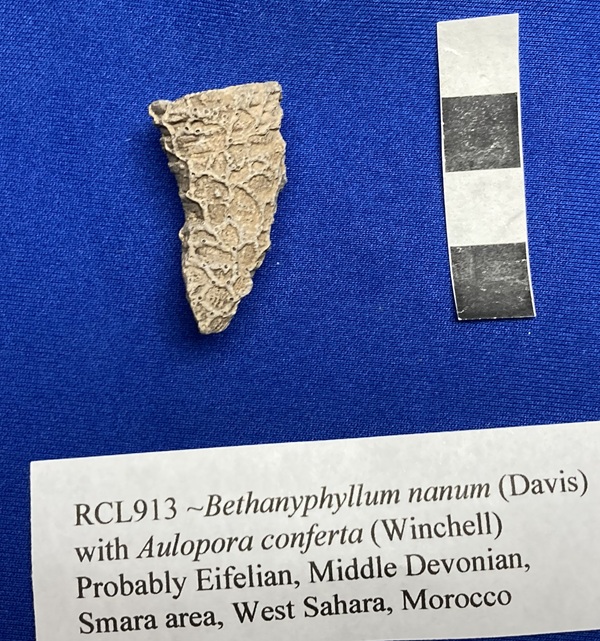
The encrusting coral is the same size and growth habit as Aulopora conferta, found in the Traverse Group of Michigan and the Beechwood Limestone in the Louisville area.
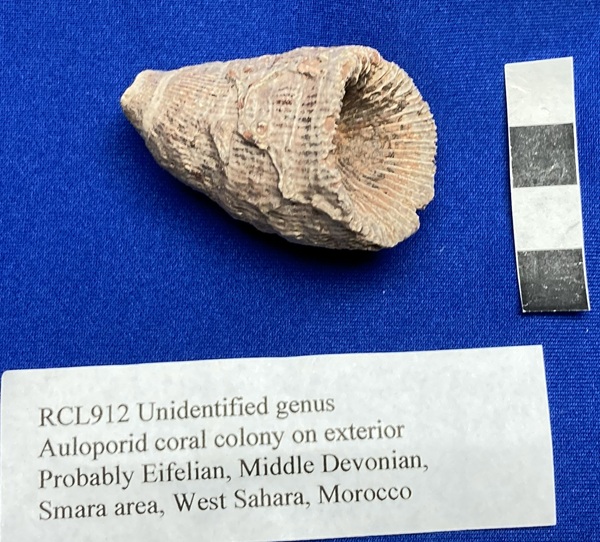
A different species of Aulopora, much larger than A. conferta.
Striatopora?
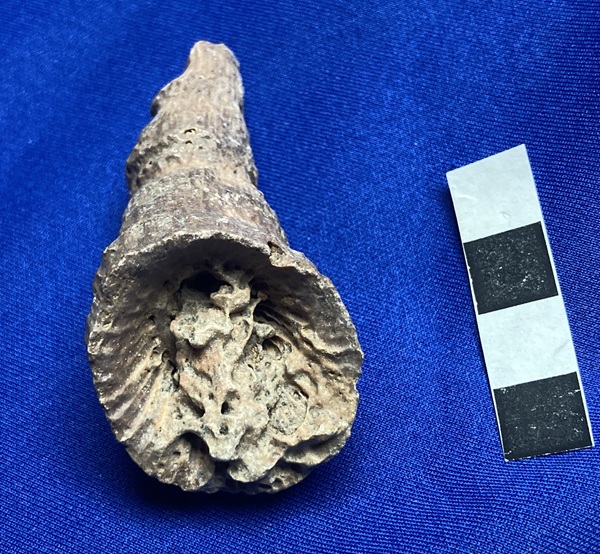
An eroded branching tabulate resembling Striatopora in the calyx of a horn coral.