
This was documented in 2009. Erosion by the Ohio River both removes and uncovers fossils on the upper fossil beds every year. If you want to try to find any of them, bring a camera. Collecting is illegal through both federal and state regulations.
Blastoids: (Bryozoan-Brachiopod zone or higher)
Elaeacrinus verneuili 1. Below building (five+/-)
2. The on west end, Indiana side (probably eroded or covered)
Decaschisma sp. 1. In boulder on trail to sandstone boulder; badly eroded.
Crinoids: (Bryozoan-Brachiopod zone or higher)
Dolatocrinus? sp. 1. Wooded area upriver from building
2. Below building (2)
3. Between upper beds below “trail” gate and sandstone boulder (cross-section w/ stem)
Himerocrinus plenissimus
1. At the west end along the Indiana shore
2. Below building, arms exposed, cup mostly gone
Megistocrinus sp. 1. Below building (washed away)
Unknown: 1. At west end, Ind. shore, “outlier” (Megistocrinus?)
2. Near first H. plenissimus, three in various states of disarticulation
3. East of above, near “Fisherman’s Point,” side view, w/ 6” stem
Trilobites:
Crassiproteus spp. 1. Pygidium at the west end, Indiana shore (cast)
2. Pygidium in B. gregarius zone near sandstone boulder (silicified)
3. Pygidium, external mold, near (1.) below.
4. Two pygidia below Eridophyllum colony below the steps.
Coronura sp.? 1. Below building (cast of tail)
2. Pygidium at west end, Indiana shore (cast)
3. Pygidium, mold, in coral zone, below and east of building
Phacops sp. 1. Pygidium, mold, below building, in the bryozoan-brachiopod zone
Cephalopods:
Orthocone 1. short section, below and east of building, in lower B. gregarius zone or A. ramosa
Coiled 1. tangential x-section, below & east of building, near soil line in coral zone, only visible when rock is wet
Rugose corals:
Blothrophyllum romingeri
1. 18″ long, looks like a vertebral column, below building by “point” (only visible when “quarried level” is completely exposed)
Craterophyllum magnificum (6” diameter horn coral)
1. Below and east of building in coral zone
Cystiphylloides infundibuliformis – Found up to 18-inches long in upper coral zone and Amphipora zone (see photo 1)
Siphonophrentis elongata 1. Four-foot long, below cliffs on Ind . shore, below west point (see photo 2)
2. Two-foot long, below building in the “quarried” level
3. Two-foot long, coral beds east of embayment below the building
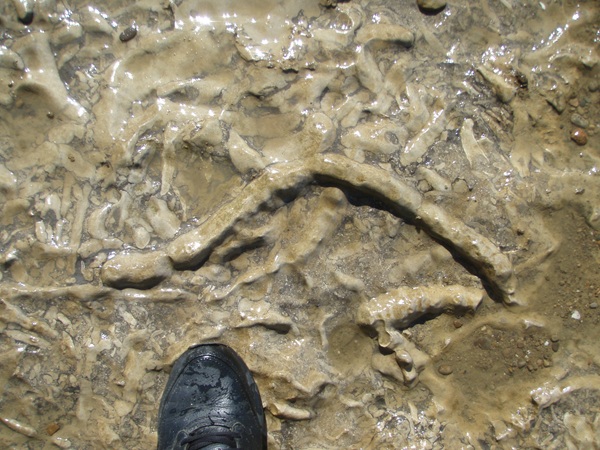
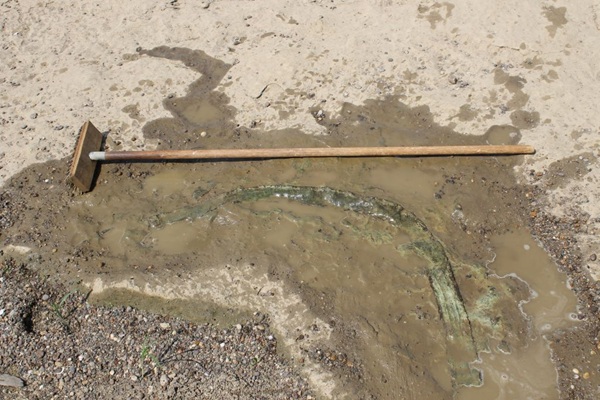
Photo 2. Siphonophrentis elongata on the upper coral beds at the Falls of the Ohio is considered the largest horn coral in the western hemisphere.
Tabulate Corals:
Thamnopora limitaris 1. 6’ x 3’ colony, at “Fisherman’s Point,” below gap in rock outcrop
2. 2′ x 2′ colony in “quarried” zone below building, right side, smaller coral colony near by what appears to be an Alveolites
Porifera (Stromatoporoidea):
1. “Largest fossil at the falls”, exceeds 100’ in length, the B. gregarius zone, west end, Indiana shore
2. Eleven-foot long colony in the Amphipora zone, a little to the right of the bed below the cliff below the steps
3. Another 11-foot-long colony in the old quarry below the steps. This one is in the lower coral zone, Emsian, latest Early Devonian in age. Not far from the two-foot horn coral mentioned under Siphonophrentis.