
By Alan Goldstein
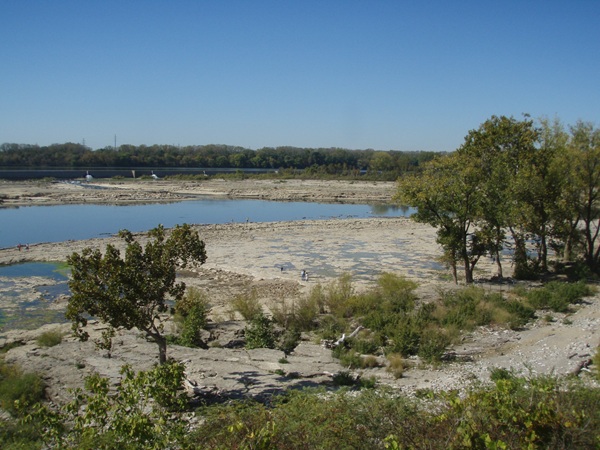
The Falls of the Ohio at Louisville, Kentucky and accessible from Clarksville, Indiana, are world-renown for the incredible number of Devonian fossils that have been documented. Fossils may be seen today, when river conditions allow. Collecting is no longer permitted. Over the last 200+ years, an enormous tonnage of fossils were hauled away to become yard ornaments, turned into gravel and cement, and – the lucky ones – ended up in museum collections around the world. We must preserve what remains for the enjoyment of generations to come.
Geologists describe the fossils in various rock layers or strata at the Falls of the Ohio. The entire geological formation is called the Jeffersonville Limestone, named from exposures at the Falls closer to that southern Indiana town (Kindle, 1899), now flooded. The individual strata (or zones) are named for their dominant fossil content.
Actually, the lowest fossil bed exposed during very low water conditions is the Silurian-age Louisville Limestone. It is some 30 million years older than the overlying Jeffersonville Limestone. There are large numbers of eroded and smooth Ordovician limestone cobbles ripped from the floor and banks of the Ohio River upstream. These add several hundred additional species to the faunal list, but will not be described further.
The lowest Devonian (Emsian stage) fossil layer is the ‘coral zone,’ which subdivided into the lower and upper coral zones. That significance is probably only appreciated by paleontologists and geologists who study rock layers (called stratigraphers). The lower coral zone is the uppermost Lower Devonian and the upper coral zone is lowermost Middle Devonian (Eifelian stage). The lower coral zone is exposed for the least amount of time per year, best seen in September. The upper coral zone is best seen August through November, and less reliably June, July, and December. These layers are usually submerged in winter and spring.
Above the coral zone is the Amphipora zone, named for a spaghetti-like stromatoporoid sponge that is found there. Its structure is microscopic. This layer is best observed in the small cliffs on the river bank that contain numerous small grottoes. The zone contains abundant corals, too.
The Brevispirifer gregarius zone contains millions of brachiopod shells. They are concentrated near a quartz-replaced layer about six inches thick formed by the concentration of ancient volcanic ash, called a meta-bentonite. The volcanoes were located in New England. This layer also contains the large snail Turbonopsis shumardi, reaching over three inches across.
Next is the Bryozoan- Brachiopod zone, dominated by fossils of those phyla. Some call it the Fenestrate Bryozoan Brachiopod zone, but there are a wide variety of bryozoan types.
The highest stratum of the Jeffersonville Limestone is the Paraspirifer acuminatus subzone, where this robust brachiopod may be found in the greatest abundance. This top layer is scarcely exposed at the Falls today, but can be found in weathered boulders in Cane Run on the west edge of the state park boundary.
The Speed Limestone, named after exposures at the cement quarry in Speed, Indiana is Eifelian Age. It pinches out north of the Falls of the Ohio and it is not found here.
Above the Jeffersonville is the Sellersburg (North Vernon) Limestone, which includes the Silver Creek and Beechwood Members. The clay-rich (argillaceous) Silver Creek Member (Eifelian) is no longer exposed at the Falls. The crinoid-rich Beechwood limestone (Givetian stage) outcrops adjacent to the lower tainter gates of the McAlpine dam on the west side of Goose Island. Within the 1404 acres of the Falls of the Ohio National Wildlife Conservation Area they are protected from collecting.
The faunal list was drafted from the sources at the end of the article. Some additions have been made through my own personal research of the fauna of these formations over the past 25 years. Further study will most likely reveal additional species and delineate the distribution of species within the zones.
Jeffersonville Limestone Fauna
Phylum Species
Foraminifera 10
Arthropoda 58
Ostracoda 31
Trilobita 27
Brachiopoda 67
Bryozoa 92
Cnidarids (Corals) 160
Echinodermata 26
Blastoidea 6
Crinoidea 20
Graptozoa (Graptolites) 1
Mollusca 94
Cephalopoda 8
Gastropoda (Snails) 53
Pelecypoda (Clams) 30
Pteropoda (Sea Butterflies) 2
Porifera / Stromatoporoidea 20
Vertebrata (Fish) 3 (Need more research)
Plants (Algae) 1
Total: 531
Sellersburg (North Vernon) Limestone
Foraminifera 13
Arthropoda 7
Ostrocoda 1
Trilobita 6
Brachiopoda 45
Bryozoa Unknown
Cnidaria 53
Echinodermata 40
Blastoidea 2
Crinoidea 38
Mollusca 73
Cephalopoda 13
Gastropoda 34
Pelecypoda 23
Pteropoda 3
Porifera / Stromatoporoidea 2 (Needs more research)
Vertebrata Unknown
Total: 233+
Additional investigation remains to gather lists from other research and site-based studies to better understand the abundance and distribution of fossils both horizontal and vertical. The reference fossil collection and resource library at the Interpretive Center allows us to retain resources for scientific use. Simple faunal studies by paleontologists are replaced by statistical analysis and distribution mapping. Like most sciences, paleontology consists of specialists – those studying a small part of the “big picture.” We view this as part of the park’s education mission.
You might think that everything would have been “studied out” at the Falls, but this is not the case. Discoveries will be made by a new generation of scientists.
Important References
Butts, Charles, 1915, Geology and mineral resources of Jefferson County, Kentucky: Kentucky Geological Survey, ser. 4, v. 3, pt. 2, 270 p.
Conkin, J. E., & Conkin, B. M. & Steinrock, L., 1998, Middle Devonian type Jeffersonville limestone at the Falls of the Ohio.
Jillson, W. R., 1931, Paleontology of Kentucky: Kentucky Geological Survey, ser. 6, v. 36, 469 p.
Kindle, E. M., 1899, The Devonian and lower Carboniferous faunas of southern Indiana and central Kentucky: Bulletins of American Paleontology, v. 3, no. 12, p. 131-239.
——1901, The Devonian fossils and stratigraphy of Indiana: Ind. Dept. Geol. and Nat. Resources, Annual Report 25, p. 529-758, 773-775, 33 pls.
Stumm, E. C., 1964, Silurian and Devonian Corals of the Falls of the Ohio: Geological Society of America Memoirs, v. 93, 184 p.