
Observing the Brightest Dwarf Galaxies

Small and Large Magellanic Clouds. Photo from Chris Schur.
Galaxies form the building blocks of the observable universe. Most have distinct shapes classified by Edwin Hubble nearly a hundred years ago. At the most basic level, they have spiral, elliptical, and irregular shapes. With the addition of barred spirals and lenticulars, the Hubble classification modifications continue to expand, filling in gaps in his original work. I believe Hubble would be impressed!
Hubble didn’t worry about the size of galaxies. Most research into the mass of galaxies didn’t bear fruit for years afterward. Harlow Shapley discovered the Sculptor and Fornax dwarfs in 1933 and 1934, the earliest low-mass galaxies described.
Like stars, there is a tremendous range in size and mass of galaxies. There are supergiant galaxies with trillions of stars at one end, and dwarfs with millions and low billions at the other. (Some may have below a million, which are difficult to observe visually.) Most of these galaxies are somewhere in between, with tens to hundreds of billions of stars.
To make a comparison, consider the lowly red dwarf star. They are difficult to observe because they are small and dim. Only the closest (like Barnard’s Star) are visible to amateur astronomers. Yet, these are the cockroaches of stars, dominating the rest of the stars by their sheer numbers. The giant and supergiant stars are rare in number, but their luminosity makes them bright. The same can be said for massive galaxies.
Most dwarf galaxies are a challenge for observers because they tend to be faint and visually unimpressive. Most have contrast close to the background sky glow, masking their light. Light pollution and humidity are the primary obstacles to observing dwarf galaxies. There are exceptions.
A swarm of dwarf galaxies orbits most large galaxies. The Milky Way has sixteen in a halo around it. The Andromeda has more dwarf companions. The brightest are visible with small telescopes, while the faintest dwarfs cannot be seen visually. The Palomar Sky Survey revealed many of the Milky Way’s mini-companions. The Hubble and Webb telescopes have expanded our vision; dwarf galaxies can be found in the earliest observable history of the universe. Astronomers hypothesize that the merging of the small galaxies led to the creation of the ones we see today. This means that, by number, there are far more piddling galaxies than the rest.
Many occur in a plane at an angle to the galactic equator. Their alignment is related to their interactions with our galaxy, much like comets and the sun.
These low-mass collections of stars, gas, and dust are far more complicated than their size might imply. Issues from mysterious dark matter that seem to play an important role in the evolution of the universe and galaxies, stellar motion, the size and location of black holes, and more.
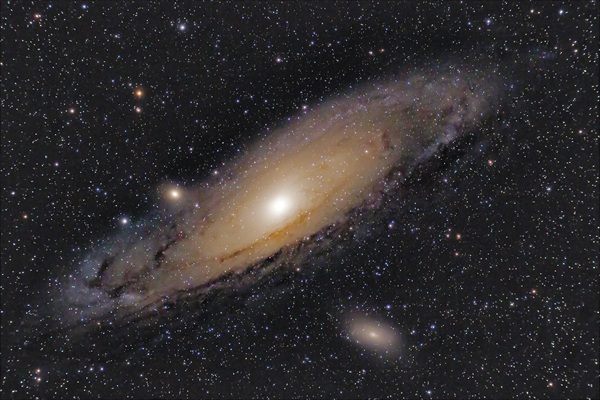
With the diminutive mass of these galaxies, you might think they are difficult to observe. But there are two dwarf galaxies visible to the naked eye in the southern skies – the Large and Small Magellanic Clouds. Two others are visible in binoculars – the Andromeda galaxy’s close companions NGC 221 (M32) and NGC 205 (M110), photo 1. The larger the aperture and dark the sky, the more you can find. Table 1 lists the brightest observable dwarf galaxies.
1.) The Giant Dwarf – The Large Magellanic Cloud
Its name tells us three facts: 1) It is the largest deep sky object in the southern skies, spanning ten degrees of the sky – that’s 20 full moons side-by-side! 2) Ferdinand Magellan noted it in his 1519 writings, bringing it to the attention of naturalists of the time. For humans living below 20 degrees north latitude, it was part of their night sky like the Milky Way and Orion. 3) It looks like a cloud because it is far from the land band of the Milky Way.
Astronomers used it as the type for the Magellanic spiral, abbreviated as Sm and SBm (so-called normal and barred Magellanic spiral) for classification. They can be best described as loosely spiraled, low-mass galaxies. They are widespread throughout the universe. The large H-II regions and clumps of stars distinguish them from other dwarfs or low-mass galaxies. The LMC is thought to have lost its spiral arm symmetry by colliding with the Small Magellanic Cloud. It is the fourth-largest galaxy in the Local Group.
If you are living in the southern hemisphere, the best dwarf galaxy in the sky is easy to observe. It’s bright, shows a lot of detail in small optics, and is circumpolar. It’s enough to make Northern Hemisphere observers envious.
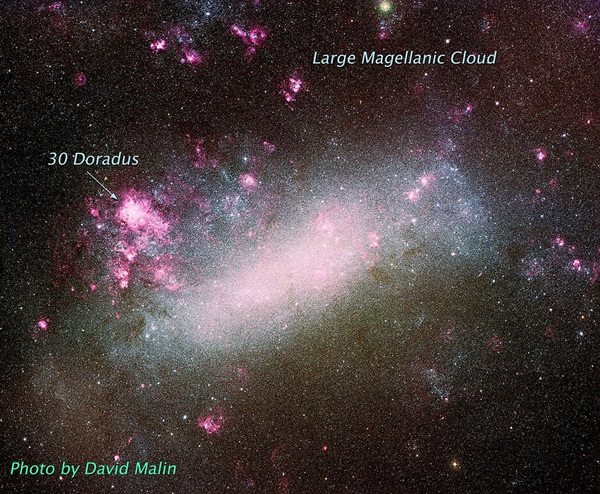
The Large Magellanic Cloud is the largest dwarf galaxy in the Local Group. David Malin/NASA photo.
2.) The Big Dwarf – The Small Magellanic Cloud
Spanning 4.2 degrees, the SMC is classified as a Magellanic Barred Spiral and as an irregular dwarf galaxy. The lack of even vague symmetry defines an irregular galaxy, and if so, it is the largest in the Local Group. Irregular galaxies show no hint of spiral arms or a distinct nucleus. The ‘hub’ of star concentration may be offset from the apparent geographical center of the galaxy. With the Small Magellanic Cloud, the concentration of stars is at one end. The largest H-II regions are at the other. At 200,000 light-years from us, it’s 37,000 light-years farther away than the LMC.
Despite being more distant and physically smaller than the LMC, it is still a wonderful target for observers. Details include several bright emission nebulae and star groups with modest optics. Larger telescopes ratchet up the detail. It is closer to the south celestial pole than the LMC.
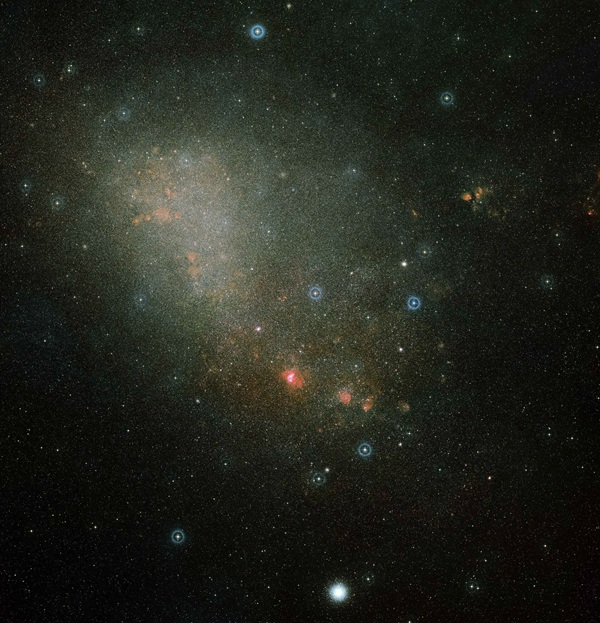
The Small Magellanic Cloud is an irregular dwarf galaxy. European Space Agency photo.
3.) The Roundish Dwarf – Messier 32
For Northern Hemisphere amateur astronomers, the brightest dwarf galaxy is M 32, also designated NGC 221. Its compact 8.7’ x 6.5’ would be unimpressive if not for its proximity to the giant Andromeda Galaxy (M31), the largest object in our Local Group of Galaxies. At a distance of 2.6 million light-years, this dwarf elliptical galaxy lies on the far side of M31. M32 has features typical of ellipticals. It’s dominated by red and yellow stars and has no significant dust or gas to create new stars. Its compact nature is rare among that class. In a sense, it is like a “globular cluster on steroids.”
With binoculars, the 8.2 magnitude M32 is superimposed on the disk of the Andromeda Galaxy. The effect is also visible with larger telescopes. When you see Messier 32, know that it is unique among the dwarf galaxies.

4.) The Oval Dwarf – NGC 205 (Messier 110)
While the Milky Way boasts two large dwarf companions with young stars and large hydrogen clouds, the larger Andromeda Galaxy has two dwarf elliptical galaxies. NGC 205 is fainter than M32 at 8.5 magnitude but larger at roughly 22’ x 11’, giving it a lower surface brightness. While not difficult in binoculars, its surface brightness makes it more challenging with increased light pollution.
M110 is about the same distance as M32. With a finder chart, a few globular clusters resembling foreground stars can be observed in larger scopes. With a dust cloud near its core, it’s peculiar for an elliptical. A few young stars are associated with the cloud – another anomaly. In Hubble’s galaxy classification, M110 is an E5p. The ‘E’ stands for elliptical galaxy, and the ‘5’ indicates this is highly elongated, and the ‘p’ means peculiar.
5. & 6.) The Cassiopeia Twins – NGC 147 and NGC 185
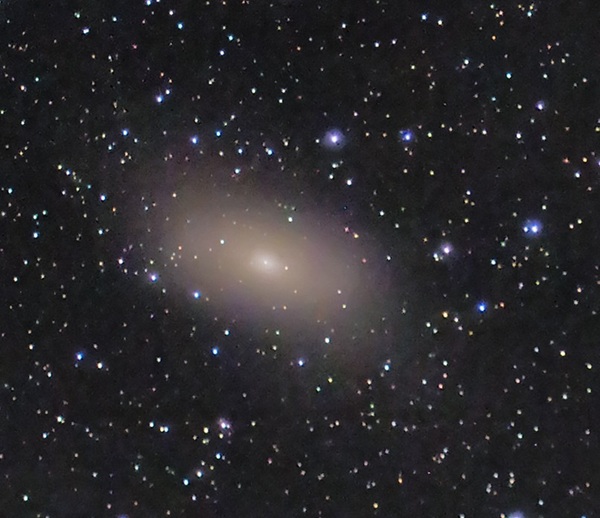
Two distant satellites of the Andromeda Galaxy are fraternal, not identical, twins. Both are dwarf ellipticals, also classified as dwarf spheroidal galaxies. Separated by one degree in the sky, if you can find one, you can find the other. They are below the “W” in Cassiopeia.
NGC 147 is about 2.6 million light-years away. When compared to NGC 185, it’s slightly fainter, at 10.5 magnitude. It is a generous 13.2’ x 7.8’ across, but like M110, its size spreads out the light and has a low surface brightness. Astronomers assign it a classification of cE5, the ‘c’ meaning compact. Like many dwarf galaxies, it is best seen in dark skies with minimal light pollution.
The second of the twins, NGC 185, is a half-million light-years closer than NGC 147, roughly 2.1 million light-years distant. This cE3p galaxy is slightly more compact and rounded at 11.7’ x 10’ across, as well as brighter at 10.1 magnitude. This galaxy shares a similarity with NGC 205 – a dust cloud. The result was the recent formation of open clusters. Astronomers reported an active nucleus resembling a Type 2 Seyfert galaxy. While there is no universal agreement that this is the case, if it is true, this diminutive member of the Local Group would be the only one having an active galactic nucleus. (The nature of the Milky Way’s nucleus is still subject to debate but as it’s intermittently active.)
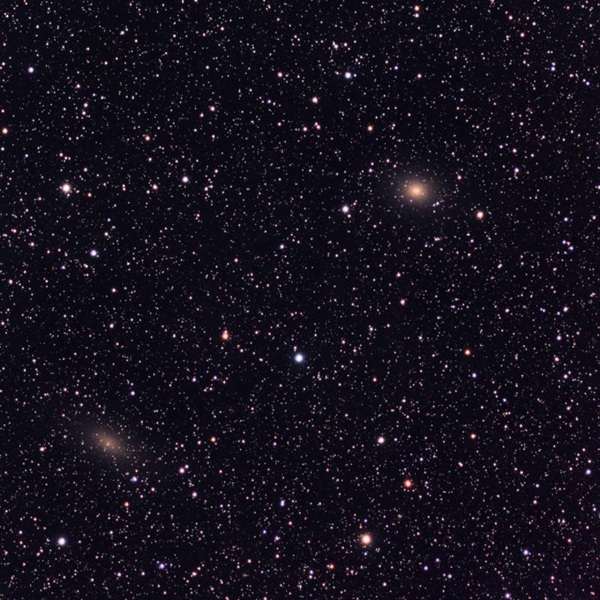
NGC 147 (lower left) and NGC 185 (upper right) are satellite galaxies of the Andromeda Galaxy. For more info on this photo, see https://www.cloudynights.com/forums/topic/940549-distant-companions-of-andromeda/
7.) Barnard’s Dwarf
Whether we call NGC 6822 ‘Barnard’ or ‘Barnard’s Dwarf,’ this bashful galaxy makes its appearance in a constellation better known for bright nebulae and clusters – Sagittarius. The east side of the constellation is far enough from the galactic plane, allowing galaxies to shine through. Edward Emerson Barnard was happy to discover this member of the Local Group with a six-inch refractor in 1884.
NGC 6822 is a sleepy, low-mass version of the SMC. Classified as a barred irregular galaxy with Magellanic characteristics, it is an “IBm.” It was ‘Doc’ Edwin Hubble who determined its distance of nearly 700,000 light-years using Cepheid variables in 1925. He wasn’t dopey, just not accurate, since the distance today is listed at 1.6 million light-years.
At 9.3 magnitude, its light is spread over an area 15.5’ x 13.5’, giving it a low surface brightness like NGC 147 and NGC 205. Don’t be grumpy if you can’t find it – it requires a dark southern horizon. It’s best seen in the late summer and fall, during the sneezy allergy season.
Many other dwarf galaxies can be seen, but freedom from light pollution and good sky transparency are critical requirements to tease these objects from their starry background. My favorites are IC 10, Leo I, and the Fornax and Sculptor Dwarfs (see Table 2).
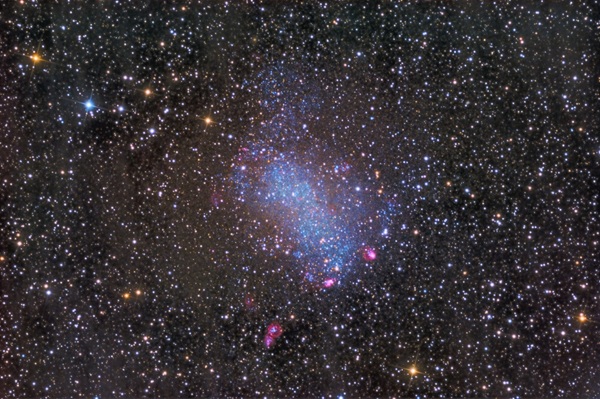
Barnard’s Galaxy, NGC 6822 is a dwarf irregular galaxy with an appearance similar to the Small Magellanic Cloud. NASA photo.
Table 1 The ‘Seven Dwarfs’ Coordinates
Large Magellanic Cloud 05h 23m 34s -60o 45’
Small Magellanic Cloud 00h 52m 45s -70o 49’ 43”
NGC 205 Messier 110 00h 40m 22s +42o 41’ 07”
NGC 221 Messier 32 00h 42m 41.8s +42o 51’ 55”
NGC 147 00h 33m 11.7s +48o 30’ 26”
NGC 185 00h 38m 57.6s +48o 20’ 14”
NGC 6822 Barnard’s Galaxy 19h 44m 58s −14° 48′ 12”
Table 2 Other Challenging Dwarfs
Coordinates Mag.(visual) Size Classification
IC 10 00h 20m 17.3s +59o 18’ 14” 10.4 6.8’x5.9’ dIrr
Sculptor Dwarf 01h 00m 09.3s -33o 42’ 33” 10.1 39.8’x30.9’ E;dSph[eroidal]
Fornax Dwarf 02h 39m 59.3s -34o 26’ 57” 9.3 17’x12.6 dE0 (with 6 globular clusters)
Leo 1 10h 08m 27.4s +12o 18’ 27” 11.2 9.7’x7.4’ E;dSph