
By Alan Goldstein
*Originally published in MAPS Digest, 1999, edited 2008
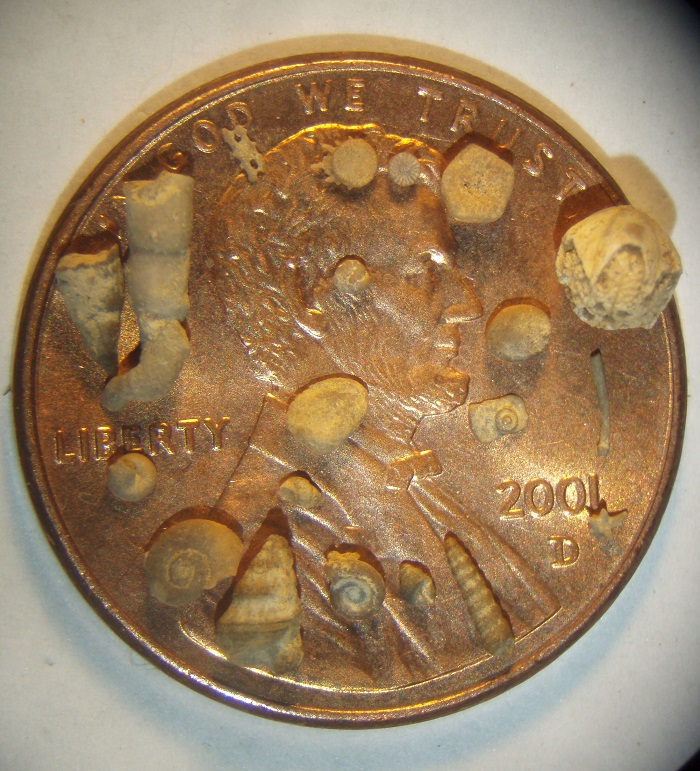
Introduction
The Salem Limestone contains one of the most famous microfossil faunas in the world. Near Bedford, Indiana, the lithology of this formation allows it to be used as dimension stone. It can be cut and carved into exterior building stones and statuary. One of the most famous buildings covered with Indiana or Bedford limestone (the commercial name) is the Empire State Building. It is covered with billions (if not trillions) of tiny fossils.
Lithology
The Salem Limestone has been called an oolitic limestone by some (see Cumings et al, 1906, p. 1190). However, oolites (ooliths) are tiny pellets formed by CaCO3 forming around a nucleus. They are of chemical, not organic origin (Whitten & Brooks, 1972). In addition, other lithofacies are present that do not contain the abundance of microfossils discussed below.
Once considered a dwarf fauna, the Salem is now considered to be size-sorted (see, for instance, Feldmann, 1984, p. 11). In other words, the ocean currents sorted out the larger fossils elsewhere and the smaller fossils (typically 0.5 – 2 mm) were deposited together, not unlike a sandstone. There are certain layers where larger fossils, particularly fenestrate bryozoans and brachiopods may be found. In addition, even the fine-grain sediment of the dimension stone has the occasional larger fossils within.
Stratigraphy
The Salem Limestone is bounded by the Harrodsburg Limestone beneath and the St. Louis Limestone above. It is Meramecean (Valmeyerian) or Middle Mississippian age, approximately 350 million years old. The type locality is the railroad cut at Spergen Hill, Washington County, Indiana. Exposures are widespread in south-central Indiana, occurring in Monroe, Greene, Lawrence, Harrison and Floyd counties. In Kentucky the Salem Limestone occurs in far-western Jefferson County, Bullitt, Meade, Hardin counties and points south and east to Pulaski County, associated with the top of the Muldraugh Hill escarpment.
In Kentucky and in southern-most Indiana (Floyd County), the lower part of the Salem Limestone is actually a shale facies called the Somerset Shale, named after the city of Somerset in Pulaski County. This shale (less than three feet thick in Indiana) contains large mats of bryozoans and rare complete three-dimension colonies of the bryozoan Cystodictya lineata Ulrich. Pentremites, Platycrinites, shark teeth, and the odd coral Palaeacis can also be found. Microfossils are not easily observed. An article on shark teeth is found on my “Fossils” web page.
The Salem Limestone occurs in surface exposures on the south western part of the Illinois. Baxter (1960) divided the Salem into four members, which in ascending order are the Kidd, Futts, Chaffin and Rocher.
In Jefferson County, Missouri (southwest of St. Louis), the formation collected on State Hwy 20 is a siltstone. It might be the equivalent of the Futts Member in Illinois which is dolomitic. The microfauna occurs with macrofossils and all are molds or steinkerns (internal casts).
Collecting Microfossils
I have collected microfossils on my family’s former property near Lanesville, Indiana. Cumings and Beede (1906) noted the Lanesville area as a classic microfossil area. I have also collected material on Highway 37, immediately north of Bedford. It is also possible to collect samples from freeze-thaw debris from buildings with Indiana Building Stone exteriors. I do not recommend using a rock hammer on buildings and statuary!
While a student at the University of Louisville, I noticed other microfossil collectors. House sparrows were eating microfossils that weathered out of building stone. Presumably they were using these as gastroliths or as a source of calcium.
The best way to collect the microfossils is to locate an exposure where the calcium cement has dissolved leaving a residuum of loose microfossils. They can be swept into a small container or zip-type baggie with a small paint brush. If there is a large quantity of sediment, a spoon or small trowel can be used.
After obtaining a sufficient quantity, the next step is to clean it. Care must be used, or your collection will end up down the drain or in some other equally useless place. I use a fine-mesh screen or cheese cloth. Remember, you are trying to clean fossils that may be smaller than 0.5mm in diameter! Another method is to put the sample in a bucket, fill it partially with water and swish it around to release soil (clay) particles. Slowly decant the water into another container while trying to keep the sand-like microfossils in the first container. Repeat the process until the water is clean, then drain the contents onto a lint free cloth or sheet of newspaper and let it dry completely. The dried fossils will stick to one another, but gently massaging the fossil “sand” with your fingers will separate them.
Examining the Fossils
The size of these microfossils make them ideal for a binocular microscope with relatively low magnification (10x is sufficient, 5x – 25x zoom is even better). Pour the fossils out into a shallow tray (I use the lid of a 35mm film canister.) Select a minimal amount, so that the fossils are not piled upon one-another. I use a fine artists paint brush (dampened slightly) so specimens will adhere. A brush with a few hairs allows one to nimbly select a single fossil out of the “masses” for separation and closer examination. I keep a number of containers on either side of the microscope so that I can sort a variety of specimens at one time. Gastropods, foraminfera, ostracods, sponge spicules, crinoids, etc., are each assigned their own container. They can later be subdivided by species, if so desired, or mounted in a micropaleontology specimen slide mount in one is available.
Paleontology – Focusing on the Microfossils
A variety of tiny fossils can be observed. This section will describe those typically found intact, or in small fragments that can be identified. Larger (>5mm) fossils are occasionally found in the mix and are interesting to examine, too.
Abrasion from being tumbled on the sea floor is apparent on some fossils. This includes blunt-tipped gastropods, broken echinoid spines, fragmented ostracods, rounded edges on crinoid calyx plates, etc. Some fossils (i.e. gastropod shells and fringed crinoid columnals) show extraordinary surface detail, indicating fairly rapid burial after death. Most of the preserved fossil remains are as a result of the death of the organism. Only the trilobites molted as they grew, and their fragments are surprisingly rare (although it could be a bias from my collecting areas). For comparison, I dissolved a block of Early Devonian Garra Limestone from New South Wales, Australia. The silicified (quartz-replaced) residuum contains plenty of trilobite pleural segments, cephalon plates and pygidia. Bryozoans and brachiopods are abundant, but mollusks and echinderm remains are scarce. This could be a bias of silicification.
Foraminifera
The calcareous foraminiferan Globoendothyra baileyi (Hall) is ubiquitous within the Salem Limestone. Even the smallest quantity of sediment will contain examples. There is some variation in size, but they are readily identifiable with a microscope or a 10x loupe. Other genera of forams may be seen, but I have not found literature describing them.
Corals
Fragments of corals may be observed in the sediments. Most juvenile corals are large enough to be sorted out. The most common coral, Hapsiphyllum cassedayi (Milne-Edwards and Haime) is too large to be considered as a microfossil, even though fragments or the tip of a coral may be seen under the scope. Fragments of Cystelasma (another rugose coral) or Cladochonus (an auloporid tabulate) may be observed, although they tend to be on the large size, as well.
Echinoderms
Fragments of echinoderms dominate the Salem Limestone. There is a tremendous variety of shapes and sizes of stem and body plates. The variety no doubt greatly exceeds the number of known species by a significant margin.
No starfish (asteroids or ophiuroids) have been described from the Salem Limestone, but as they are found in Osagean and Chester-age strata, especially associated with crinoid anal tubes, they are very likely among the disarticulated echinoderm remains found in the sediment.
Crinoids
A variety of columns and columnals can be observed. Among the most interesting are those fringed with multiple cirri and oval Platycrinid columnals. Numerous plate fragments can be observed and most cannot be assigned to a particular genus, much less a species! Of those that can, basal and radial plates of Strimplecrinus coxanus Worthen, Dichocrinus simplex Shumard, Hyrtanocrinus ornatus Wachsmuth & Springer and Synbathocrinus swallovi Hall may be identified by their plate ornamentation or shape.
Blastoids
By far, the most abundant blastoid in the Salem fauna is Pentremites conoideus Hall (also see Galloway and Kaska, 1957). It is possible to find tiny thecas (bodies) and an assortment of tell-tale plates in the mix. Ambulacral plates are occasionally seen. Columns are indisguishable from crinoids.
Echinoids
Socket plates and spines of echinoids like Archaeocidaris norwoodi Hall are fairly abundant. Spines may be longer than many crinoid columns in the same mix, but are readily apparent by their tapering to a sharp point and lack of segments. Some still contain the terminal ball that connected to the socket plate. The socket attachment is also easily recognized in the sand-size particles with magnification. Juvenile echinoids must have been as small as a pea.
Holothuroids
Sea cucumbers are perhaps the most abundant echinoderm on the sea floor today. Most holothuroids do not contain the calcified plates like most echinoderms. They contain tiny plates called sclerites. Most are microscopic and readily disperse after death; consequently sea cucumbers are rare in the fossil record. Cumings, et al (1906), attribute some radiating spicules to holothuroids. This writer is does not know if these spicules belong to sea cucumbers or sponges. Many lack the symmetry of other Mississippian sponges (i.e. hexactinellids) I have observed.
Worms
Three worm species of genus Palaeoconchus (formerly known as Spirorbus) are described: (P. annulatus Ulrich, P. imbricatus Hall and P. nodulosus Hall) and are common in the Salem Limestone. Usually, this tiny coiled worm is attached to a substrate, such as a shell or bryozoan, but it may be found loose (and often incomplete) as a particle in the “oolite.” Species are distinguished by their surface ornamentation.
One species of Cornulites, C. blatchleyi (Beede) has been described. It appears as wrinkled and somewhat annulated, narrow funnel-shaped shell and can be found attached to bryozoans and brachiopods.
Bryozoans
Bryozoans are usually considered too large to be microfossils, but fragments of fronds such as Worthenopora or Rhombopora often observed in the remains. The fenestrate bryozoans are particularly interesting. Distinguishing the numerous species of Polypora is extremely challenging. Differentiating that from Hemitrypa or Fenestella is only slightly less difficult. One of most interesting is Pinnatopora with its off-set branching.
Brachiopods
There are a great variety of brachiopods – productids, rhynchonellids, spiriferids, and terebratulids. Most of these are juveniles – larger specimens may also be found in the formation where depositional characteristics were different.
Mollusks
Perhaps the most recognizable fossils are the mollusks, particularly the snails. Of the rarer mollusks, two species of chiton have been recognized.
Gastropods
Snails are common in the microfauna, Cumings et al (1906) illustrate some 40 species. Their diminutive size makes identification of some species difficult. Whether the name of the genera are still accurate is unknown by this writer.
Polyplacophora (Chitons)
Rare in the fossil record, chitons are represented by head, tail and intermediate valves. The writer has not observed any in Lanesville sediments.
Rostroconchs
Cumings & Beede et al (1906) illustrate five species under the name “Conocardium.” Whether this is accurate is questionable. Similar rostroconchs from the New Providence Shale have been identified by Dr. Richard Hoare as Pseuomuloscens. Although the Salem rostroconchs are small, they rarely occur as microfossils.
Pelecypods (Bivalves)
With only a quarter of species compared to the snails, the pelecypods are not as abundant. Without magnification, the shell symmetry of some genera is difficult to distinguish between some brachiopods.
Arthropods
Trilobites
Instars of young trilobites have not been documented in the Salem Limestone. Trilobite molt fragments are also scarce, probably too delicate to survive the grinding action of the calcareous sand-sized particles composed of other fossils on the sea floor.
Ostracods
Ostracods are fairly common in the sediment. Most are smooth like Paraparchites carbonaria (Hall). Single and articulated carapaces are found in equal numbers. Geis (1932) and Brayer (1952) described the ostracods from this formation.
Conodonts
A number of conodonts have been reported from the Salem by Nicoll and Rexroad (1975). The dark colored phosphatic elements are in marked contrast with the other calcified fossils. The writer has not observed any in sediments near Lanesville. They are most often collected using techniques developed for conodonts.
Acknowledgements
The writer thanks Dr. Alan Horowitz for reviewing and updating the faunal list. Larry Osterberger provided some stratigraphic information. Margaret Kahrs motivated me to write this paper.
If anyone else finds a more recent name, please contact me at the address at the head of this paper.
Bibliography
Baxter, J., 1960. Salem Limestone in southwestern Illinois. Illinois State Geological Survey, Circular 284, 32 p.
Brayer, R. C., 1952. Salem Ostracoda in Missouri. Jour. Paleontology, v. 26, p. 162-174, Cumings, E. R., Beede, J. W., Branson, E. B., and Smith, E. A., 1906. Fauna of the Salem Limestone of Indiana. Indiana Dept. of Geol. and Nat. Resources, 30th Annual Report, p. 1187 – 1486.
Feldmann, H. R., 1984. Paleontology and paleoecology of the Somerset shale member of the
Salem limestone (Mississippian) in central Kentucky. M.A. Thesis, Indiana University, 112 p.
Galloway, J. J. and Kaska, H. V., 1957. Genus Pentremites and its species. Geological Society of America Memoir 69, 104 p.
Geis, H. L., 1932. Some Ostracodes from the Salem Limestone, Mississippian, of Indiana. Journal of Paleontology, v. 6, p. 149 – 188.
Whitten, D.G.A. and Brooks, J.R.V., 1972. Dictionary of Geology, Penguin Books, London, 516 p.
Willman, H. B. and 7 other authors, 1975. Handbook of Illinois Stratigraphy, Illinois State Geological Survey, Bulletin 95, 261 p.
Appendix 1: Salem Limestone Faunal List
Microfossils are noted within the list.
Compiled by the author from many sources. Those with an asterisk (*) have been noted as microfossils. ss = also reported from the Somerset Shale member
Foraminiferan (for all except G. baileyi, (see Willman, et al 1975 p. 141)
Calcisphaera sp.
Endothyra sp.
Eoendothyranopsis spiroides
*Globoendothyra baileyi (Hall)
Septabrunsiina sp.
Tournayella sp.
Cnideria (Corals) (Most are not microfossils.)
Amplexus blairi Miller
Amplexus coralloides Sowerby
?Aulopora gigas Rominger
Bordenia zaphrentiformis Greene
Cladochonus agglomerata (Grabau)
Cladochonus beecheri (Grabau) – ss
Cyathaxonia venusta Greene
Cystelasma lanesvillense Miller
Cystelasma rugosum Ulrich
Cystelasma septatum Greene
Cystelasma tabulata Cumings & Beede
Enallophyllum grabaui Greene
Hapsiphyllum cassedayi (Milne-Edwards & Haime) – ss
Michelinia indianensis Cumings & Beede
Palaeacis cuniformis Milne-Edwards & Haime – ss
?Palaeacis obtusus Meek & Worthen
Protopora cystoides (Grabau)
Syringopora monroense Cumings & Beede – ss
Triplophyllites sp. – ss
Zaphrentis compressa Milne-edwards & Haime
Zaphrentis clinatus Greene
Conularids (Not as microfossils)
Paraconularia missouriensis Swallow = Conularia greenei Miller & Gurley
Paraconularia sublata Hall
Porifera (Spicules are microfossils)
Belemnospongia parmula Rigby, Keyes & Horowitz – ss
Hapliston armstrongi Young & Young – ss
*Misc. sponge spicules
Echinodermata
Blastoids (Blastozoa) (Pentremites and Diploblastus may be microfossils)
Diploblastus sp. – ss
Metablastus bipyramidatus (Hall) – ss
Metablastus wachsmuthi (Gurley) – ss
Metablastus wortheni (Hall)
*Pentremites conoideus Hall – ss
var. amplus Rowley
var. perlongus Rowley
Tricoelocrinus meekianus Etheridge & Carpenter – ss
Tricoelocrinus woodmani Meek & Worthen
Crinoids (Crinozoa) (Plates as microfossils but most calices are not.)
Actinocrinites gibsoni? Miller & Gurley – ss
Barycrinus astericus Miller & Gurley – ss
Barycrinus punctatus Feldman – ss
Batocrinus calyculus Hall – ss
Batocrinus crassitestus Rowley
Batocrinus davisi Rowley
var. lanesvillensis Rowley
var. sculptus Rowley
Batocrinus isodactylus Casseday- ss
Batocrinus irregularis Casseday- ss
Batocrinus magnirostris Rowley- ss
Batocrinus salemensis Miller & Gurley
Batocrinus somersetensis Feldman – ss
Batocrinus spergenensis Miller- ss
Camptocrinus sp.- ss
Cyathocrinites multibrachiatus (Lyon & Casseday)- ss
Cyathocrinites parvibrachiatus (Hall)- ss
Dichocrinus ficus? Lyon & Casseday- ss
*Dichocrinus simplex Shumard- ss
Dizygocrinus calvus Feldman- ss
Dizygocrinus decoris Miller- ss
Dizygocrinus euconus Meek & Worthen?
Dizygocrinus whitei Wachsmuth & Springer- ss
Dizygocrinus unionensis Worthen
Eretmocrinus sp.- ss
Forbesiocrinus multibrachiatus Lyon & Casseday- ss
*Hyrtanocrinus ornatus (Wachsmuth & Springer)- ss = Dichocrinus blatchleyi Beede
Icthyocrinus clarkensis Miller & Gurley
Platycrinites bonoensis (White)- ss
Platycrinites boonesvillensis (Miller)
*Platycrinitid columnals
Poteriocrinites coryphaeus Miller
*Strimplecrinus coxanus (Worthen)- ss = Dichocrinus oblongus Wachsmuth & Springer and Dichocrinus striatus Shumard
*Synbathocrinus swallovi Hall- ss
Talarocrinus cf. T. trijugus Miller & Gurley
Echinozoa (Echinoids & Holothuroids)
*Archaeocidaris norwoodi Hall- ss
*Misc. holothuroid sclerites?
Oligoporus blairi Miller & Gurley- ss
Worms (Vermes)
*Cornulites blatchleyi Beede
*Spirorbus annulatus Hall
*Spirorbus imbricatus Ulrich
*Spirorbus nodulosus Hall
Bryozoans (Fragments of many listed below can be found as microfossils.)
Batostomella sp.
Cystodictya lineata Ulrich- ss
Cystodictya ocellata Ulrich
Cystodictya pustulosa Ulrich
Dichotrypa flabellum (Rominger)
Fenestella compressa var. elongatum Cumings- ss
Fenestella exigua Ulrich
Fenestella multispinosua Ulrich
Fenestella rudis Ulrich
Fenestella serratula Ulrich
Fenestella serratula var. quadata Cumings
Fenestella tenax Ulrich
Fenestella tenax var. multinodosa Cumings
Fenestella tenuissima Cumings
Fenestralia compacta Ulrich
Fenestralia sancti-ludovici Prout
Fistulipora spergenensis Rominger- ss
Glyptopora michelinia (Prout)- ss
Hemitrypa beedei Cumings- ss
Hemitrypa hemitrypa Prout
Hemitrypa nodulosa Ulrich
Hemitrypa plumosa (Prout)
Hemitrypa proutana Ulrich- ss
Hemitrypa proutana var. nododorsalis Cumings
Lioclema sp.
Meekopora? sp.
Palechara tuberculata (Prout)
Pinnatopora sp.
Polypora biseriata Ulrich- ss
Polypora internodata Cumings
Polypora maccoyana Ulrich
Polypora simulatrix Ulrich
Polypora spininodata Ulrich
Polypora striata Cumings
Ptilopora valida Ulrich
Rhombopora bedfordensis Cumings
Stenopora rudis Ulrich
Worthenopora spatulata (Prout)- ss
Worthenopora spinosa Ulrich
Brachiopods (Some may be microfossils, but most are not.)
*Allorhynchus macra (Hall) = Rhynchonella ricinula Hall
*Anthracospirifer? bifurcatus (Hall)
Antiquatonia gallatinensis (Girty)
*Athyris densa Hall = Centronella? crassicardinalis Whitfield
*Beecheria formosa (Hall)
*Beecheria crawfordsvillensis (Gurley) = B. sinuatum (Weller)
Brachythyris suborbicularis (Hall)
*Camarophoria wortheni (Hall)
*Cleiothyridina hirsuta (Hall)
Cleiothyridina parvirostrus (Meek & Worthen)
*Composita trinuclea (Hall)
*Cranaena sulcata? Weller
*Dielasma arkansum Weller
*Dielasma gorbyi (Miller)
Echinoconchus alternatus (Norwood & Pratten)
Echinoconchus biseriatus (Hall)
*Eumetria verneuliana (Hall)
*Girtyella turgidum (Hall)
Imbrexia forbesi (Norwood & Pratten)
?Linoproductus altonensis (Norwood & Pratten)
Marginata burlingtonensis (Hall)
Orthotetes aff. O. kaskaskiensis (McChesney)
Ovatia ovata (Hall)
*Perditocardia dubia (Hall)
Productus keokuk Hall
*Pugnax grosvenori (Hall)
*Pugnax? quadrirostrus Beede
*Pugnax wortheni (Hall)
*Schuchertella minuta (Cumings)
*Scoloconchus indianensis (Hall)
Setigerites setigerus (Hall)
Skelidorygma subcardiiformis (Hall)
Spirifer horizontalis Rowley
Spirifer washingtonensis Weller
*Spiriferella neglecta (Hall)
*Spiriferina norwoodi (Hall)
Tegulocera tenuicostata (Hall)
Tetracamera arctirostrata (Swallow)
Tetracamera subcuneata (Hall) = Camarophoria subcuneata
Torynifer pseudolineata (Hall)
Torynifer salemensis (Hall)
Torynifer setigera (Hall)
Warsawia lateralis (Hall)
Warsawia lateralis var. delicatus (Rowley)
Molluca
Gastropoda (almost all gastropods are found as microfossils)
Acmaea? sp.
Anomphalus rotuliformis Cumings
Bellerphon gibsoni White- ss
Bellerphon sublaevis Hall
Bembexia elegantula (Hall)
Bucanopsis textilis (Hall)
Bulimorpha bulimiformis (Hall)
Bulimorpha canaliculata (Hall)
Bulimorpha elongata (Hall)
Cyclonema leavenworthenana (Hall)
Cyclonema subangulatum (Hall)
Eutrochus concavus (Hall)
Euconospira concula (Hall)- ss
Holopea proutana Hall
Lepetopsis levitti White
Loxonema yandellana Hall
Macrocheilus littonanus (Hall)
Macrocheilus stinesvillensis Cumings
Murchisonia insculpta Hall
Murchisonia terebriformis Hall
Murchisonia vincta (Hall)
Platyceras (Orthonychia) acutirostris (Hall)- ss
Platyceras circularis Rowley
“Pleurotomaria” humilis Hall
“Pleurotomaria” meekana Hall
“Pleurotomaria” nodulostriata Hall
“Pleurotomaria” piasaensis Hall
“Pleurotomaria” subglobosa Hall
“Pleurotomaria” swallovana Hall
“Pleurotomaria” trilineata Hall
“Pleurotomaria” wortheni Hall
Polytremaria? solitaria Cumings
Soleniscus glaber Cumings
Solenospira attentuata (Hall)
Solenospira turritella (Hall)
Solenospira vermicula (Hall)
Straparollus planispira (Hall)
Straparollus quadrivolvis (Hall)
Straparollus spergenensis (Hall)
Straparollus spergenensis var. planorbiformis (Hall)
Strophostylus carleyana (Hall)
Subulites harrodsburgensis Cumings
Polyplacopora (Chitons)
*Pterochiton exlevatus Kues
*Pterochiton parvus (Stevens)
Rostroconchia (Most not microfossils)
Conocardium carinatum Hall
Conocardium catastomum Hall
Conocardium cuneatatum Hall
Conocardium equliaterale Hall
Conocardium meekanum Hall
Conocardium perattenanum Hall
Pelecypoda = Bivalvia (most can be found as microfossils)
Allorisma maxvillense? Whitfield (=Wilkingia?)
Aviculopecten sp.
Cypricardella subelliptica? Hall
Cypricardinia indianensis Hall- ss
Deltopectin sp.
Edmondia? subplana (Hall)
Goniophoria? plicata (Hall)
Leptodesma spergenensis Whitfield
Macrodon sp.?
Microdon ellipticus (Whitfield)
Microdon oblonga (Hall) = M. nucleatus (Hall)
Microdon subelliptica (Hall)
Myalina sp.- ss
Nuclea shumardana Hall
Nuculana nasuta Hall
Pteronites spergenensis Whitfield
Worthenia? sp.
Cephalopoda (not found as microfossils)
“Nautilus” clarkanus Hall
“Orthoceras” epigrus Hall
“Orthoceras” sp.
Temnocheilus coxanus Meek & Worthen
Trilobita (not found as microfossils)
Griffithides bufo Meek & Worthen – ss
Ostracoda (all microfossils)
Acratia deloi Geis
Amphissites altanodosus Geis
Amphissites centronotoides Geis
Amphissites mimicus Geis
Amphissites nodosulcatus Geis
Amphissites planoventralis Geis
Amphissites reticulatus Geis
Amphissites rotundus Geis
Amphissites vanniae Geis
Bairdia bedfordensis Geis
Bairdia compacta Geis
Bairdia compressa Geis
Bairdia depressa Geis
Bairdia permagna Geis
Bairdia salemensis Geis
Bairdia subaequalis Geis
Bythocypris lydeae Geis
Bythocypris marginifera Geis
Bythocypris norrisensis Geis
Cavellina glandella (Whitfield)
Cythere demissa Brady
Cythere flos-cardui Brady
Cytherella cribrosa Geis
Cytherella emaciata Geis
Cytherella savagei Geis
Cytherella spergenensis Geis
Cytherella venusta Brady
Cytherura clavata Brady
Cytherura curvistriata Brady
Glyptopleura carinata Geis
Glyptopleura elegantis Geis
Glyptopleura karli Geis
Glyptopleura parvacostata Geis
Glyptopleura perbella Geis
Healdia variolosa Geis
Jonesina oblonga Geis
Jonesina sinuodorsata Geis
Kellettella incarinata Geis
Kirbya dorsoconvexa Geis
Kirbya rothi Geis
Kirbya welleri Geis
Loxoconcha australis Brady
Microcheilus distortus Geis
Microcheilus spinosus Geis
Oliganisus punctatus Geis
Oliganisus sulcatus Geis
Paraparchites carbonaria (Hall)
Paraparchites subcircularis Geis
Pontocypris billingsella Geis
Pontocypris coryelli Geis
Sansabella inflata Geis
Savagella lindahli (Ulrich)
Savagella rhomboidalis (Girty)
Xestoleberis faveolata Brady
Conodonta (all microfossils)
Hibbardella abnormis
Hibbardella ortha
Hindeoella spp.
Ligonodina spp.
Ligonodina levis
Ligonodina magnilaterina Rhodes, Austin & Druce
Magnilaterella spp.
Neoprioniodus spp.
Neoprioniodus tulensis
Neoprioniodus cf. varians
Ozarkodina spp.
Synprioniodina laxilabrum
Taphrognathus spp.
Taphrognathus varians Branson & Mehl