
Introduction
In 1998, only three years after the last mine closed in the Illinois-Kentucky fluorspar district, I organized a symposium at Indiana University Southeast, inviting several experts from the district to speak on a variety of topics.
The article below is based on my presentation. It has been updated due to my post-1998 exploration of the district, focusing on Hastie’s quarries near Cave in Rock, Illinois, and the old mines in Crittenden and Livingston, Kentucky.
This article would not be possible if not for folks like Don Hastie, Bill Frazer, and Gill Montgomery (all deceased), who provided information and allowed me access to collect with them for many years.
I don’t have pictures of every 39 species in the Illinois Kentucky fluorspar district, but I will add photos whenever possible. Native copper and stibnite remain unconfirmed. Hyrdocarbons are not distinguished as separate species. The list is in alphabetical order.
First, an igneous rock description!
Alnöite – A lamprophyre is chiefly composed of biotite or phlogopite and melilite as essential minerals, commonly with olivine, calcite, and clinopyroxene. Perovskite, apatite, nepheline, and garnet may be present. Its name (Rosenbusch, 1887) is derived from Alnöe, Sweden. [From Mindat] The dikes in the fluorspar district occur in Illinois and Kentucky, but are most accessible in Crittenden and Livingston Counties. Permian age, they are deeply weathered and often dominated by calcite. Accessible dikes include the Claylick (Photo Aln1), Hutson mine (two dikes) (Photo Aln2 & Ank1), Old Jim, and the Summerland mine.
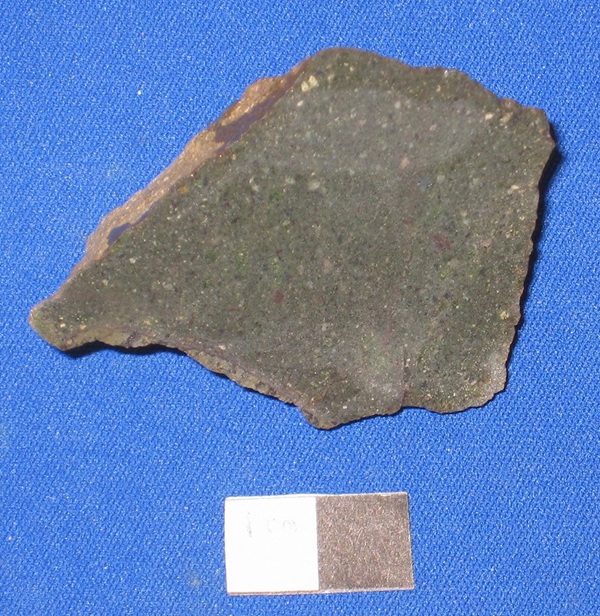
Photo Aln1, Claylick dike, cut and dampened to see phenocrysts. Collected in 1981.
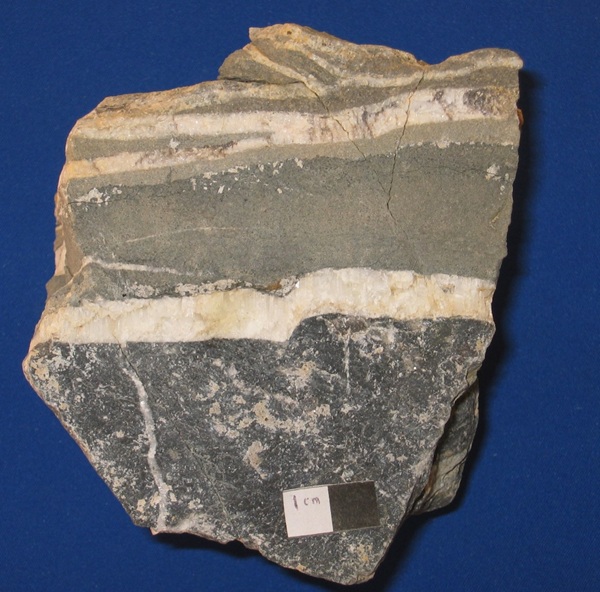
Photo Aln2, Hutson dike with calcite veins and limestone wall rock on the bottom.
Mineral Descriptions
Alstonite is a calcium double carbonate found in the Minerva #1, one of two occurrences in the U.S. (The other is a well in Wyoming.) It is uncommon, noted in small scalenohedral colorless to white 1-5 mm crystals. It has been found with benstonite, calcite, fluorite (often partially etched yellow), and sphalerite. It’s not readily identifiable by appearance alone. There may be collections with alstonite unrecognized by the owners.

Alstonite in 1 mm crystals on calcite from the Minerva No. 1 mine. FOV about 1 cm.
Anglesite is lead sulfate and is very rare in the fluorspar district. Most deposits were too deep for galena to weather and form anglesite. Several shallow deposits produced secondary minerals (see cerussite and pyromorphite). Anglesite was noted at the Patrick lead mine, a surface prospect southwest of the Hastie’s property, Minerva No. 1, and W.L. Davis-Deardorff.
Ankerite was described as a calcium iron magnesium carbonate from the Old Jim mine dikes. Other occurrences are probably ferroan dolomite rather than true ankerite.
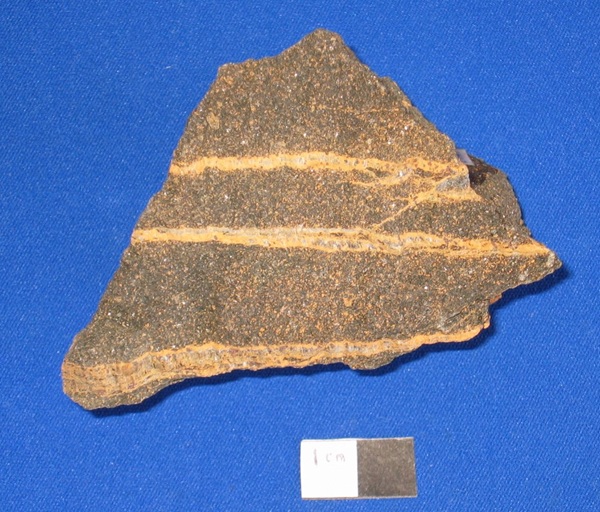
Photo Ank1, Possible ankerite veins cutting through the igneous alnöite dike at the Hutson mine. It could also be ferroan dolomite.
Aragonite form of calcium carbonate was noted from the Dyer Hill mine in Kentucky, and in the Minerva #1 in coatings and flos ferri, and at the W.L. Davis-Deardorff mine.
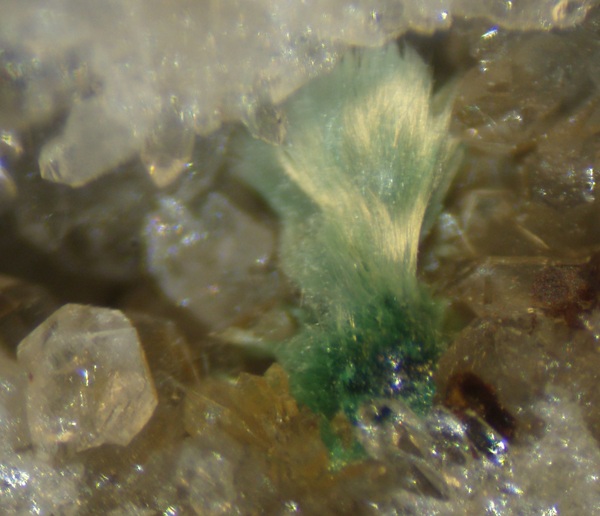
Aurichalcite is a rare secondary mineral found at the Hickory Cane mine dumps. It is possibly of post-mine origin. The mineral has not been analyzed, but the microcrystals are the proper color, and crystals occur in minute acicular sprays and crusts.
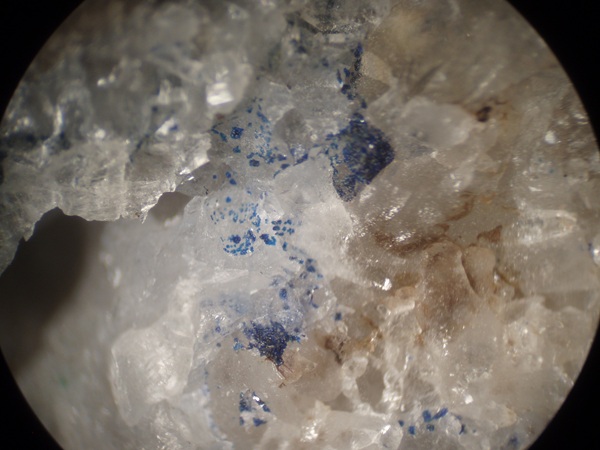
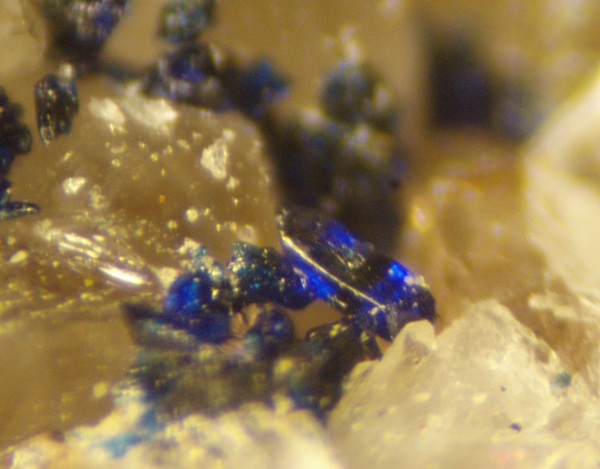
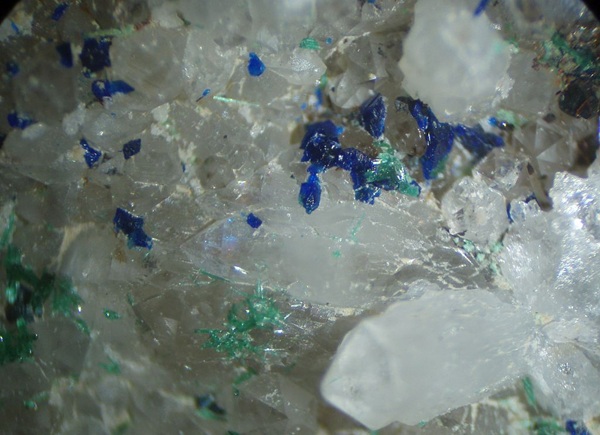
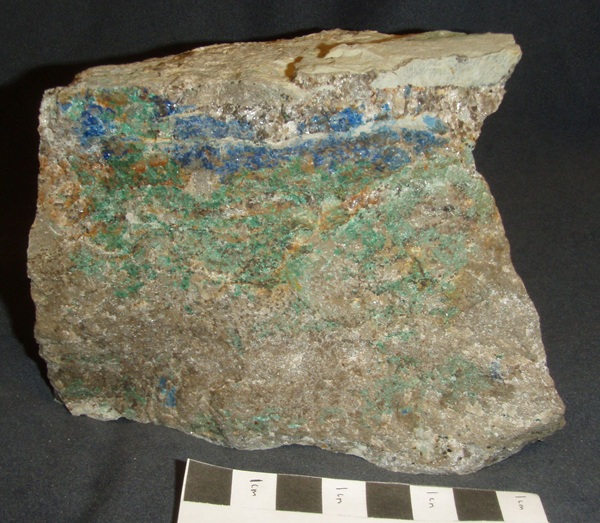
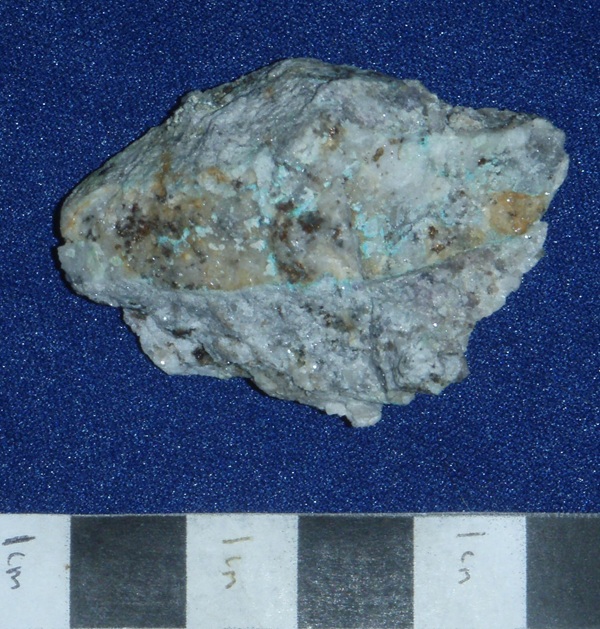
Azurite – copper carbonate – had not been reported before my 1997 paper. I found blue grains associated with malachite from the Minerva No. 1 dump. Brecke reported in coatings on quartz at the Patrick Lead mine. A quantity was collected at the Hastie property in 2016 and later. The source was a chert-limestone boulder in riprap from the westernmost quarry on Lead Hill. Azurite occurs in blue stains resembling spray paint, in thin joint fractures, and as mostly submillimeter crystals on quartz crystals (Photo Az1). It is mixed with malachite. While malachite is found in the limestone, the azurite is found in the chert matrix.
Barite – barium sulfate – is a widespread mineral throughout the district. Most mines produced massive to crystalline specimens. Some mines with notable barite include the Crystal, Denton, Annabel Lee, Gaskins, Minerva No. 1,and Victory. Barite is typically white, but pale blue is well known (Photo Ba1,2). The Hastie’s property had abundant barite with most single crystals under 5 mm. I found some interesting specimens. Most barite formed after fluorite, but there are exceptions (Photo Ba3). Barite casts after witherite and celestine are known (Photo Ba4).
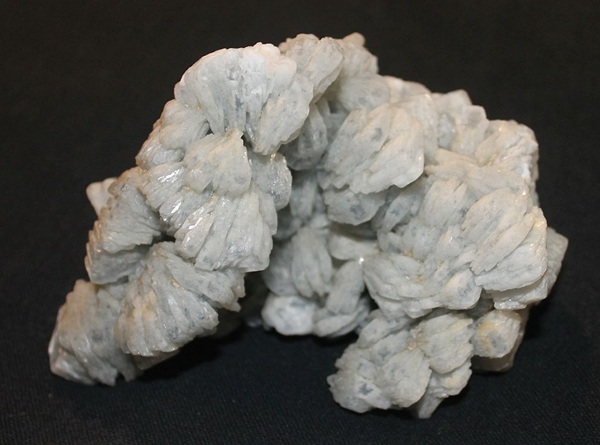
Photo Ba1, Pale blue barite from the Crystal-Victory mine complex on Spar Mountain. Ben E. Clement Mineral Museum specimen. 14 cm specimen.

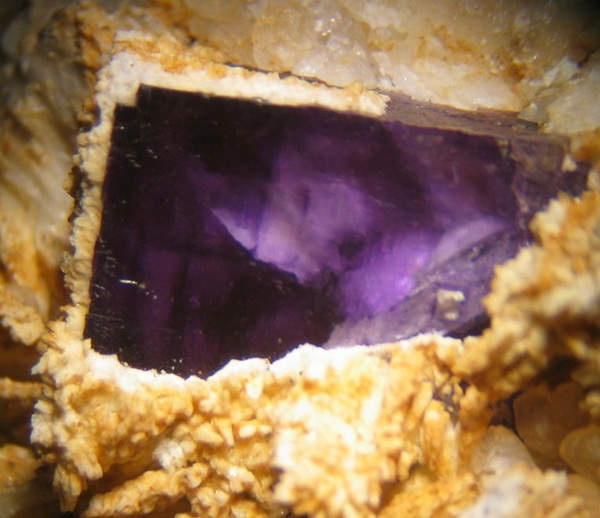
Photo Ba3, Barite both coating and inside (overgrown by) a fluorite cube, from the old Cleveland mine, Hastie’s property, collected October 17, 1987. FOV ~2 cm
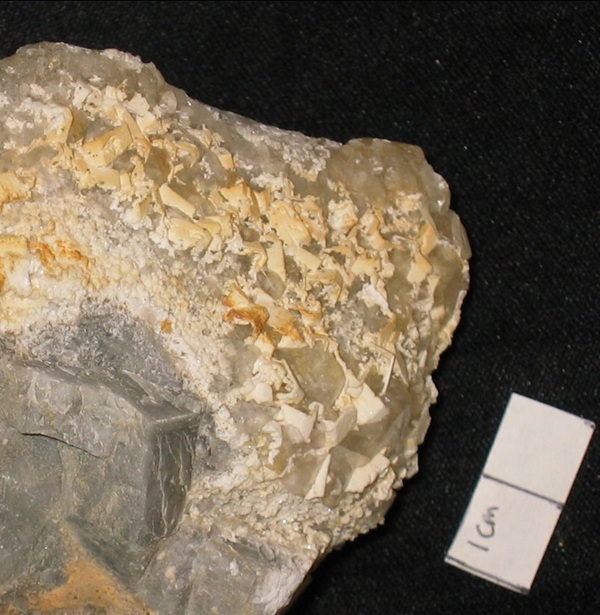
Photo Ba4, Barite forming casts over witherite or celestine on calcite, from the old Cleveland mine, Hastie’s property, collected October 17, 1987.
Barytocalcite has been found in the Minerva No. 1 mine, associated with other rare barium minerals. It is described as not fluorescing in LW and red in SW ultraviolet. It was analyzed with EDS.
Benstonite is a barium double carbonate found in the Minerva #1 mine near the shaft. These crystals are the best of this mineral species known anywhere. They form unmodified rhombohedral crystals often arranged epitaxic (in this case, perpendicular) to the narrow crystals of calcite (Photo Be1).
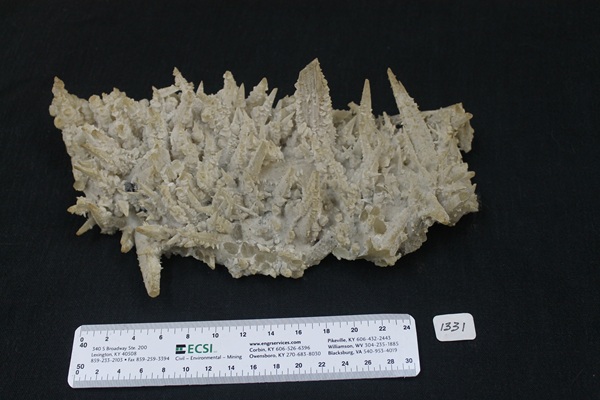
Photo Be1, Benstonite on calcite, Minerva No. 1 mine. Ben E. Clement Mineral Museum specimen.
Bitumen – see Hydrocarbons.
Calcite is probably the most common mineral in the district. It is not an ore mineral, but it occurs in virtually every mine. The earliest form of calcite was simple rhombic crystals. They are rarely of specimen quality. Scalenohedral crystals are the most widespread form. Crystals up to 18 inches long were found in the Dyer Hill mine. I collected several large calcite crystals at the Hastie’s property. Different deposits had different crystal habits (Photos C1 & C2). The largest calcite is about 15 inches by 12 inches. The Denton mine produced the greatest variety of calcite crystals within the district itself. The Minerva No. 1 mine was famous for its long scalenohedrons, but had other forms (Photo C3). The north ore body of the Annabel Lee also produced elongated crystals (Photo C4, C5), while the south ore body produced the shorter honey-colored scalenohedrons with common twins along the 001 axis. The Knight mine produced rambling intergrown calcite aggregates (C6,7). Calcite crystals on fluorite were common (C8). Sometimes, the calcite completely covers fluorite.
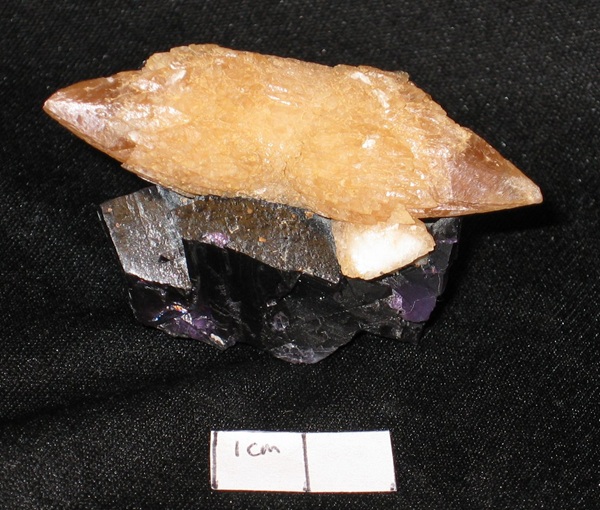
Photo C1, “The Mustache” is a doubly terminated calcite on fluorite from the old Cleveland mine on the Hastie property, collected in 1986.
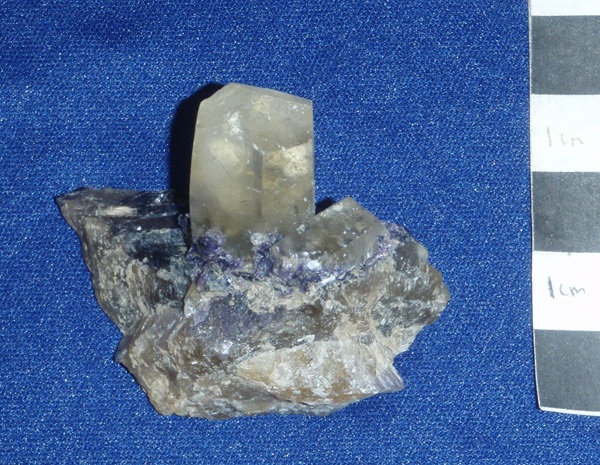
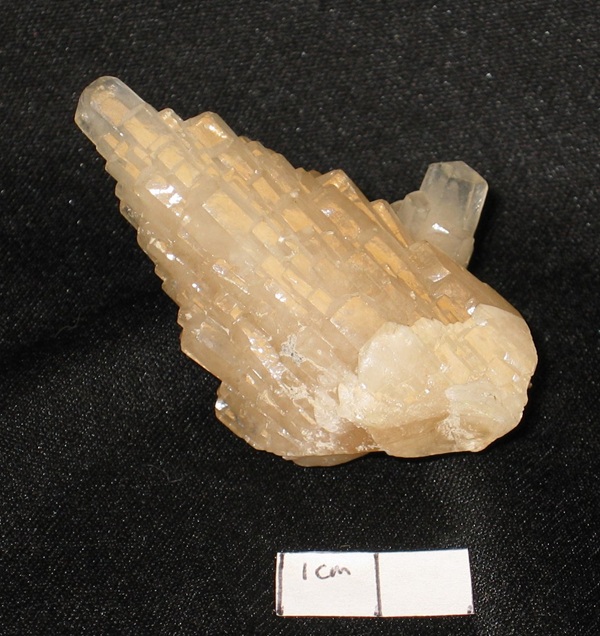
Photo C3, Calcite in parallel growth with low-angle faces, Minerva No. 1 mine, collected in the early 1960s by Jim Below. In my collection now.
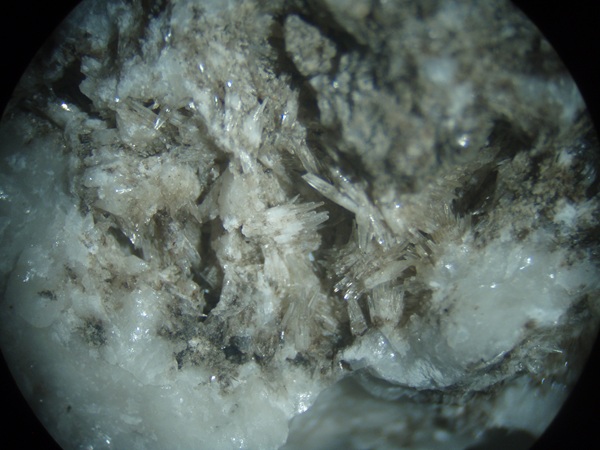

Photo C5, Calcite (on both sides) with minor etched fluorite from the Annabel Lee mine (north ore body). Purchased at a rock shop near the old Minerva No. 1 in Sept. 1992 for $15!
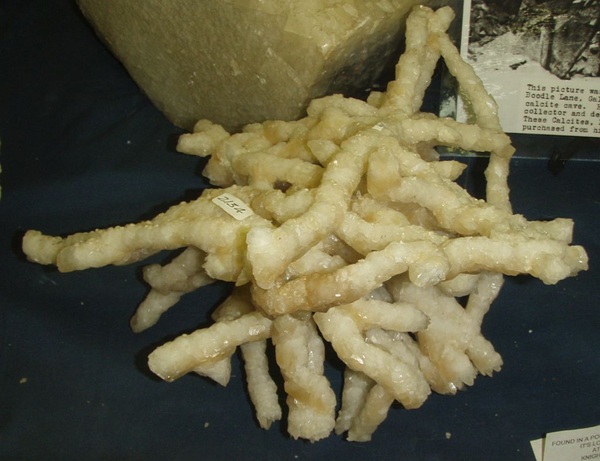
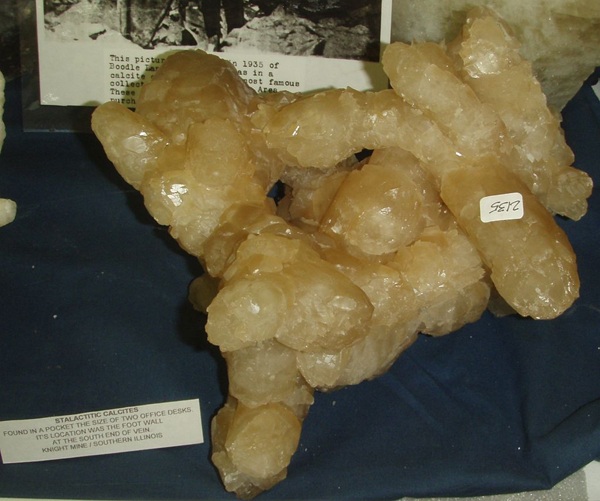
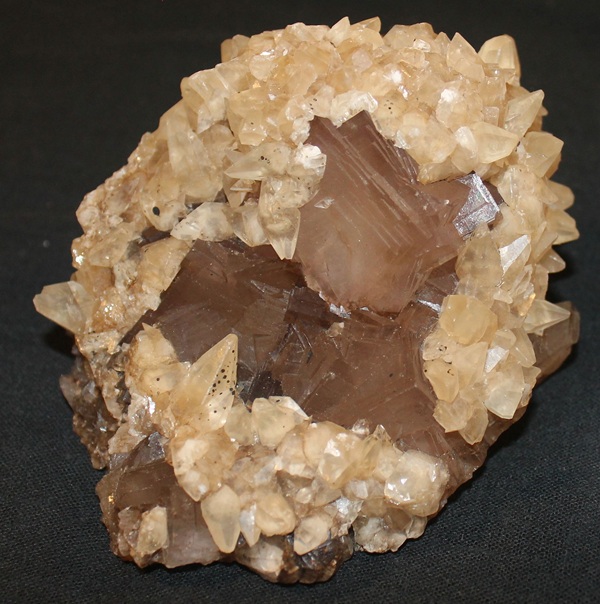
Photo C8, Scalenohedral calcite on fluorite, from the Alcoa mine on the Rosiclare vein. Ben E. Clement Mineral Museum specimen.
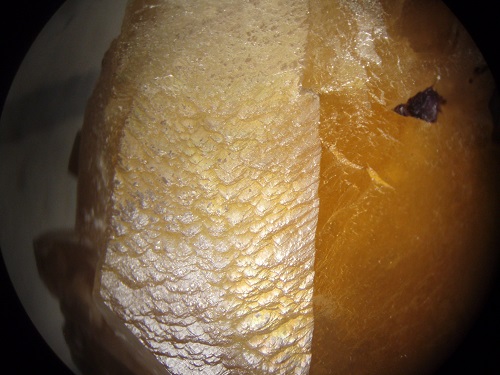
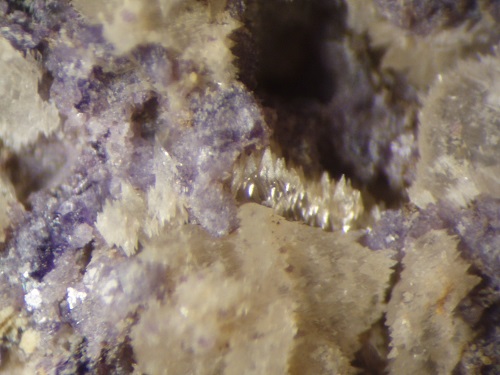
Celestine (celestite) is strontium sulfate. Although it seemed common in the 1980’s and early 1990’s due to abundant specimens from the Annabel Lee, celestine is a rare mineral in the district (Photo Cl1). The first appearance was in Kentucky from the Jameson prospect in the early 20th century. The Minerva No. 1 and the Barnett Mine produced celestine. Celestine vugs were found at the Slats Lucas Quarry in Livingston County, a limestone aggregate producer (Photo Cl2).
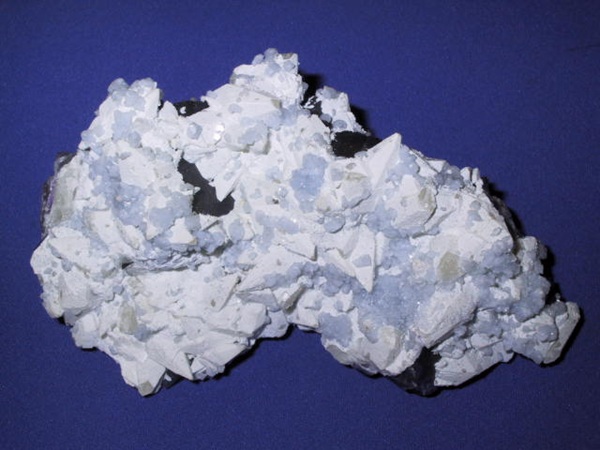
Photo Cl1, Celestine on white barite-coated calcite on fluorite from the Annabel Lee mine. Obtained in spring 1988 for $35.
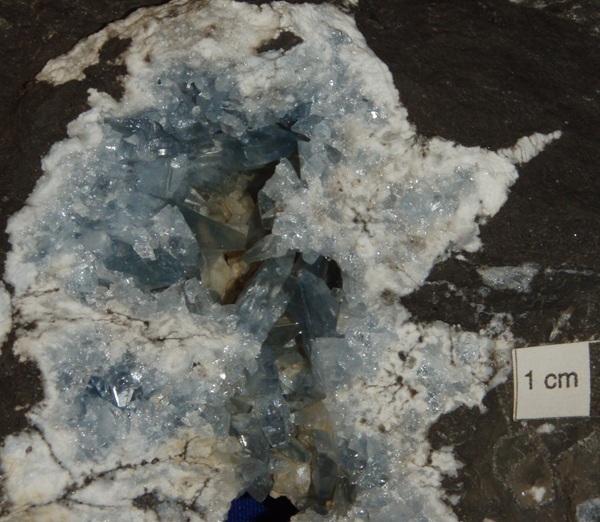
Photo Cl2, Celestine geode or vug in the Fort Payne Formation. Collected at the Slats Lucas Quarry in Livingston Co., KY, on March 21, 2008.
Cerussite – lead carbonate is another secondary lead mineral that occurs in near-surface deposits. Calcite provides the carbonate elements that, when combined with deeply weathered galena, make it more widespread than other lead alteration minerals. It forms crusts and small crystals that range from microscopic to 5 mm across. It can be found throughout the district, but is usually inconspicuous. Conn’s mine, a strip mine adjacent to the Gaskins mine, was my first encounter in 1984. It occurs in white chalky needles up to 1 mm long with pink(!) fluorite (Cr1). A sandstone boulder in the weeds at the old Rosiclare mill site with traces of fluorite was split, and inside colorless microcrystals of cerussite were found. They were associated with tetrahexahedral purple fluorite and acicular pyromorphite. Since it came from a mill site, the source could be anywhere. The finest cerussite I have collected comes from the dump of the Hickory Cane mine. Crystals are up to 5 mm across, colorless, white, gray to black. All fluoresce orange. I have seen singles, twins, and trillings in a wide range of growth habits (Photo Cr2, Cr3). The Columbia mine produced some small but unusual crystals (Cr4).
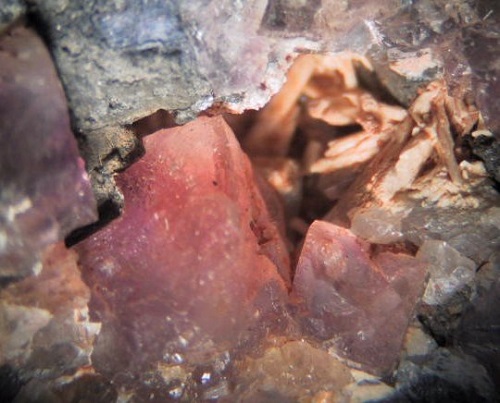
Photo Cr1, Chalky white cerussite crystals with pink fluorite, from Conn’s mine, Pope Co., IL. Collected in 1984. FOV ~35 mm

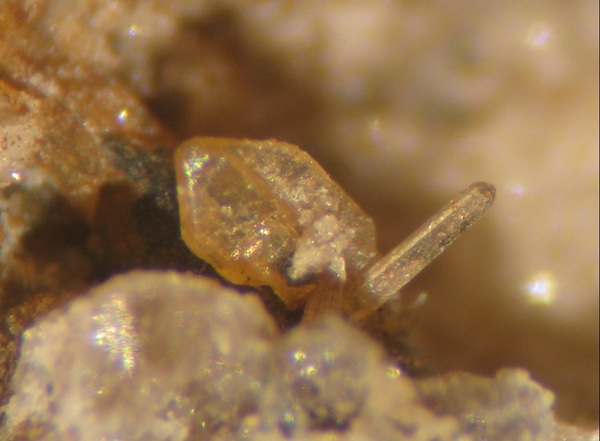
Photo Cr3, Cerussite, two crystals of different forms, from the Hickory Cane mine. FOV ~7 mm
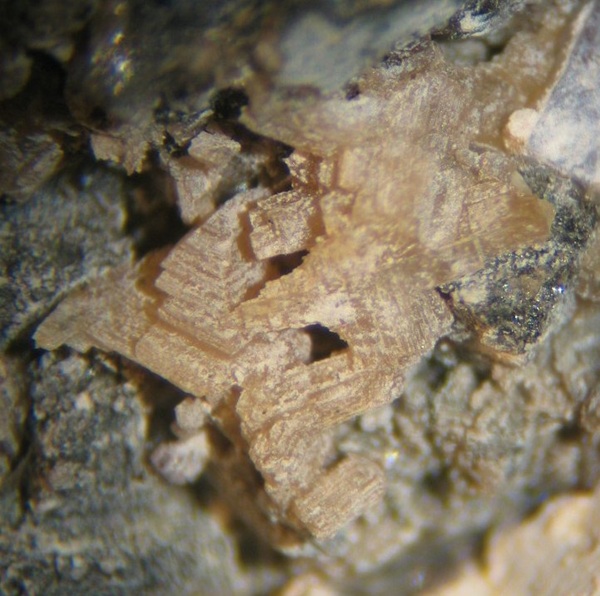
Photo Cr4, Cerussite in pagoda-like crystals, from the Columbia mine. FOV ~7 mm
Chalcopyrite – an iron, copper sulfide occurs in disphenoids (tetrahedral) and elongated nail-like crystals, which occur as inclusions (Photo Ch1). They are particularly noted in the transitions between the yellow and purple fluorite. Decomposing chalcopyrite may have a malachite halo. The largest known mass of chalcopyrite was found in the Hillside mine in Rosiclare and weighed about four pounds. A sizable mass of chalcopyrite on fluorite was found at the Annabel Lee (Photo Ch2).
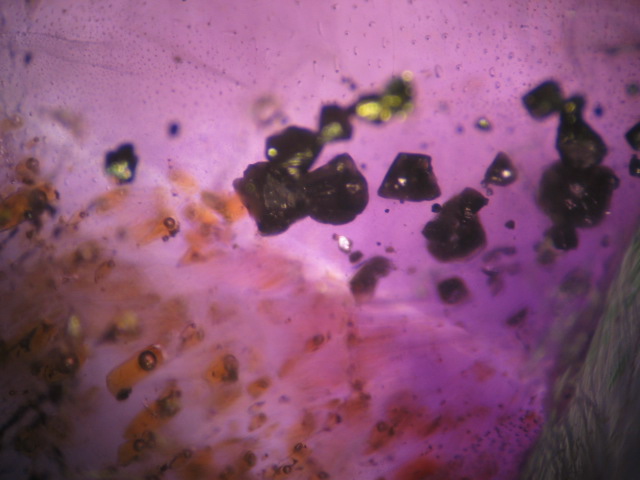
Photo Ch1, Chalcopyrite crystals included in fluorite, with fluid inclusions to the lower left. FOV ~20 mm
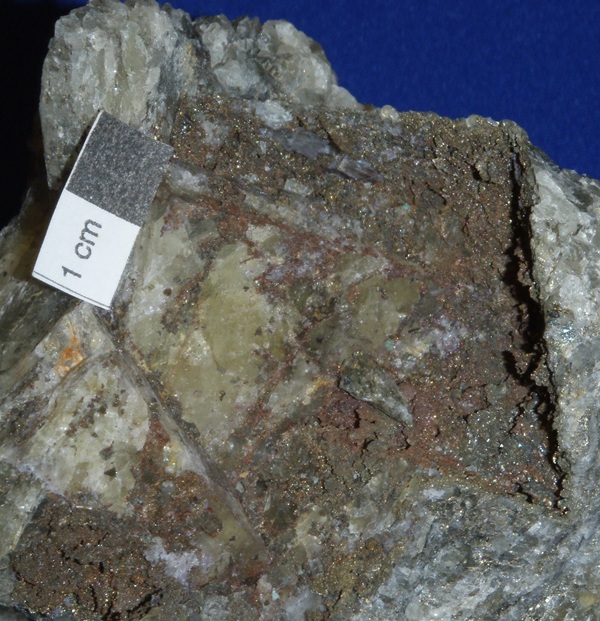
Photo C2, Chalcopyrite on fluorite, from the Annabel Lee.
Native copper reported by Bain (1905) as small flakes resulting from the reduction of chalcopyrite. He didn’t know which mine it was from.
Cuprite is a copper oxide. It was reported in vein deposits, sometimes associated with malachite and corroded chalcopyrite, but it is not conspicuous.
Dolomite is calcium magnesium carbonate. Some has been reported as sugary coarse buff-colored material from the Number One and Deardorff mines. It’s considered ferroan. I found pale 1mm crystals with sphalerite from the Annabel Lee mine (Photo D1) and the Hutson zinc mine (Photo Hy3).
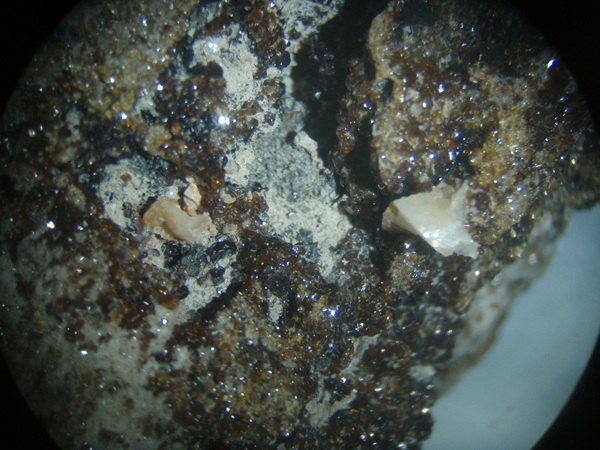
Epsomite (magnesium sulfate with water) was found over in Hastie’s property in an exposed Victory mine adit. White needles were observed covering the floor of the mine at the tunnel entrance. My identification was by its bitter taste. It was not mirabilite, which is similar in appearance, but not bitter. I took a piece of dirt covered with white fuzz outside and watched the mineral disappear before my eyes!
Fluorite (Fluorspar)
Click on this link to a page on fluorite with information and photos.
Many of the fluorite specimens were collected by me over the years at a few old mines exposed on Hastie’s property. Almost all of those localities no longer exist. Other photos include specimens from the Ben. E. Clement Mineral Museum.
Galena – lead sulfide – is common throughout the district. The pre-1880 mines were lead mines. The Columbia mine was opened for galena, though its silver content (also sought) was negligible (Photo Ga1). Fluorite wasn’t mined until its use as a flux was discovered in the early 1880s. Crystals are in cubes and cubo-octahedrons (Photo Ga2). They range from several millimeters to a foot across, though large ones are rare. The W.L. Davis- Deardorff complex may have had the largest quantity of galena in the district.
Galena is reported to have 14 ounces of silver to the ton around Hicks dome and on the Kentucky side of the district, 2 to 3 ounces per ton.
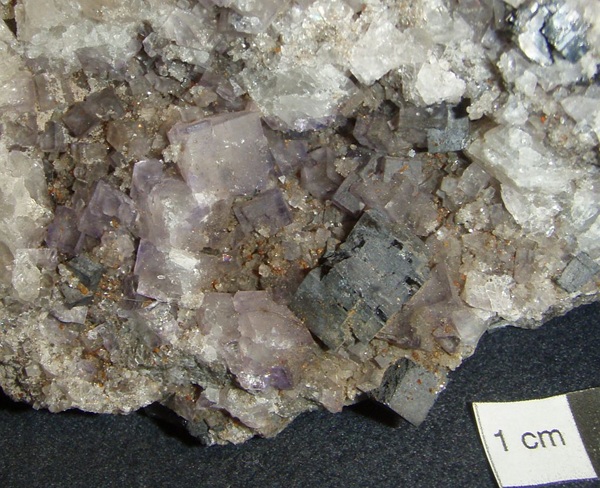
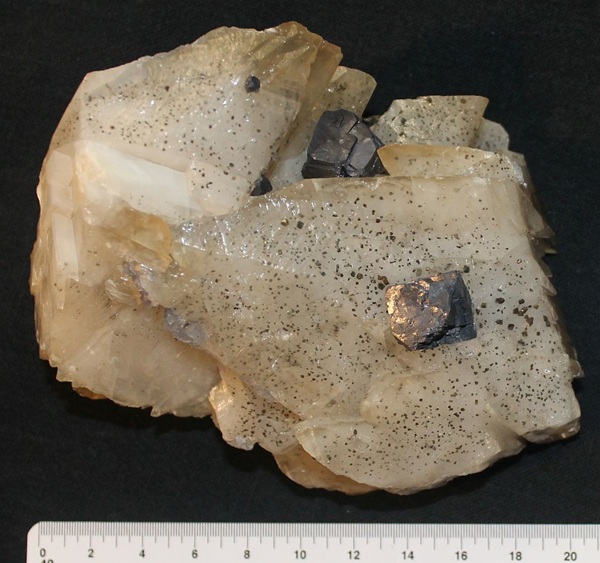
Photo Ga2, Galena in cubes modified with the octahedron on calcite with chalcopyrite inclusions. Gaskins mine. Ben E. Clement Museum specimen.
Greenockite is cadmium sulfide, a rare weathering by-product of sphalerite. It is the an important source of cadmium and germanium. It occurs as yellow or orangish crust on sphalerite and colors smithsonite and calcite. It was reported from the Red mine in the Empire district in Pope County near Gaskins mine, and in the Commodore mine in Kentucky, according to Irwin Brecke. It occurred as yellow-green stains and microcrystals at the Eureka prospect, near the Columbia mine, and at the Columbia mine, coloring small calcite crystals (Photo Gr1,2). The Hutson and Old Jim zinc mines likely had this mineral, albeit in small quantities.
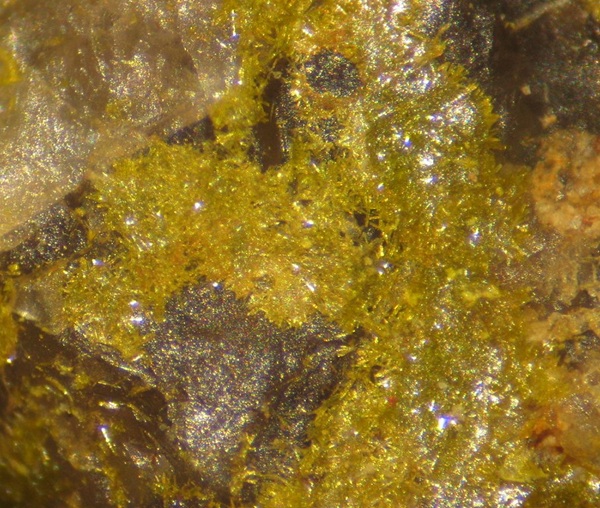
Photo Gr1, Greenockite forming a matt of acicular crystals on fluorite from the Columbia mine. Collected April 1, 2006. FOV ~5mm
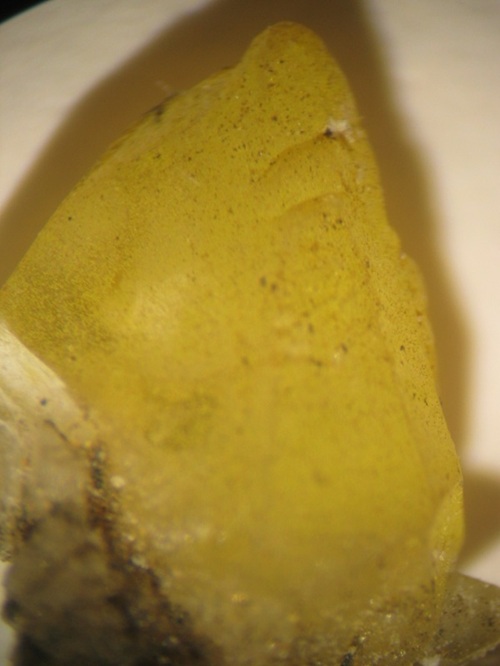
Photo Gr2, Greenockite colored calcite from the Columbia mine. Crystal is about 6 mm long.
Gypsum – calcium sulfate + water is another rare mineral. It has been described in the upper levels of the Hillside mine in Rosiclare, 330’ level of the Deardorff mine (4cm crystals) in Illinois, and the Guill and Klondike mines in Kentucky, in large crystals in limonite vugs. Large pockets of impressive selenite crystals were recently found in a limestone quarry near Eddyville, KY.
Hemimorphite is a zinc silicate, an alteration product of sphalerite. I first encountered it while collecting at the Hickory Cane mine in 1987 (Photos Hm1,2,3). It is often associated with cerussite. Ulrich & Smith (1905) reported it from the Hodge and Evening Star mines. I have found it at the Lafayette mine, on dumps with pyromorphite. I collected a single specimen at the Minerva No. 1 mine dumps, exposed after the calcite was etched away. (Possibly the only one known.) Individual hemimorphite crystals are 1-3 mm, but they are almost always aggregated in clusters across up to 5mm. Crystals may be clear, chocolate brown, salmon, orange, olive-green, or black.

Photo Hm1, Hemimorphite from the Hickory Cane Mine, and old zinc mine. FOV = 4 mm

Photo Hm2, SE photo of Hemimorphite from the Hickory Cane Mine, from Rudi Turner. Scale on photo.

Photo Hm3, Hemimorphite (with calcite powder between crystals giving it a striped appearance) from the dumps of the Hickory Cane mine. Different of colors have been found here. Specimens are often associated with galena and cerussite, indicating they came from an area between 160 – 240 feet underground, where a galena zone occurred. FOV = 5 mm.

Hemimorphite crystals interspersed among quartz crystals (220x). R. Turner specimen & took image for Alan Goldstein who collected it.
Hydrocarbons, asphaltite and grahamite are widespread in the fluorspar district. Gill Montgomery related a story about a quantity of oil coming out of the Minerva No. 1 mine. Eric Livingston, Ozark-Mahoning geologist, described maybe a quart of oil out of the Annabel Lee for several days and then occasionally encountered pockets with oil in them that required buckets for collection. It was critical to remove the oil before removing the ore because it inhibited the separation of the ore from waste rock by the flotation method used at the mill. During the first visit to Hastie’s in 1984, fluorite with hydrocarbons (examined years later) was found to have spheres of calcite and fluorite, presumably pseudomorphs after water or gas bubbles (Photo Hy1,2). Hydrocarbons were found associated with sphalerite and dolomite at the Hutson zinc mine (Photo Hy3). Fluorite coated with bitumen in Photo Hy4 is from a drill core from the dump at the Victory mine mill site. The core is most likely from the Minerva No. 1 mine because the core dump was from the company that owned the mine.
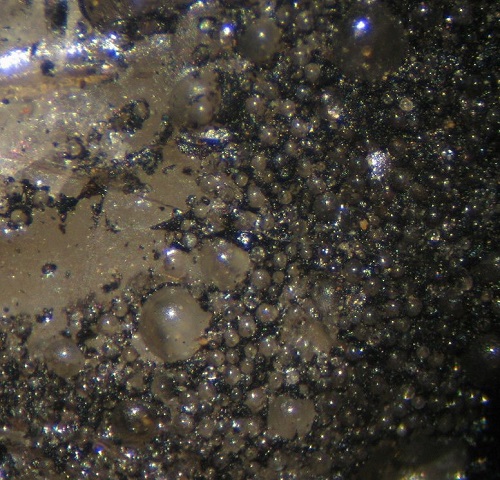
Photo Hy1, Bitumen (dried hydrocarbons) around calcite spheres, from the Hastie’s property, collected in 1984. FOV ~ 7.
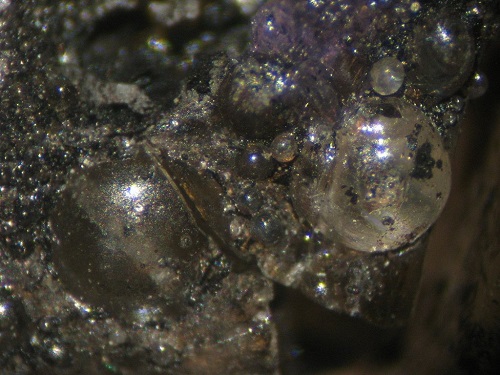
Photo Hy2, Bitumen (dried hydrocarbons) around calcite spheres (and fluorite spheres above), from the Hastie’s property, collected in 1984. FOV ~ 5mm.
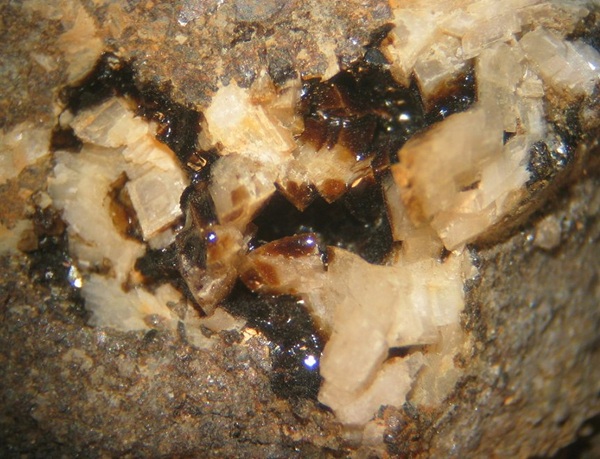
Photo Hy3, Petroleum on dolomite, an unusual association in sphalerite, from the Hutson Zinc mine in Livingston Co., KY. FOV = 35mm
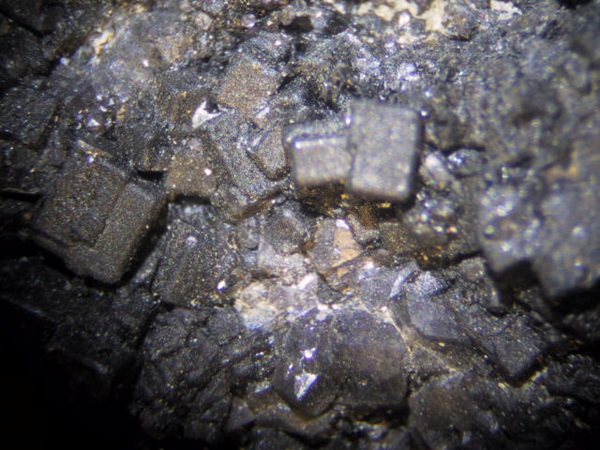
Photo Hy4, Fluorite cubes with a thick coating of dried bitumen/hydrocarbon, from a diamond drill core found at the Victory mine core dump in 1986. FOV = 35 m
Hydrozincite is a zinc carbonate, best identified by its bright blue fluorescence in shortwave ultraviolet light. Most zinc mines in western Kentucky, including the Hickory Cane (Photo Hz1), Hutson, Old Jim, Commodore, have it on the mine dumps. How much is from depth versus post-mining origin remains to be seen. It’s dull white, typically a crust, and is often associated with smithsonite and sphalerite. The Old Jim Mine was the only place where it occurred in mineable quantities.
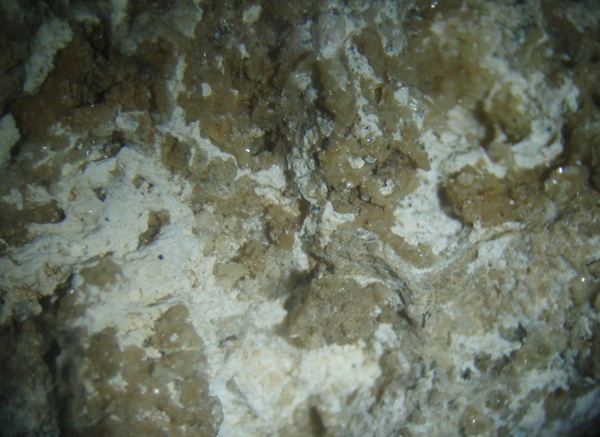
Kaolinite is a clay mineral that is noted as a cream-colored mineral primarily in Kentucky, often adjacent to a fluorite vein. Ulrich & Smith noted it from the Asbridge and the No. 6 shaft of the Blue and Marble mine on the Tabb fault system. I have found white clay in the dumps at the Lafayette mine, also on the Tabb fault.
Limonite is a generic name for Goethite – iron hydroxide. It is widespread, although good specimens are rare. I found a pretty large mass of marcasite with goethite at Conn’s mine. It occurs in minute amounts as bubbles and web-like growths (with wad, manganese oxide) at Spar Mountain (Photo LG1, LG2). Bastin noted it in stalactitic masses from the Hillside and Stewart mines in Rosiclare. I collected a massive specimen at the Old Jim mine (Photo LG2), (Photo LG3), stalactitic goethite, and as the cementing agent in brecciated fluorite at the Lafayette dumps.

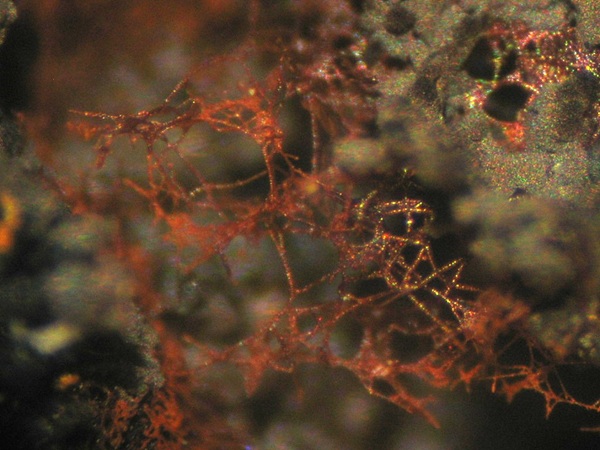
Photo LG2, Tiny, web-like growth goethite with black wad (MnO2) from Hastie’s, associated with petroliferous barite crystals. Collected October 1984. FOV ~5 mm
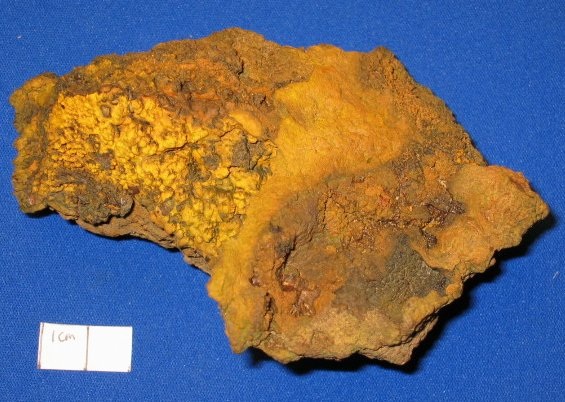
Photo LG3, Goethite, almost velvety, from the Old Jim Mine, collected in October 2004.
Malachite – copper carbonate – is widespread but rarely conspicuous. The copper source is chalcopyrite, associated with fluorite. It is on or in fluorite associated with chalcopyrite (Photo Mal1). It was found in the Henson mine as inclusions in fluorite, Conn’s mine, in barite at the Hastie’s property, and in several drill cores, probably from the Minerva No. 1 mine. It also occurs as green stains, where the fluorite-bearing matrix was exposed to surface weathering, such as the gravel parking lot at the old Rosiclare Mill site (now the location of the American Fluorite Museum). Most appears to be post-mine origin and is mixed with fluorite (Photo Mal2). Malachite was found associated with azurite at the Lead Hill quarry, Hastie property in crystals, silky masses, and crusts (Photo Mal3). Brecke reported it in nearly all shallow deposits.
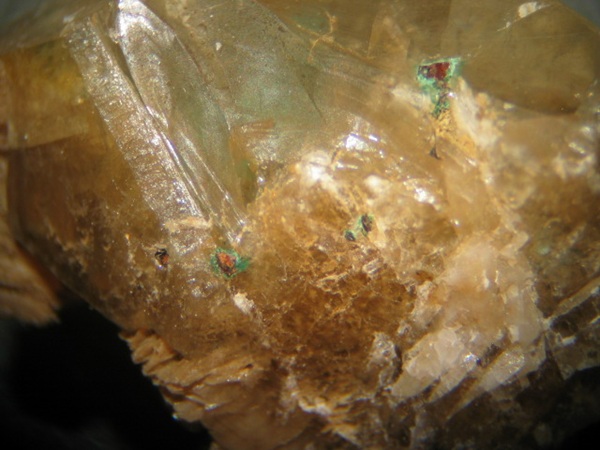
Photo Mal1, Malachite coating oxidized chalcopyrite in fluorite and calcite. FOV ~25mm
Manganese Oxides, Wad – occurs in some residual clay deposits. I found on chert at the Pigmy Mine, near Mexico in Crittenden Co., KY (Photo Mn1). MnO2 dendrites are common on limestone throughout the district. It’s found in the quartz at the Minerva No. 1 mine, with goethite at Hastie’s Quarry (Photo Mn2), and with galena at Conn’s mine in the Pope County area.
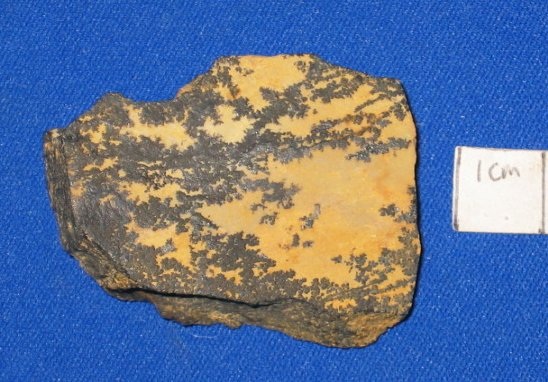
Photo Mn1, Dendritic manganese oxide on chert from the Pigmy mine, collected on my first trip to the fluorspar district in April 1981.
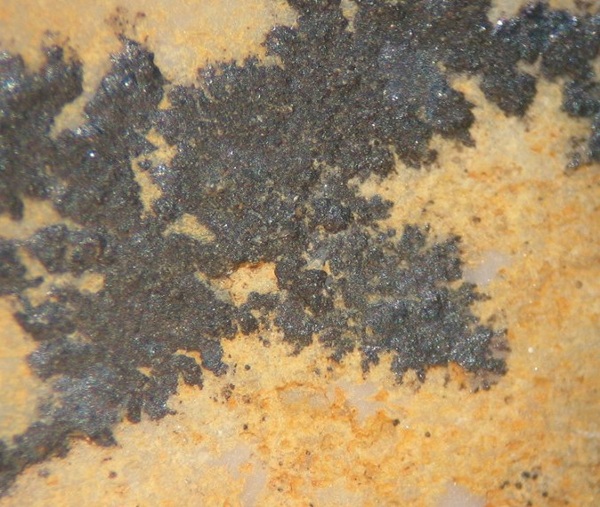
Photo Mn1A, Close-up – top/center, of the specimen (above). FOV ~1 cm
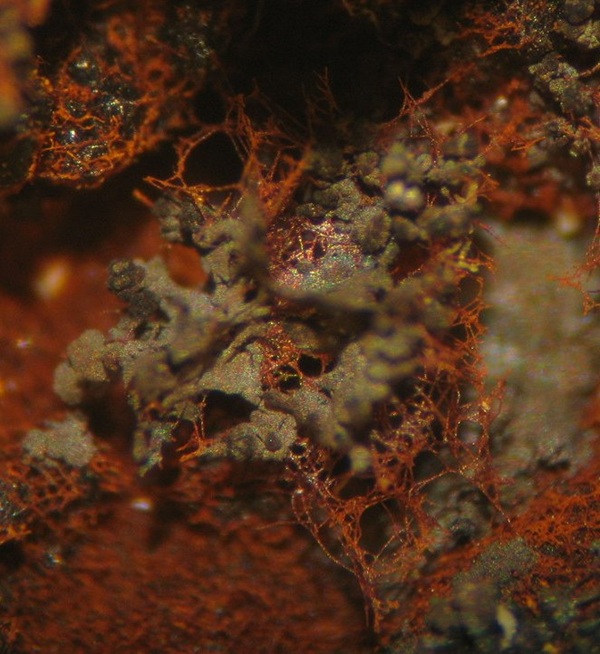
Photo Mn3, Wad, irregular black material associated with orange goethite, from the Hastie Quarry. FOV ~1 cm
Marcasite – iron sulfide – often, there was confusion whether it was marcasite or pyrite – Weller called it pyrite, and Brecke called it marcasite. Oesterling reported significant deposits mixed with sphalerite at the Hutson mine. Marcasite at Conn’s mine cannot be confused for pyrite (Photo Mc1, Mc1A). The Annabel Lee and Henson mine produced wire overgrowths of marcasite (Photo Mc2).
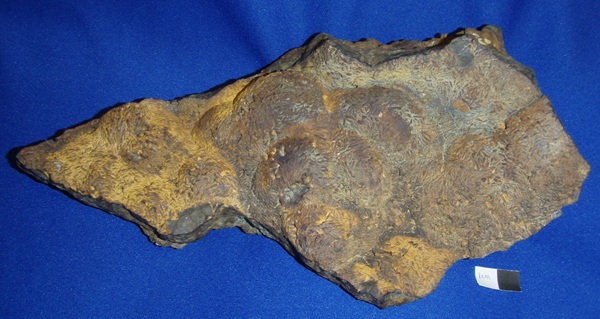
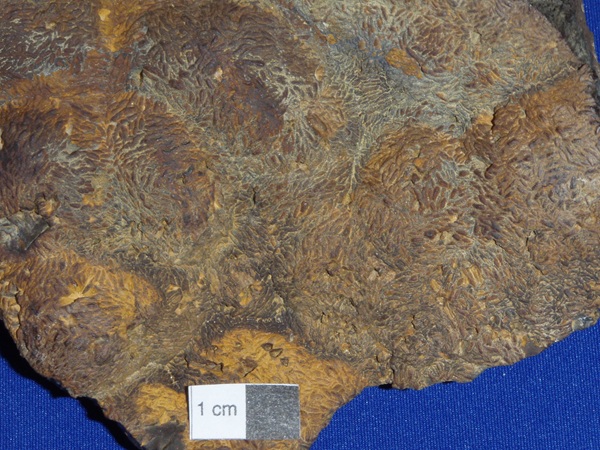
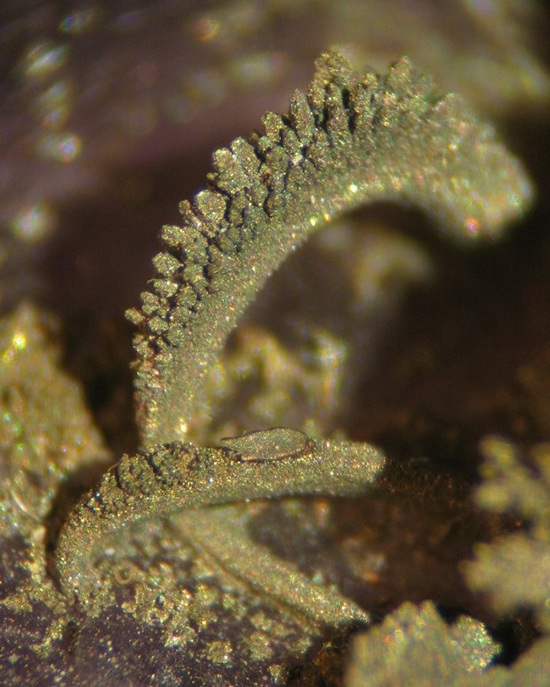
Photo Mc2, Marcasite, the largest arch is 5mm wide. From the Henson mine, Pope Co., IL.
Methane and Water Inclusions, In fluorite and quartz that have a bluish yellow fluorescence, sometimes the bubbles are big enough that you can turn the specimen and see the bubble shift inside the crystal (Photos Inc1 & 2). One time, I had a calcite crystal I collected underground from the Annabel Lee. At home the next day, I heard a loud BANG like a firecracker. I had no idea what it was and ignored it. Five minutes later the whole house smelled like an oil can, from one crystal that exploded. A 3 or 4 mm diameter bubble of natural gas stunk up the entire house. I can see how a pocket could do the same for an entire mine. The force of the gas bubble explosion split the crystal in two. One piece flew about two feet away from the rest. I had to open up all the doors to vent the house! (Photo Inc3)
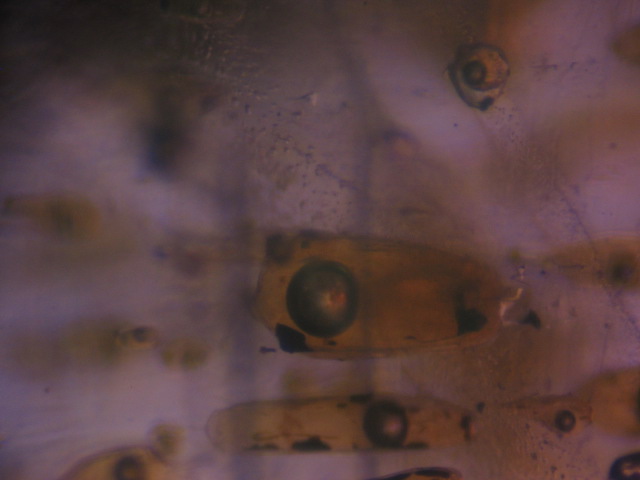
Photo Inc1, Gas bubble on the left side of a fluid inclusion in fluorite. FOV ~ 6mm
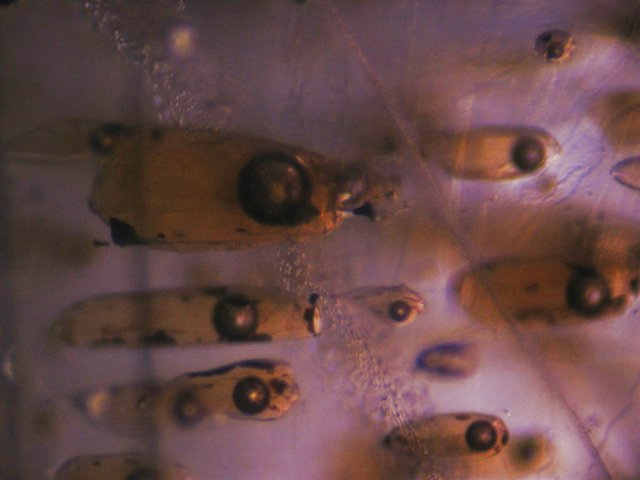
Photo Inc2, Gas bubble on the right side of a fluid inclusion in fluorite. FOV ~ 6mm
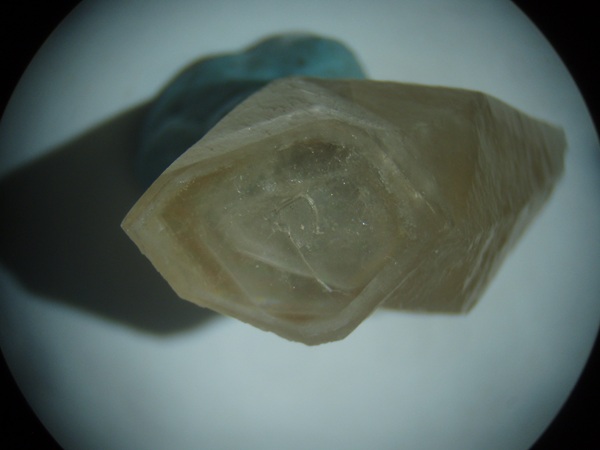
Paralstonite is a similar composition to alstonite and was found as crystals in the Minerva No. 1, the type locality (Photo Pr1), and the Annabel Lee mines. Primarily, the difference between alstonite and paralstonite is determined by X-ray diffraction. Paralstonite fluoresces orange under shortwave UV.

Photo Pr1, The white granular mineral is paralstonite, on witherite. The specimen is about 8 cm wide. Obtained from Ross Lillie, and its identification is confirmed.
Pyrite – iron sulfide – is widespread throughout the district (Photo Py1). It was common from the Old Jim mine, at the Hillside and Argo veins in Rosiclare. It had been reported to have worm-like crystal growth habits and the more typical forms.
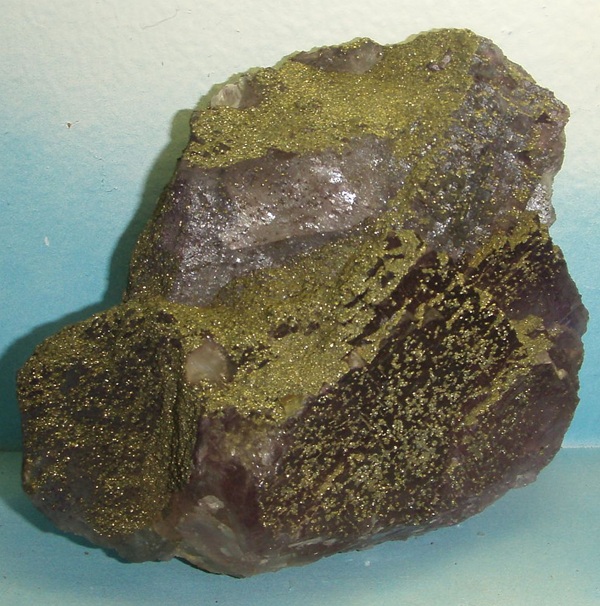
Pyromorphite – lead phosphate w/ chlorine – occurs in microscopic crystals either in single crystals or in aggregates. It is very pretty, although you get into microscopic minerals, and the specimen that I have was on the boulder with cerussite and fluorite (Photo Pmy1). It was widespread (though microscopic) at Lafayette mine (Pmy2). It was reported at the Patrick Lead mine, an open pit near Cave in Rock.


Photo Pmy2, Radiating pyromorphite crystals on fluorite from the Lafayette mine. FOV = 4 mm
Quartz – silica dioxide – is not common in the fluorite deposits. The largest and greatest quantity was found in the Deardorff complex in crystals up to an inch (2.5 cm) across (Photos Q1,2). There, bedding replacement had quartz layered with ore minerals. Other locations include Conn’s mine, where microscope crystals were found in the soil. Rudy Turner, an electron microscopist, did a couple of images. It turns out that some of this is quartz, it’s actually
Smoky quartz is widespread, colored by petroleum inclusions. I have collected it from the dumps of the Minerva No. 1, Rosiclare Mill (Photo SQ1), Columbia, Eureka prospect, Hickory Cane mines, and a few other locations. It is often associated with sandstone deposits.
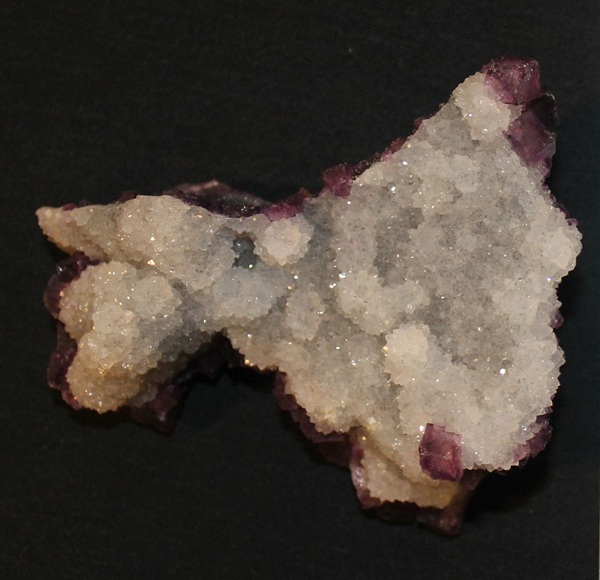
Photo Q1, Quartz and fluorite (mostly on the other side) from the Davis-Deardorff mine complex, 18 cm specimen. Ben E. Clement Mineral Museum specimen.
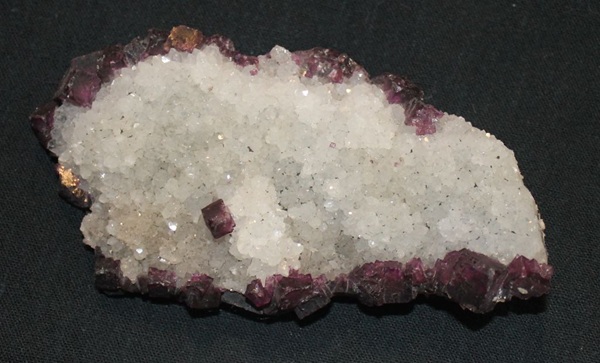
Photo Q2, Quartz and fluorite (mostly on the other side) from the Davis-Deardorff mine complex, 20 cm specimen. Ben E. Clement Mineral Museum specimen.
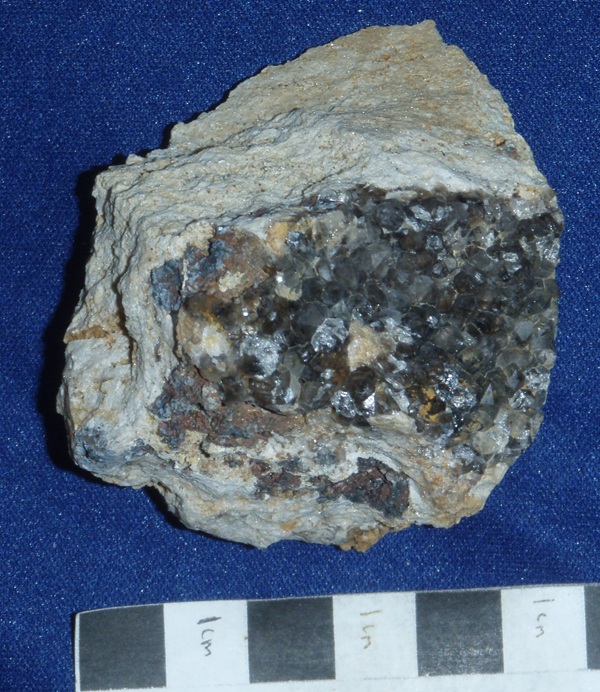
Siderite is an iron carbonate. It is documented in Richardson & Pickney (1984), without further discussion. It could be the progenitor of rhombic goethite pseudomorphs.
Smithsonite – zinc carbonate – is found in shallow deposits where weathering of sphalerite can occur. The zinc mines in Kentucky all have it to some degree. The Columbia, Commodore, Eureka prospect (Photo Sm1), Hickory Cane (Photo Sm9), Hutson (Photo Sm2, 3), Lady Farmer, Mann-McDowell, and Old Jim mines are known for this mineral. A colorful smithsonite has been displayed at the Kentucky Geological Survey from the Old Jim mine.
In Illinois, specimens from the Hill lead mine (property adjacent to the Spar Mountain area, as documented in Harvard & American Fluorite Museum specimens), the Victory Mine dump (Photo Sm4) and the Hastie property. In 2001, I found a mine pillar at the Hastie’s quarry with a large vug filled with brown crystals and a botryoidal habit (Photos Sm5,6). Fossils including brachiopods and crinoids in smithsonite were collected (Photos SM 7,8) Bain reported trace amounts in the Empire district, while Brecke noted it in the shallower parts of the A. L. Davis mine.
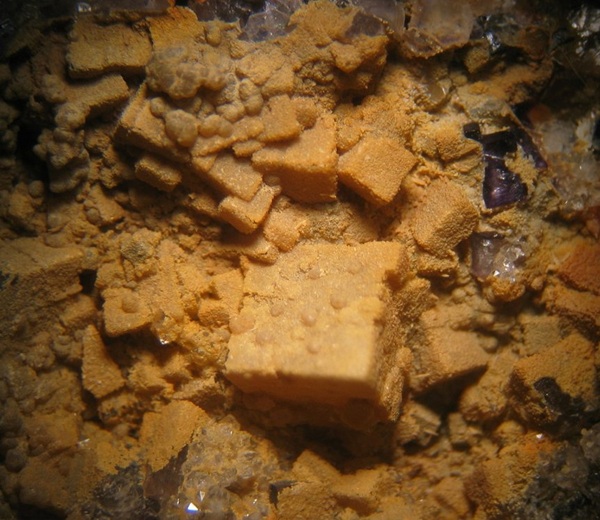
Photo Sm1, Smithsonite coating fluorite from the Eureka prospect, FOV = 35mm
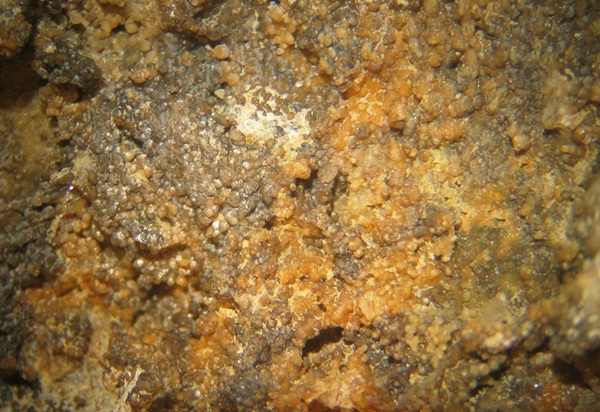
Photo Sm2, Smithsonite crystals from the Hutson Zinc mine, FOV 30mm
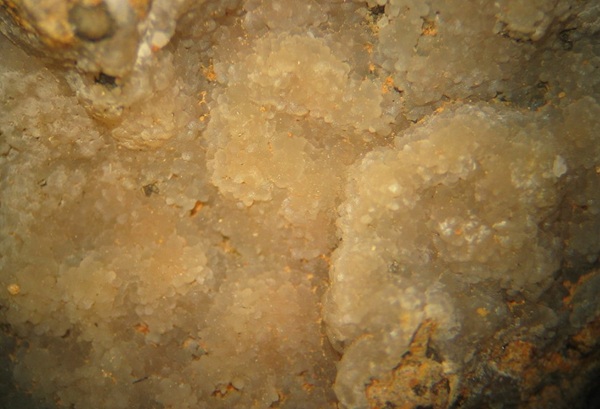
Photo Sm3, Smithsonite in rounded crystals from the Hutson Zinc mine, FOV 30mm

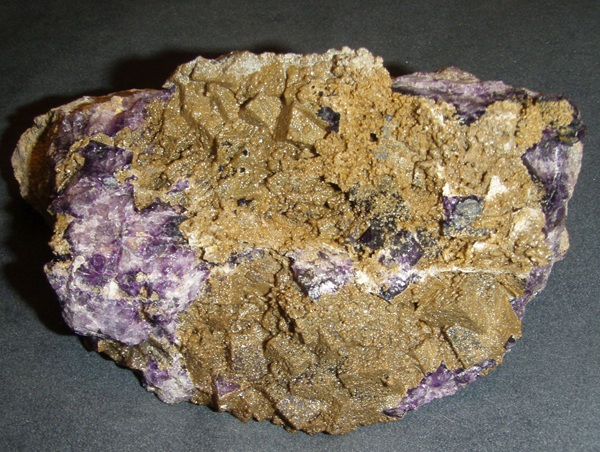
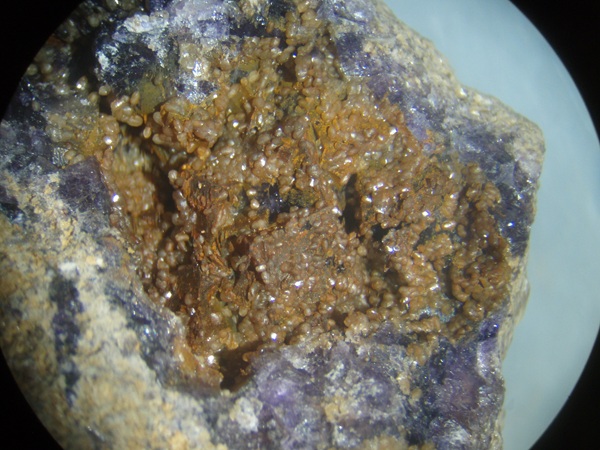
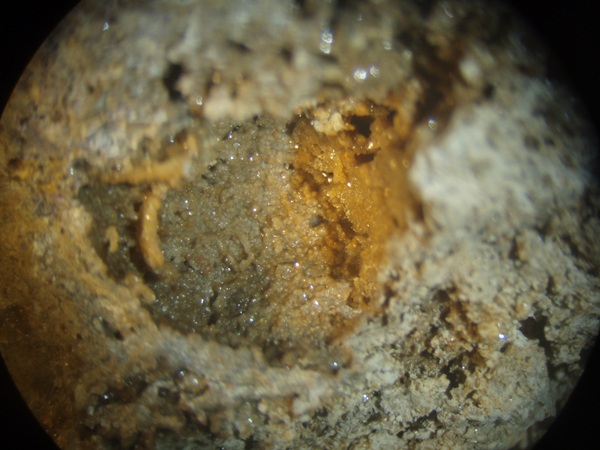
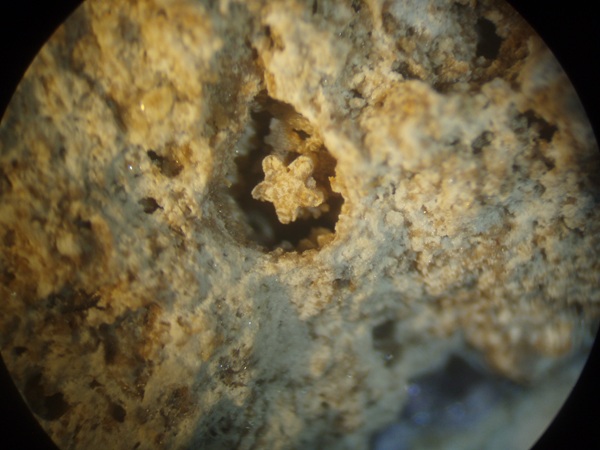

Photo Sm9, Smithsonite in rhombic crystals from the Hickory Cane mine. FOV = 1 cm
Sphalerite – zinc sulfide – was dominant at both Number 1 mine and Davis-Deardorff mine complex (Sp1,2,3), and was of economic value at other mines, such as the Annabel Lee and Denton. Crystals range from less than a millimeter to over 4 centimeters across. Color ranges from yellow to red to black. At the Annabel Lee mine, I saw chunks of sphalerite resembling sandstone (Photo Sp4). Sphalerite is found at many of the zinc mines in Kentucky, but good crystals are uncommon. The Columbia mine had beautiful microcrystals of the so-called “ruby jack,” a low-iron sphalerite (Photos Sp5,6). The Lasher-Robinson mine in Livingston Co. had significant sphalerite, but it was only mined briefly. Other deposits are known but remain unmined. Sphalerite contains germanium and lesser amounts of gallium.
An unusual association of brachiopod fossils and “black jack” sphalerite came from the Annabel Lee mine (Photo Sp7).
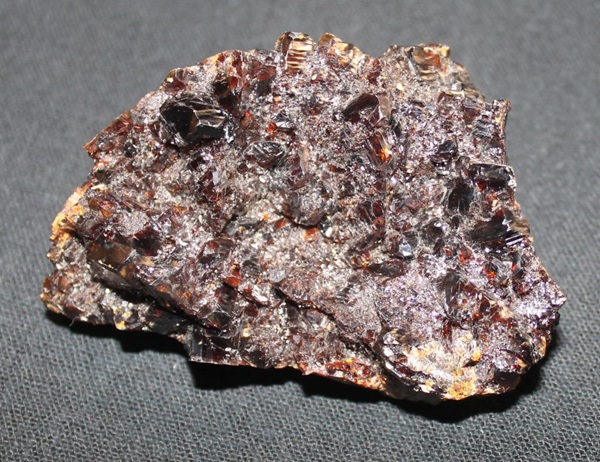
Photo Sp1, Sphalerite, deep red (a bit over-exposed), from the Davis-Deardorff mine complex, 12 cm specimen. Ben E. Clement Mineral Museum specimen.
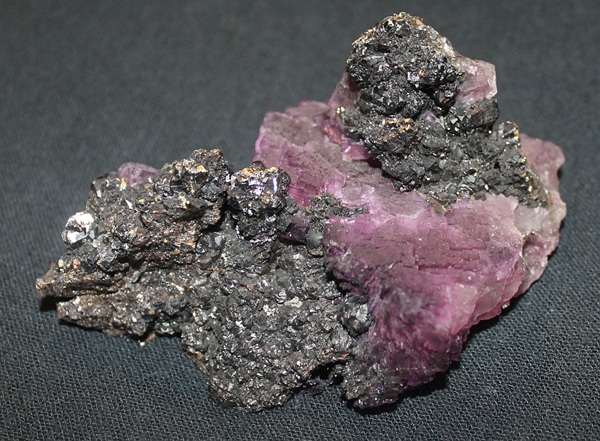
Photo Sp2, Sphalerite and fluorite from the Davis-Deardorff mine complex, 14 cm specimen. Ben E. Clement Mineral Museum specimen.
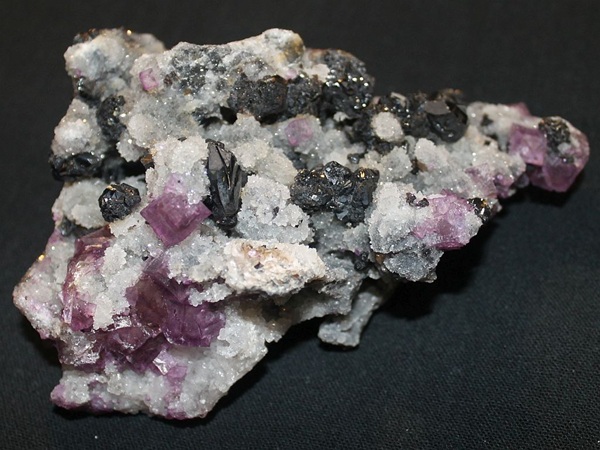
Photo Sp3, Sphalerite, Quartz, and fluorite from the Davis-Deardorff mine complex, 18 cm specimen. Ben E. Clement Mineral Museum specimen.
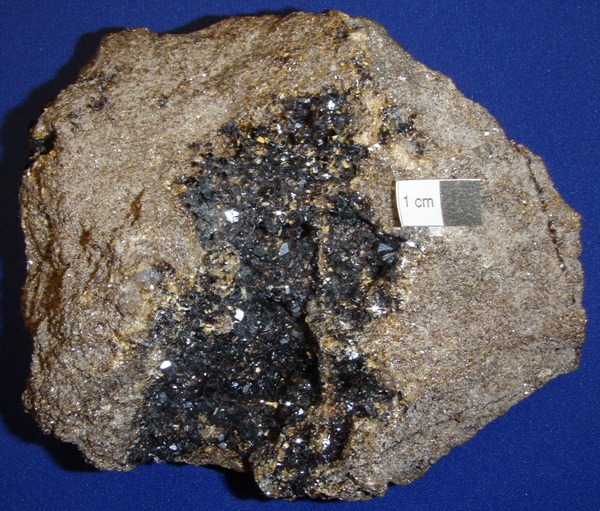
Photo Sp4, Sphalerite crystals in a matrix of small sphalerite crystals that resembles sandstone. Collected at the Annabel Lee mine, September 1988.
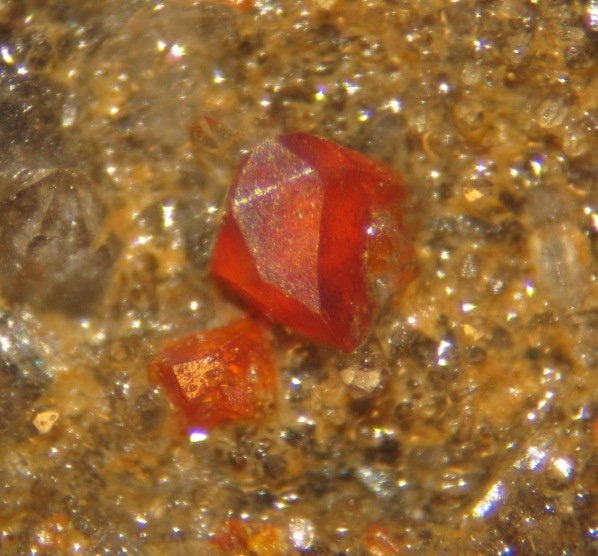
Photo Sp5, tiny red sphalerite crystals on quartz from the Columbia mine. FOV ~5 mm
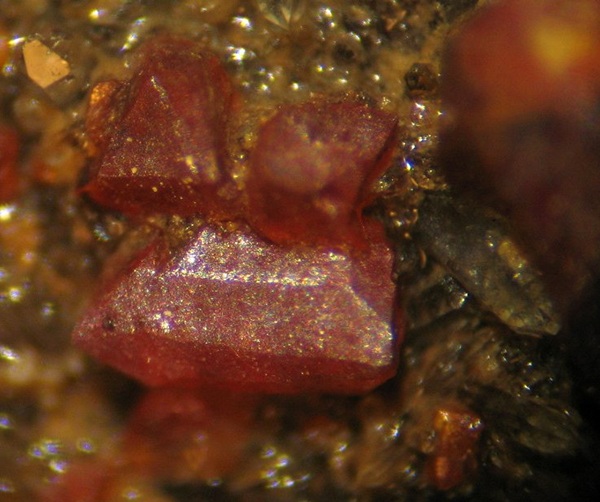
Photo Sp6, red sphalerite crystals on quartz from the Columbia mine. FOV ~6 mm
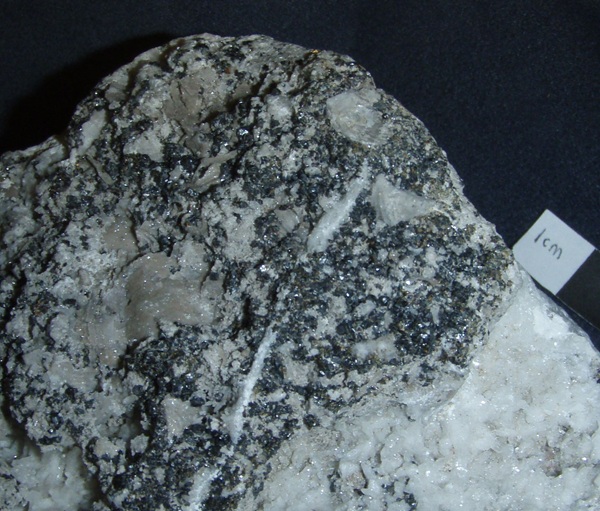
Stibnite – antimony sulfide – was reported from a vein at the Fairview mine, but it’s not preserved. It remains unconfirmed, but is mentioned because it’s in the literature.
Strontianite – strontium carbonate – was reported in several mines in Illinois. The Minerva No. 1 mine was a world-class producer of strontianite mineral specimens. They are pink, white, and light brown in radiating spheres or bow-tie aggregates. They are associated with barite, fluorite, and galena from Minerva No. 1 (Photo St1,2,3), and West Green mines, with marcasite at the Henson mine, and with scaleonhedral calcite from the West Vein mine.
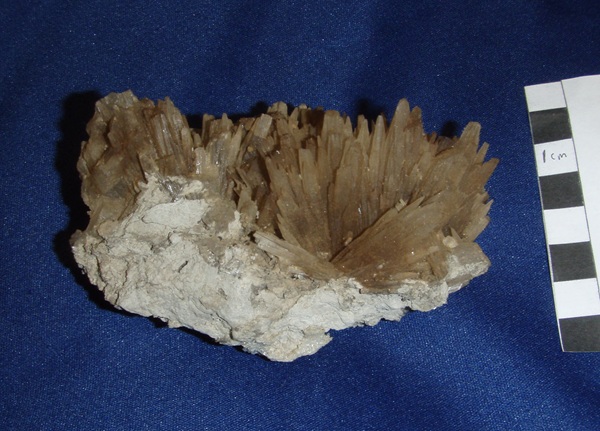
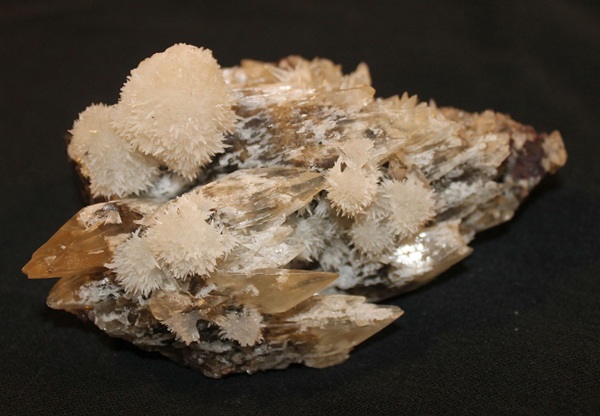
Photo St2, Strontianite on calcite, Minerva No. 1 mine. Ben E. Clement Mineral Museum specimen.
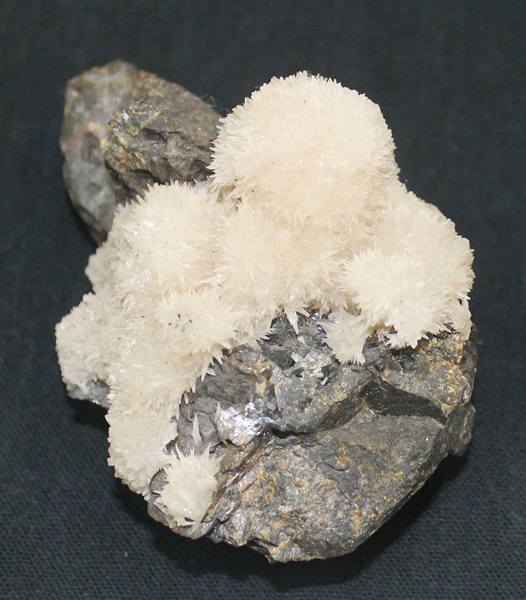
Photo St3, Strontianite on sphalerite, Minerva No. 1 mine. Ben E. Clement Mineral Museum specimen.
Sulfur was noted by Ulrich & Smith from the Brown and Kentucky No. 4 mines in yellow crystals associated with partially weathered galena. Brecke noted sulfur with gypsum at the Edgar Davis mine. I collected some granular sulfur at the Victory mine. I collected two drill cores, possibly from the Minerva No. 1 mine, containing crystals of brown calcite with sulfur (Photos S1, 2).
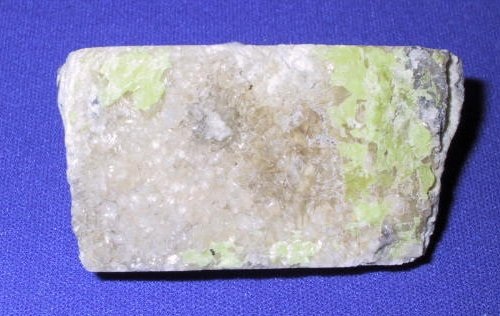
Photo S1, sulfur and calcite, a drill core found by the Victory Mill dump. Core is about 6 cm long.
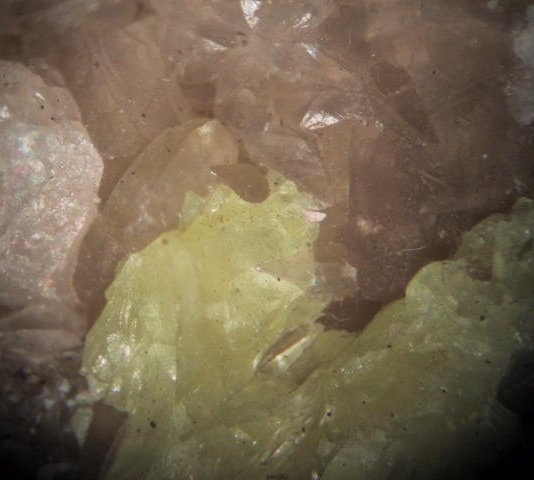
Photo S2, sulfur and calcite crystals, a drill core found by the Victory Mill dump. FOV = 30 mm
Vaesite is a nickel sulfide that occurred in microscopic grains at the W.L. Davis and Deardorff complex associated with pyrite and nickeloan pyrite in “coon tail” ore. Coon tail is a banding of the different minerals. Bravoite may also be present.
Vaterite is another form of calcite, found at the Minerva No. 1 mine. It can only be detected with advanced analytic equipment.
Witherite – barium carbonate – occurred in the Minerva No. 1 and the West Green mine as pseudo-hexagonal crystals, steep-sided dipyramids being rarer than prismatic crystals. They also occur as botryoidal, spherical, or drusy masses on limestone, barite, calcite, etched fluorite, and sphalerite (Wi1). Crystals are gray-white, tan to yellowish (Wi2).
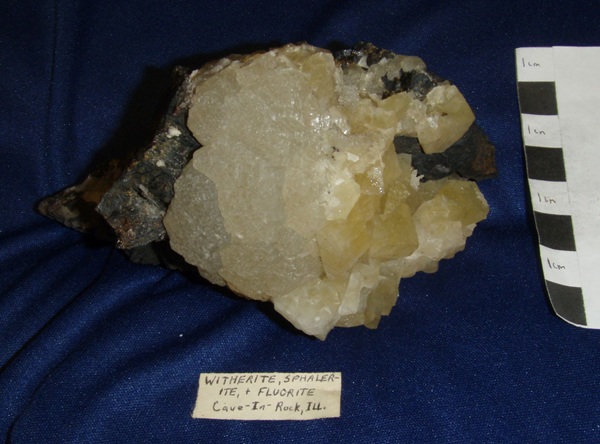
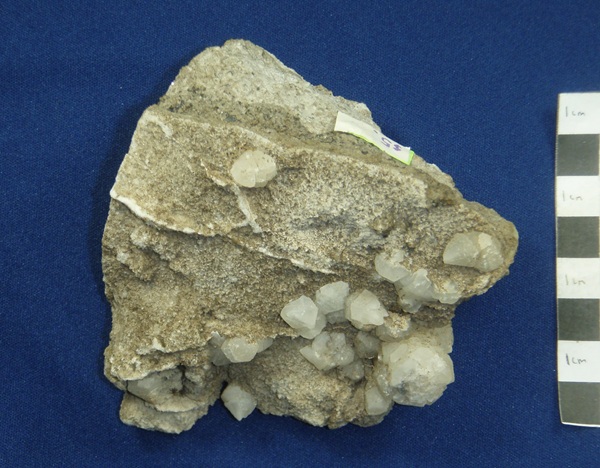
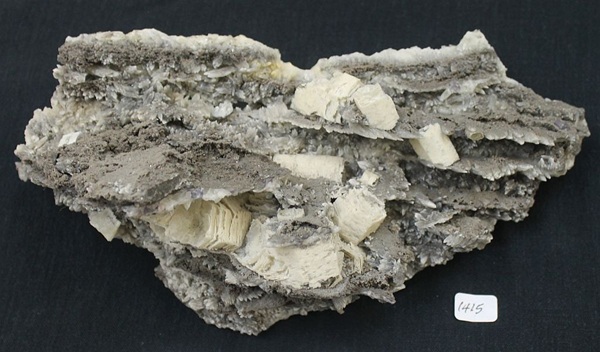
Photo Wi3, Witherite with hopper-like crystals, Minerva No. 1 mine. Ben E. Clement Mineral Museum specimen.
This description of about 39 species of minerals isn’t the end of the story. Microscopic minerals, inclusions, and mining for rare earths will probably reveal more. Abundant azurite from the Lead Hill quarry proves that discovery is possible. Shallow deposits and mine dumps in Kentucky have turned up some nice examples of hemimorphite, smithsonite, pyromorphite, and other secondary minerals.
Bibliography
Bain, H. F. (1905) The Fluorspar deposits of Illinois: United States Geological Survey Bulletin 255, 75 p.
Bastin, E. (1931) The Fluorspar deposits of Hardin and Pope Counties, Illinois. Illinois State Geological Survey Bulletin 58, 116 p.
Baxter & Desborough (1965), Illinois State Geological Survey Circular 385, 40 p.
Baxter, Desborough and Shaw (1967), Illinois State Geological Survey Circular 413, 41 p.
Baxter, Potter & Doyle (1963), Illinois State Geological Survey Circular 342, 43 p.
Brecke, E. A. (1967) Sulfide and Sulfur occurrences of the Illinois-Kentucky fluorspar district, Economic Geology, 62 (3), 376-389.
Currier, L. W. (1923) Fluorspar deposits of Kentucky. Kentucky Geological Survey, series 6, 13, 198 p.
Denny, F. B., Fifarek, R. H., Guillemette, R. N., Padgett, P. L., Petrographic and Microprobe Analysis of the Cottage Grove Dike (Saline County, Illinois); North-Central and Southeastern Section of the Geological Society of America, Joint Annual Meeting at Lexington, April 2002.
Goldstein, A., 1997, Illinois – Kentucky Fluorite District, Mineralogical Record, vol. 28, no. 1., p. 3-49
Hook, J. W. (1962) Selected features of the Kentucky fluorspar district and the Barkley dam site. (Field trip guidebook), Kentucky Geological Survey, 2 – 18.
McGrain & Tibbs (1973), Geologic Guide to a Portion of the Fluorspar Mining District in Livingston and Crittenden Counties, Kentucky. Kentucky Geological Survey, 12 p.
Richardson, C. H. (1925) Mineralogy of Kentucky. Kentucky Geological Survey, series 6, 27, 127 p.
Richardson C. K., and Pinckney, D. M. (1984) The chemical and thermal evolution of fluids in the Cave in Rock fluorspar district, Illinois: Mineralogy, paragenesis, and fluid inclusions. Economic Geology, 79, 1833 – 1856, Discussion, 80, 2045-2046.
Trace, R. D. & Amos, D. H. (1985), Stratigraphy and structure of the western Kentucky fluorspar district. U.S. Geological Survey Professional Paper 1151-D, 41 p.
Ulrich, E. O., and Smith, W. S. T. (1905) The lead, zinc and fluorspar deposits of western Kentucky. United States Geological Survey Professional Paper 36, 218 p.
Weller, J. M., Grogan, R. M., and Tippie, F. E. (1952) The Geology of the fluorspar deposits of Illinois. Illinois State Geological Survey Bulletin 76, 147 p.