
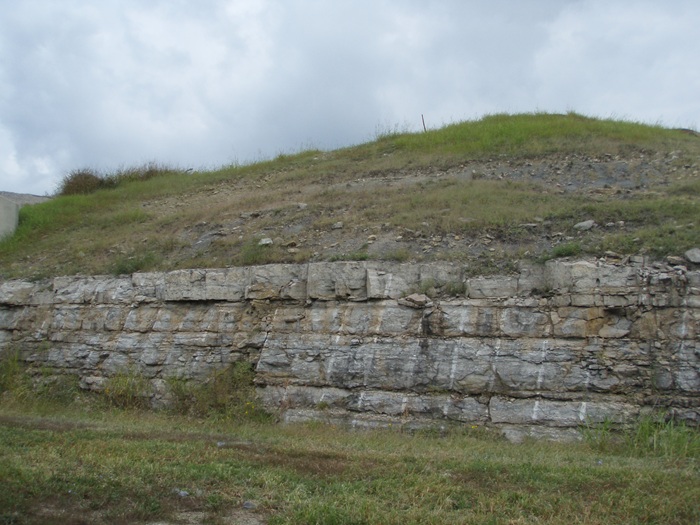
The Glen Dean Formation (Glen Dean Limestone) was named for the village of Glen Dean in southern Breckinridge Co., Kentucky. It is Chester age, Late Mississippian, and is bracketed by the Hardinsburg Sandstone below and the Tar Springs Sandstone above. It is composed of limestone and shale in varying proportions and locations. The thickness of the Glen Dean varies between 40 – 50 feet northwest of Bowling Green (Warren County), Kentucky and in southern Illinois, reaching a maximum of 180 feet in western Breckinridge Co., Kentucky.
The Glen Dean has been documented in Hardin and Pope Counties of southern Illinois (see Butts, 1917) as well as south-central Indiana (Crawford, Dubois, Martin, Orange, and Perry Counties). Horowitz (1965) considers this formation as having abundant, highly diversified marine fauna which existed in clear, shallow agitated water and in quieter water where mud was deposited.
E.O. Ulrich (in Butts, 1917) considered this formation to be the most fossiliferous of the Chester series by volume, although the Golconda (now Haney Formation in Kentucky) has more species. Fifteen fossils are considered index fossils, restricted to this formation. The most common phylum is bryozoans, with just under 70 of the 162 species listed by Ulrich (pages 226 – 230).

Table 1 shows number of species of phyla in Ulrich’s list. This does not show later species, such as Perry and Horowitz (1963) and Utgaard & Perry (1960), nor trace fossils.
Phylum Species Notes
Corals 2 Zaphrentites spinulosa (Edwards & Haime); myself and others have noted, Amplexus geniculatus (Worthen)
Echinoderms 55 22 Pentremites blastoids, considerable over-splitting by 20th century paleontologists, according to the late Dr. Alan Horowitz (through personal correspondence).
Bryozoans 67 References make ID possible on the fenestrates and a few others without thin-sectioning them.
Brachiopods 17 Most were buried quickly and are crushed, but occasionally inflated shells are found.
Worms 1 Paleoconchus, formerly known as Spirorbus.
Mollusks 7 An assortment of bivalves and gastropods
Arthropods 11 One species of trilobite, rest ostracods
Vertebrate fossils include typical Chesterian shark teeth, spines, and dermal plates. They were not included in Butt’s or Ulrich’s lists, but have been found by the writer and other collectors.
Index species in Ulrich’s list (refer to comments above about Pentremites)
Pentremites brevis
P. canalis
P. elegans
P. fohsi
P. lyoni
P. robustus
P. robustus hemisphericus
P. subplanus
Pterotocrinus acinus
P. bifurcatus
Anisotrypa symmetrica
Eridotrypa macrostoma
Chilotrypa hispida
Meekopora clausa
Tabulipora ramosa (Stenopora in 1917)

References
Charles Butts, 1917 – The Mississippian Formations of Western Kentucky
Horowitz, Alan S., 1965, Crinoids from the Glen Dean Limestone (Middle Chester) of Southern Indiana and Kentucky
Perry, T.G. and Horowitz, A.S. 1963, Bryozoans from the Glen Dean Limestone (Middle Chester) of southern Indiana and Kentucky: Indiana Geol. Survey Bull. 26, 51 p. (This is not on-line yet).
Utgaard, J. & Perry, T.G. ,1960, Fenestrate Bryozoans of the Glen Dean Formation of Southern Indiana
See my fossil pages for many photos of Glen Dean specimens.
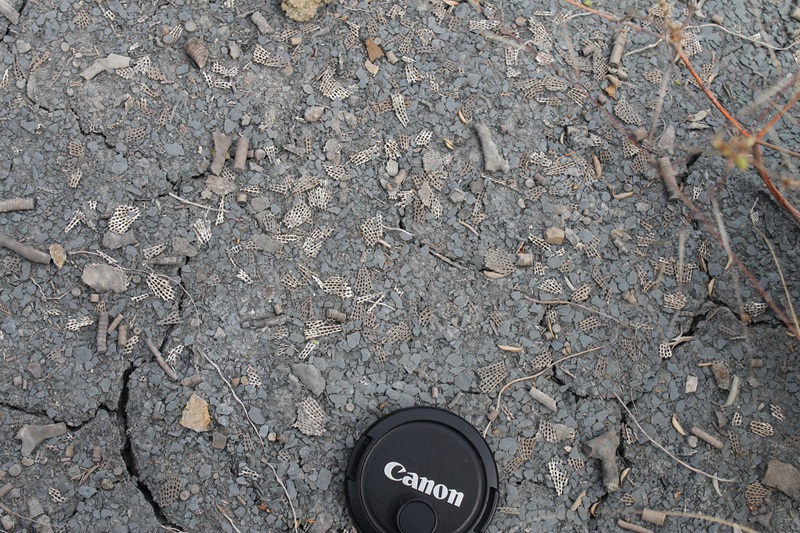
Fragments of the fenestrate bryozoan, Polypora, in situ, Grayson Co., Kentucky.

