By Alan Goldstein January 2, 2026
Today, I stand atop Jeptha Knob. My name is Jim Gilford, and I’m here to solve an act of violence. Mano a mano? No. Naturaleza a naturaleza, nature versus nature. Shelby County was brutalized before the first human set a foot on the land, and I’m here to solve the long-buried mystery.
I’m not your typical detective. I am a rockhound because I love to sniff out crimes against the Earth. My friends call me a geological gumshoe in hiking boots.
Mantled in farms and forests, Jeptha Knob is Shelby County’s highest point. Why is it here? Lord knows I’ve passed the knob on Interstate-64 countless times traveling between Louisville and Frankfort. My high-mileage Ford pickup truck is one of thousands that traverse the edge of the hill, going to and fro every day. Four wheels humming the song where rubber meets the road.
Drivers must think about everything in the world but ancient Kentucky. I’d bet my favorite trilobite that most focus on the future: where they are going, or what they will do upon reaching their destination. A few might be ruminating about where they have been, or problems they left behind. My thoughts are deeper. Millions of years deeper.
The Commonwealth has many geological secrets, questions that I have longed to answer. I’ve always suspected that Jeptha Knob, a “hairy” hill decorated with cell towers, must have an interesting history.
My investigation begins with a dig that needs no shovel. I mine university libraries and the internet for articles and maps written by long-past geologists. By learning what they knew, I can draw my own conclusions.
What I unearth is two competing interpretations. If only I were a fly on the wall listening to a decades-old conversation when it happened. True, I’d be a long-dead fly by now. I can easily envision two scientists espousing their hypotheses, back and forth, in a scholarly version of Wimbledon, and imagine it went something like this:
“It’s volcanic,” the professor states with confidence. He wears a stiff black jacket with a red bow tie and stands behind a polished walnut desk decorated with carefully scattered maps. His thick fingers drum the surface in a tattoo of impatience. An ample belly mimics his theory, threatening to emerge from his jacket like a magma chamber rising to Earth’s surface, shirt buttons potential volcanic bombs.
“But there’s no igneous rock there,” counters the geologist from the front of the desk. Dressed in dusty blue coveralls with a rock hammer hanging from his belt, the man is tall and wiry, with skin as rough as Kentucky’s landscape. His shoes look as worn as an old barn.
“True. But maybe it’s buried deep beneath the roots of the Knob.”
“No. Drilling has revealed nothing. I believe it fell from the heavens as a giant meteorite, like the crater in Arizona,” replies the geologist, looking at an electric globe lamp hanging from the ceiling as if it is going to drop on his head.
The professor cups his clean hands. “There’s no crater.”
The field scientist mirrors the professor cupping his hands with dirt-filled fingernails. “It’s ancient. The crater has eroded over the eons.” He wriggles the shape away.
I realize their theories can be investigated because they left written documentation. I don’t have to believe one over the other. My task is to sniff out clues. There’s only so much one can get by reading and poring over maps. Direct evidence may allow me to learn the answer. I love a good challenge.
On this October day, I make time to flex my skills as an amateur field geologist. The reason for all those cell towers is simple: signals can be broadcast far and wide. The view from the top of the knob is incredible, even if trees and buildings interrupt the panorama. The air is redolent with the aroma of falling leaves and freshly mowed hay. I can taste autumn.
With its fields and woods, houses, barns, and roads, Jeptha Knob’s landscape is no different than most of rural Kentucky. My goal is to tease out the secret, one hidden beneath a tableau of gold, scarlet, and burgundy hues. I must hunt for bare spots in the heavy vegetation to find… rocks. They will provide the clues.
Ambling down the hill, traversing one of the dry rivulets, I kneel and pick up a chunk of tawny chert. The sharp-edged rock is decorated with tiny shells called brachiopods, our State Fossil. The mysteries of paleontology began in Europe, hundreds of years ago, when people climbed the Alps and found fossils on their peaks. Although these early mountaineers knew nothing about geology, their presence fit nicely with Noah’s flood.
Jeptha Knob is a blip on the Earth compared to the Alps, but the wonder of finding fossil sea creatures up here, a thousand miles from the ocean, remains unspoiled by knowledge of how marine mud ended up here. As a rockhound, I am aware of the technology that paleontologists use to date rocks and the fossils within.
My eyesight, failing as I age, makes it necessary to memorize the three-point font geological time chart in my wallet. What I do recall is that the fossils I’ve collected are about 443 million years old. That is ancient beyond measure, but not the oldest fossils in the Commonwealth. The weight of history in my hand is greater than one pound. This wonder only increases my appetite to know more. It is but one piece of my geological jigsaw puzzle.
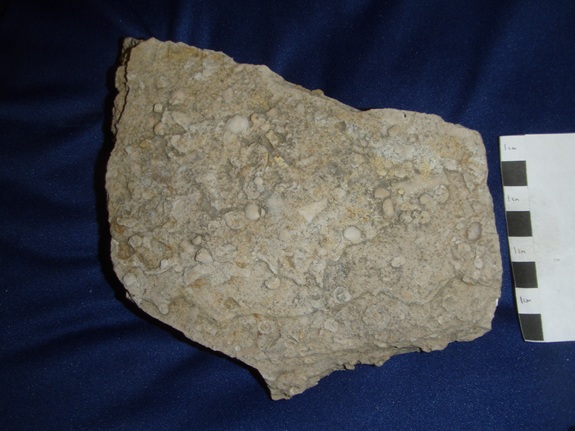
I must reconnoiter further to seek clues. Farther down the hill, I find horizontal shale layers upended. A force of nature from above or below levered the strata. Somewhere close is a fault line, a fracture in the bedrock. Kentucky is a state with many faults. This isn’t a trite political statement, but a geological observation. While most are normal faults, those within Jeptha Knob are anything but.
Exploration shows different-looking rocks mere footsteps apart, suggesting that an obscured fault line must be here. I wish I could see the hill in its entirety, as bald as my grandfather’s head, unsullied by groundcover. In my mind’s eye, a naked knob appears, with shale and limestone splintered by radiating and curved faults. It’s as if Mother Nature hurled a mountain-sized rock at Shelby County, shattering the land into a hundred pieces. Or did it give a punch from below? That’s the debate, why I’m here today.
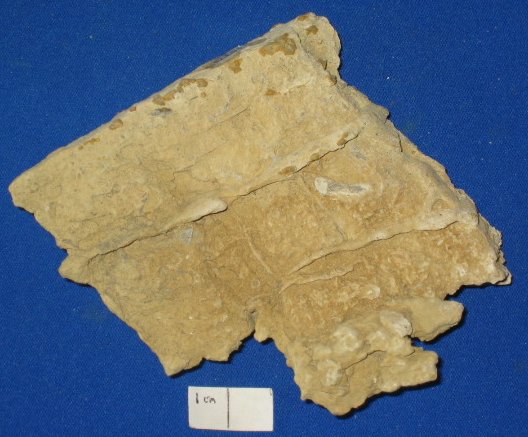
Evidence of a cataclysm is scant. It takes a trained eye to eke out details. I hope my eyes and my brain are sharp enough. With a fossil here, a smidgeon of bedrock there, the knob would be more obvious if it were unrooted and moved to Utah or New Mexico, where bare hills abound. But it’s my secret to reveal.
Following a meandering deer trail, I think back to a time when this hill was covered by virgin chestnut, maple, oak, and hickory. They bore girths I couldn’t begin to encircle, even with a rock hammer in each hand.
Surely the First People would have wondered about this round hill rising from a gently undulating landscape. Did they cross it, or find it easier to walk around? Perhaps they climbed the knoll to seek chert to knap into tools? Did they give it a name?
Questions I can’t answer continue to fill my head. Did elephantine mammoths and mastodons pass here tens of thousands of years ago? How much rock was eroded and carried away over the eons? Did this hill exist during the Age of Dinosaurs? Or is it recent? I have too many questions.
I clear my head, catch my breath, and sip from my water bottle. There’s a convenient tree stump to sit. From my chair, I distract myself from the past and listen to catalogue the sounds carried by the autumn breeze. A “chip, chip” comes from my left, a few hundred feet away, hidden in the forest underbrush. A chipmunk announces an intruder to its companions. It might be me.
Rustling overhead comes from a grandfather red oak. I gaze at a furry gray squirrel galivanting over a gnarled branch, gathering fresh acorns for winter. The chiseling of a pileated woodpecker comes from a deadfall not a hundred feet away. I smile at the antics of this crow-sized bird of red, black, and white, thankful that I don’t have to use my rock hammer to find a meal of grubs. The growling downshift of a big rig reminds me that I’m not alone in the wildness; the interstate highway is at the bottom of the hill.
I pull out my loupe to examine a fossil that I haven’t packed away. It’s a section of disks from the stalk of an ancient sea lily – an animal related to starfish. It was anchored to the seafloor as firmly as a stalk of golden corn in the field at the bottom of the hill. Perhaps it perished when Jeptha Knob was created, as surely as a stalk of corn survives a powerful tornado.
Any fossil preserved in Kentucky’s bedrock tells a story whispered to those who are willing to listen and interpret. I hear the quiet voice that survived weathering and erosion through time immemorial. This is Kentucky before it had a name; from an age so vast, millennia become microseconds on our galaxy’s pocket watch. Millions of years have no meaning to people when a century seems like an eternity.
It requires an “inner” eye or an active imagination. What do I see?
A vibrant cerulean ocean where the only movement is the clouds scudding across a crystalline sky and waves undulating, bringing oxygen to the creatures hidden below. Plankton follows the meandering currents, living and dying, unaware that they will become the power for modern society, petroleum. They will be transformed into ubiquitous plastic, forming pernicious new “plankton” that finds its way into all living things. Life begets life, death begets death.
Plunging into saltwater, I see corals, boulders cloaked with tiny tentacles, and live sea lilies – brittle stars riding strands of beads. Squids, in long cone-shaped shells, are fingering the seafloor for tasty snails and clams. Big roly-poly-like trilobites scuttle across the bottom, scooping up morsels in gray mud. Gardens of seaweed, waving back and forth with the currents, greet me as I float by. Okay. The sea is not familiar up close. It is a place of peace with the same solace I find whether snorkeling in Laurel Lake or the Florida Keys.
What about the sky? Darkness without city lights allows me to view so many stars that I get lost in the firmament. A crescent moon hovers near the horizon, larger than any I have ever seen. A crème color dances like sprites on the waves. I sing to myself, “I see a bad moon setting.”
An unfamiliar dappled glow spans the sky: a ring. Earth has a ring? It is pitiful compared to Saturn’s, and it’s not made of sparkling ice. Perhaps an asteroid has crumbled above, forming a coarse gray necklace overhead. It lies too close to exist for long. As if to emphasize its brief life, a blazing fireball shoots across the sky in yellow and red. It fizzles out before it can plummet into the sea. Earth’s gravity will pull down the bigger rocks, and they will make a big splash… or splat.
It’s D-Day. Or should I say J-Day, the day one of two natural forces creates Jeptha Knob. Will it be a volcanic eruption? I sit and wait on a blue and white surfboard in a wetsuit. I don’t have to worry about sharks nibbling on my fingers and toes. They don’t exist yet. A sea without fish. How weird is that?
A gorgeous sunrise greets me like an old friend. The rocks of doom above fade but don’t disappear. I paddle aimlessly, looking at the horizon, flat in every direction. Haze rises off the water. It’s a saline scent not found in any body of water in the Commonwealth.
If there are any islands, they must be scattered and low. The rocks should be barren. Plants will appear on land soon, in a million years or two. Perhaps there is some moss, liverworts, or a green goo encrusting rocks that will never be preserved; another secret lost to time.
High in the western sky is a flash. The sea brightens as a new sun, a ball of fire descends like Helios on a trail of yellow, green, and blue sparks. I hold out my hand, shielding my eyes as this “sun” dives into the expansive sea. A few seconds later, there’s a deafening rumble, before the sea erupts in an explosion putting Krakatoa to shame. Streaks of white shoot high into the stratosphere, followed by a roiling mushroom cloud of steam and dust. The first shockwave pushes mist from the wave crests at hypersonic speed. I sit, unaffected.
My gut tightens into a knot. The worst is yet to come. I stand up on the surfboard, ready as the calm sea laps around me. I watch the expanding cloud and the sea at the horizon. A line of haze thickens as the roar of the asteroid impact vibrates through my bones. A wall of water, a tsunami, rises. The churning sea climbs to touch the clouds.
I bend my knees and lean forward. I lift with the water and pick up speed. Within seconds, I’m surfing across Kentucky. Hanging ten hundreds of feet above, I view the sea spread out before me, a patchwork of blues in shades of aqua and turquoise. In minutes, I pass what will be Bardstown, Elizabethtown, and Leitchfield. It doesn’t matter which direction I choose; Kentucky is completely flat and covered by saltwater. The Appalachians don’t exist.
I feel water on my face and stick out my tongue. Do I detect a little salt?
Reality returns, and Jeptha Knob is once again under my feet. An autumn rain dampens my clothes but not my spirit. It won’t spoil my day, for I have surfed across Kentucky in time and space.
There were no igneous rocks beneath Jeptha Knob that I could take for granite. Not a trace was found as I gathered limestone and shale from one side of the hill to the other. I didn’t see a volcano erupt.
This rockhound gumshoe concludes, after much research, careful field studies, and reasoning with a vivid imagination, that the geologist who hypothesized the asteroid impact was correct.
It came from space.
A rockhound must snoop on. I’m comfortable concluding that I can check off this mystery in Kentucky’s history. But rest on my laurels? Never. I hear of another geological crime scene near Fort Knox. The evidence includes oil, gas, and geodes!
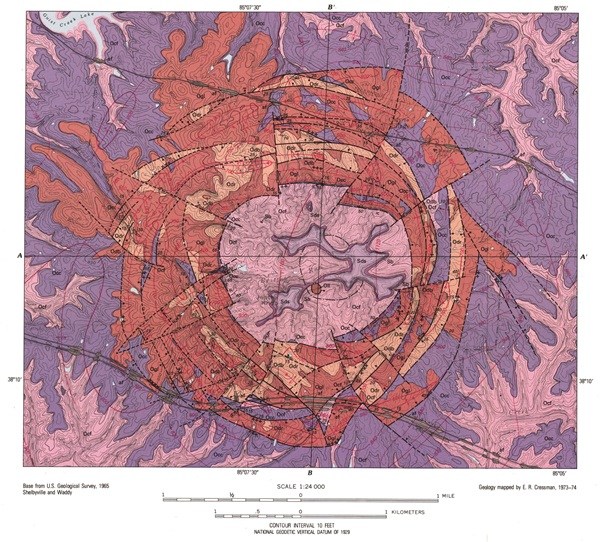
Map of Jeptha Knob, Shelby Co., Kentucky. The radial and radiating dashed likes represent faults. The double solid line at the bottom is Interstate 64, the single line toward the top is Highway US 60.