I revisited the Irvington Quarry in Breckenridge Co., KY for the first time in a decade. This time, I met with the quarry manager to tour with him, get some final details, and take pictures for the article I’m finishing for the Mineralogical Record magazine. I provided him with my knowledge from studying and collecting at the quarry since the late 1970s. A piece of trivia, my first date with Debbie included a visit to this quarry in early 1986!
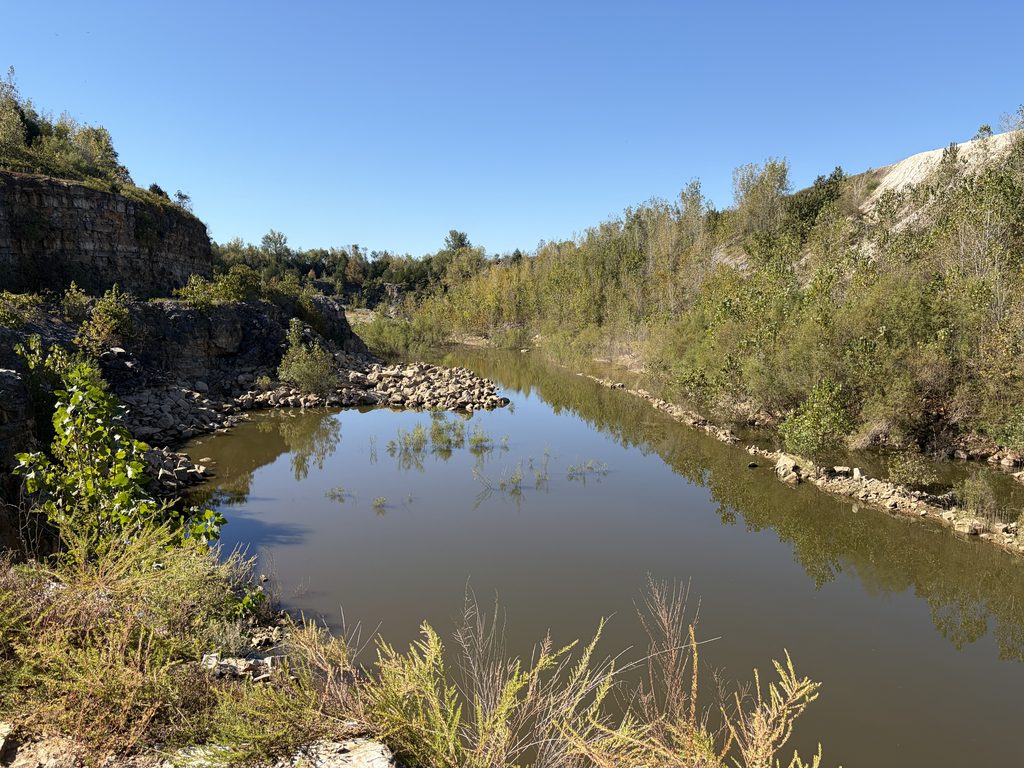
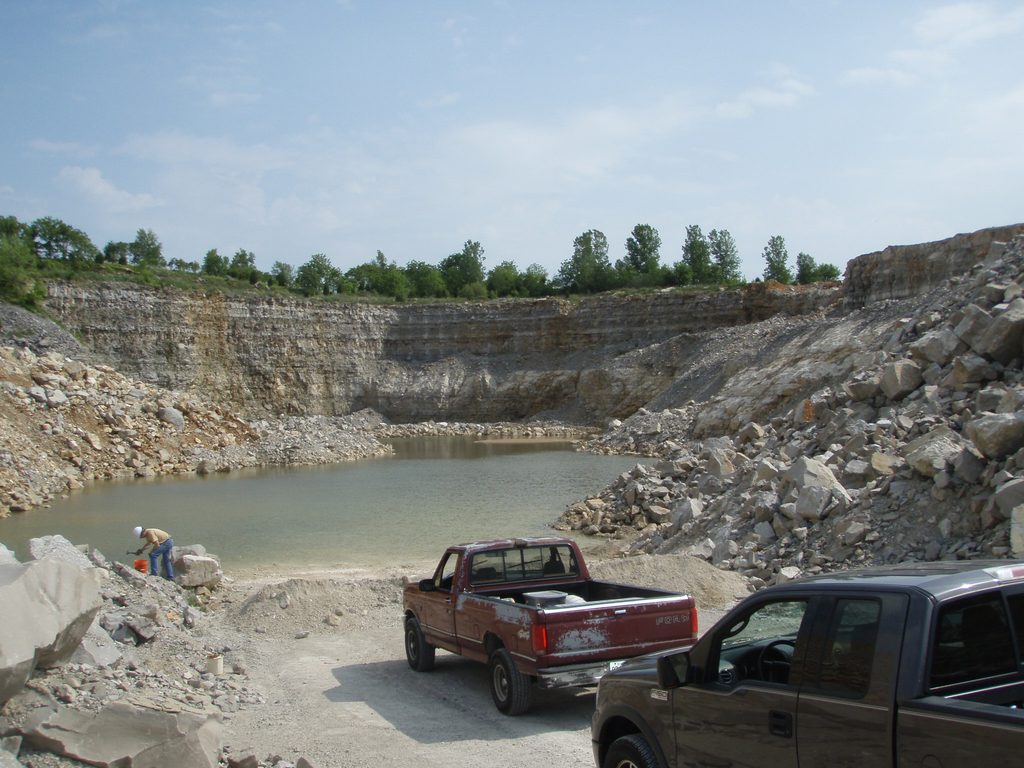
We started at the lower (north) pit. That’s where the Ste. Genevieve Limestone with the zone containing fluorite, calcite, and other minerals was located. When our club visited the quarry in 2014, they were nearing the end of mining there. In 2016, it was partially flooded. It was partially drained during my visit, but the pit resembled a cross between and pond, swamp, and forest. Collecting fluorite is nearly impossible because finding loose rock is very difficult with the obstacles.
View from the top of the ledge on the north side of the lower pit, facing south. And this is the pit mostly drained!
View facing north, the location where the above photo was taken is near the sunlit rock left of the foreground cottonwood tree.
Same general area as above in 2010 on a club field trip.
Photograph of the lower pit in 2003.
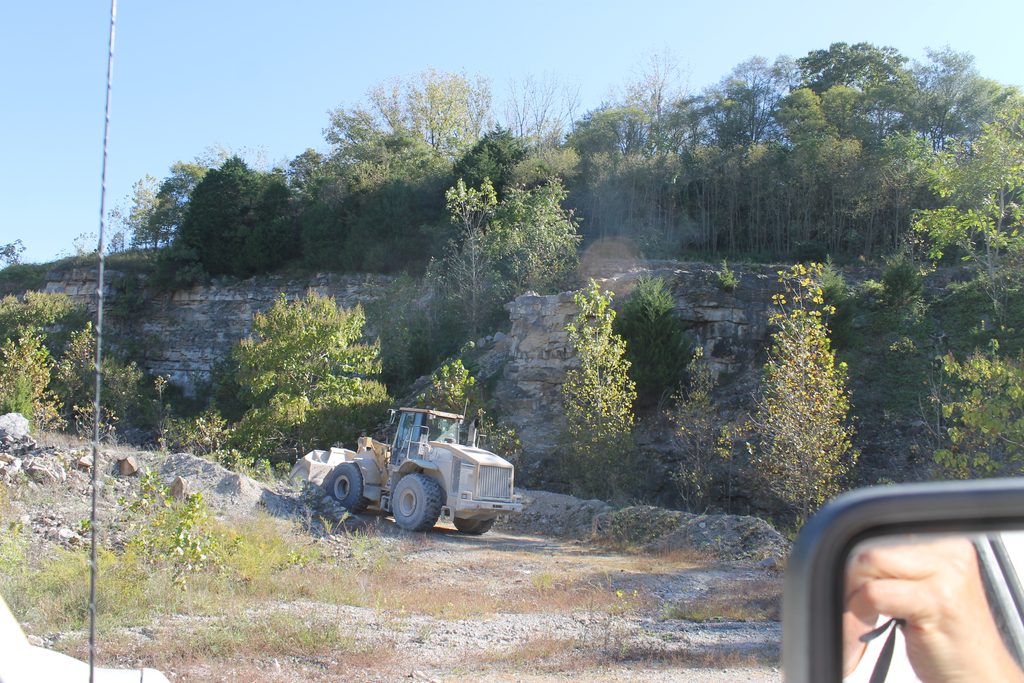
The manager had a frontend loader remove a barrier of gravel so we could drive to the north end on the bench. He wanted to show me a cave speleothem in the high wall.
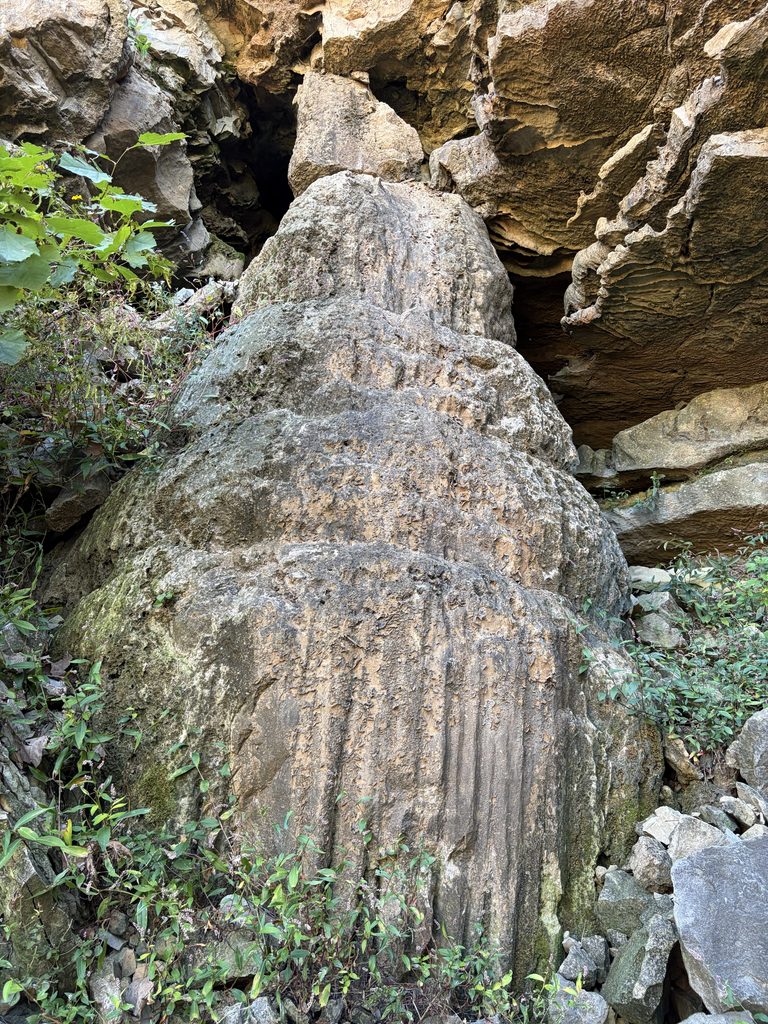
A weathered stalagmite (15 to 20 feet tall) and other speleothems to the right, on the east high wall. It used to look good when it was first exposed. Note the small drapery and flowstone to its right.
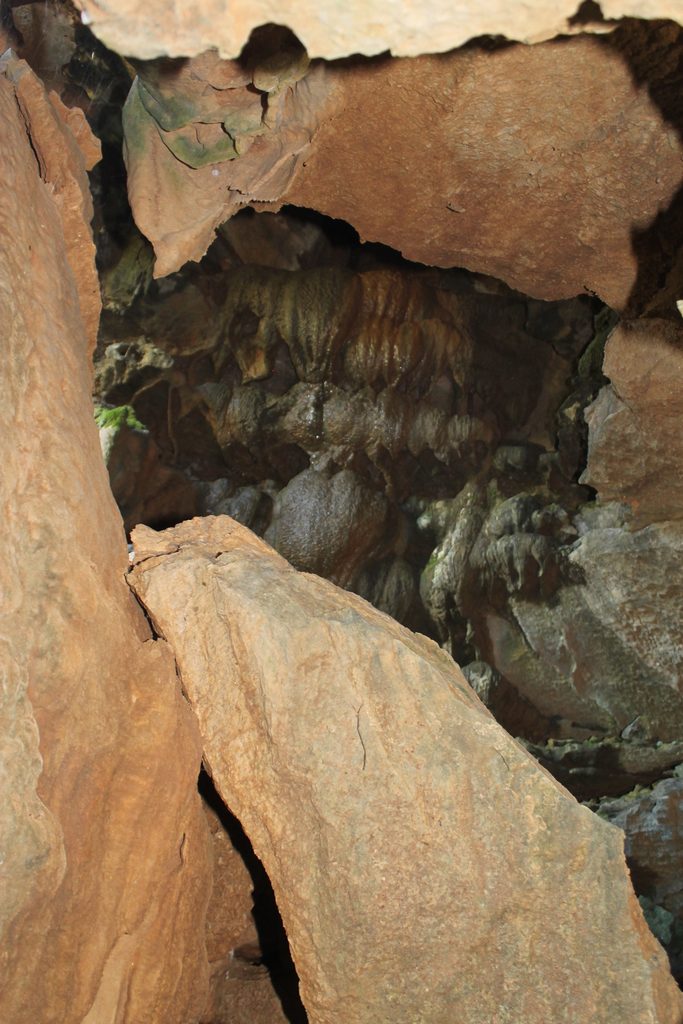
Other speleothems behind the stalagmite. This was likely a dome feature within the cave. Water flows out from small openings from a sinkhole about 500-feet distant.
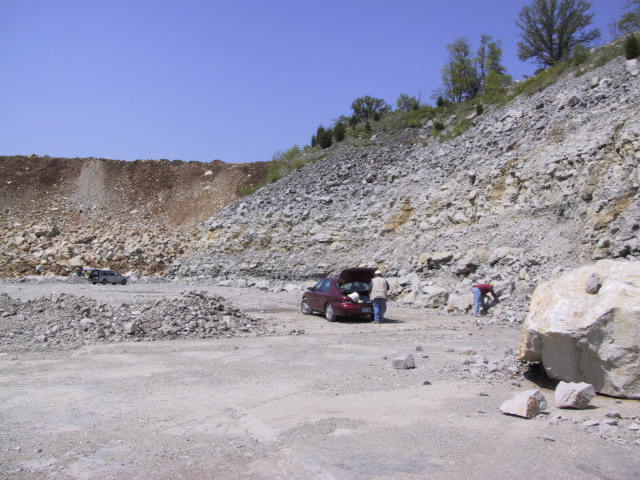
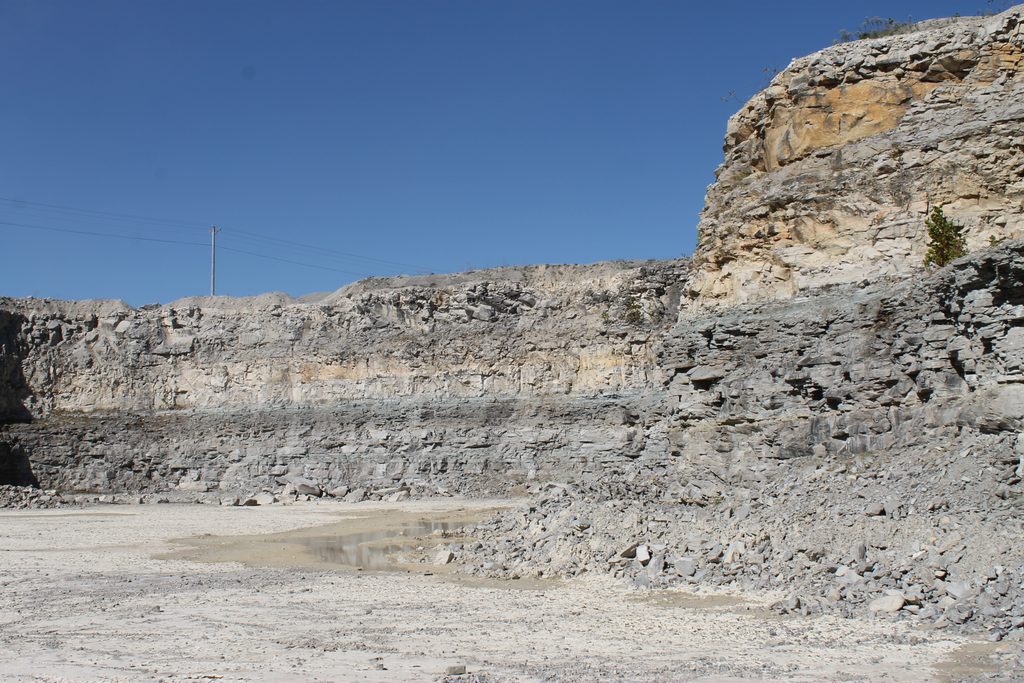
After exploring the north pit, we went to the active quarry, it is significantly larger. Pit is fifty to seventy feet deep, depending on the location and the topography of the quarry rim. It is all Ste. Genevieve Limestone, though there is a thin greenish shale layer that has been correlated to the Rosiclare Sandstone in the fluorspar district of southern Illinois. For mineral collectors, this quarry is a disappointment. Even the lowest level is above the fluorite zone in the north pit. (The property is basically a hill sloping north and the main pit is the top.)
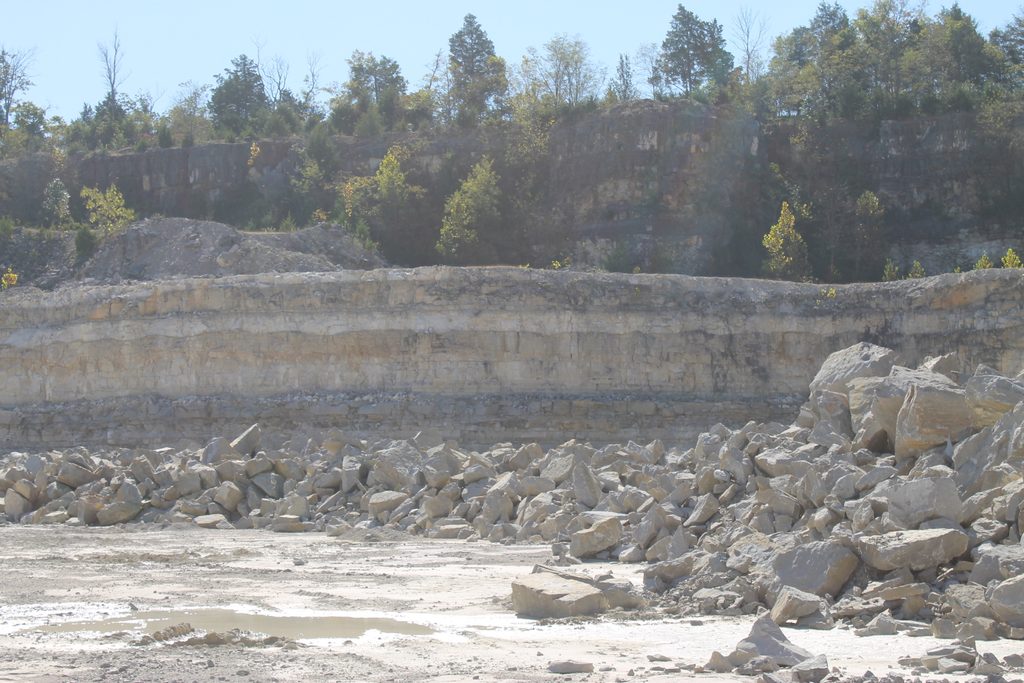
Limestone, limestone everywhere – and crystals are hard to find! The white rock is called oolitic limestone, about 95% calcium carbonate. Great for power plant scrubbers… Between the white and dark gray limestone is a thin shale equivalent to the Rosiclare Sandstone one hundred or so miles west.
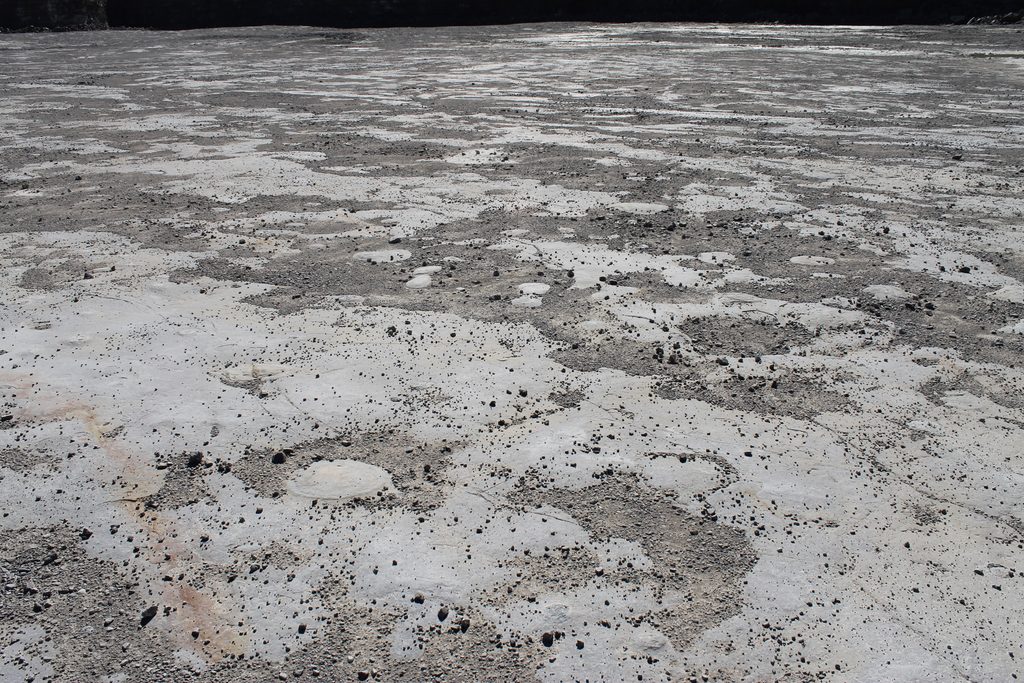
For flint knappers and landscapers, the quarry contains abundant chert/flint nodules, some the size of grapefruit and cantaloupe. When they blast, the nodules fly loose like cannonballs!
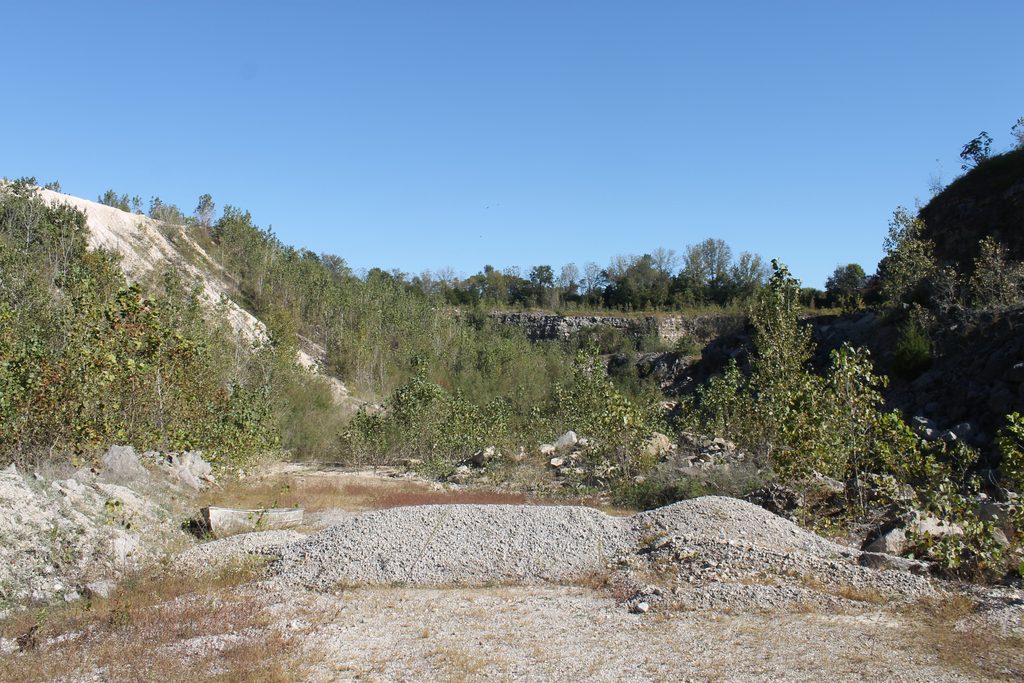
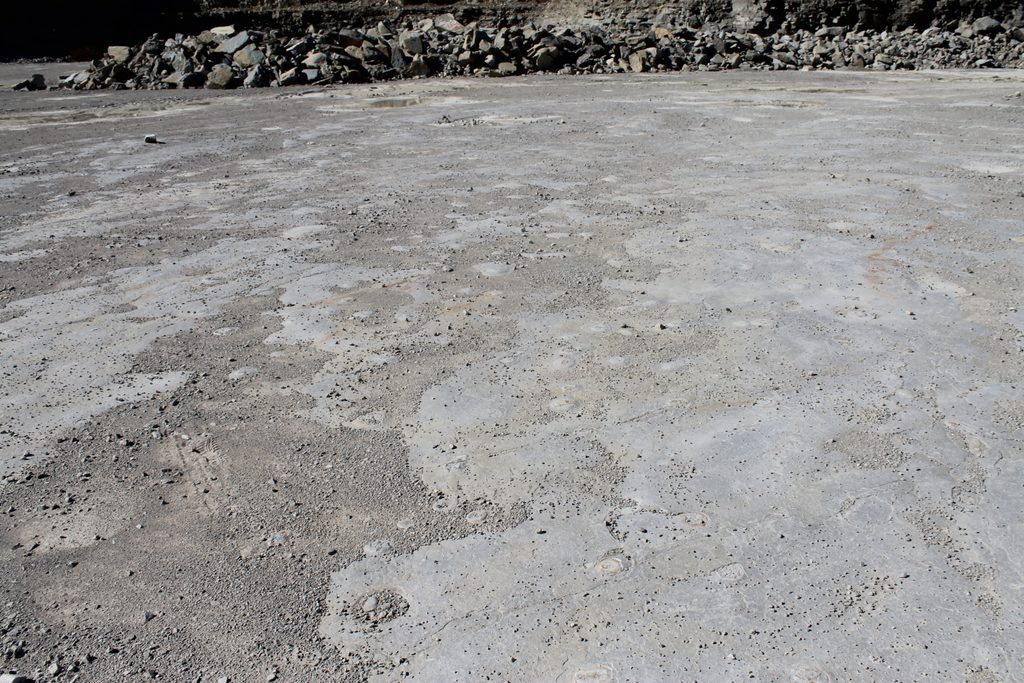
Look closely and you’ll see a lot of round places on the quarry floor. Those are flint nodules.
More flint nodules on the quarry floor.
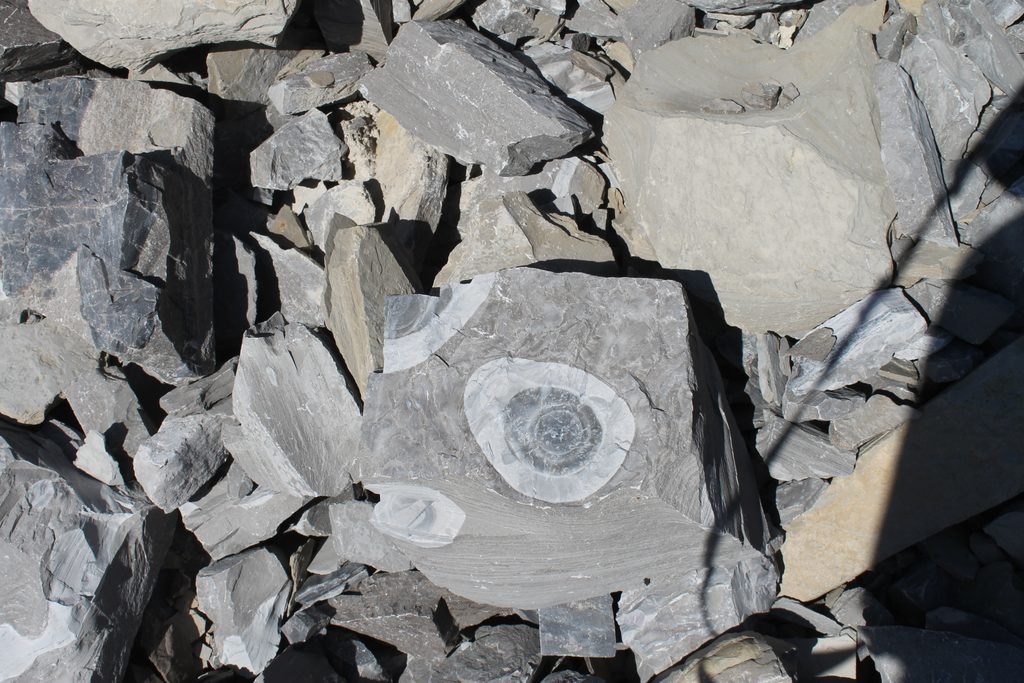
Small boulder with bull’s-eye flint nodules. This beauty now graces my landscaping. These are abundant in the quarry, through some are in rather large rocks!
Look closely at the cliff face where the brown and white layers meet. Do you see the mega ripples? These were large scale ripples on the sea floor. We saw these at our crinoid quarry in Elizabethtown in a different formation.
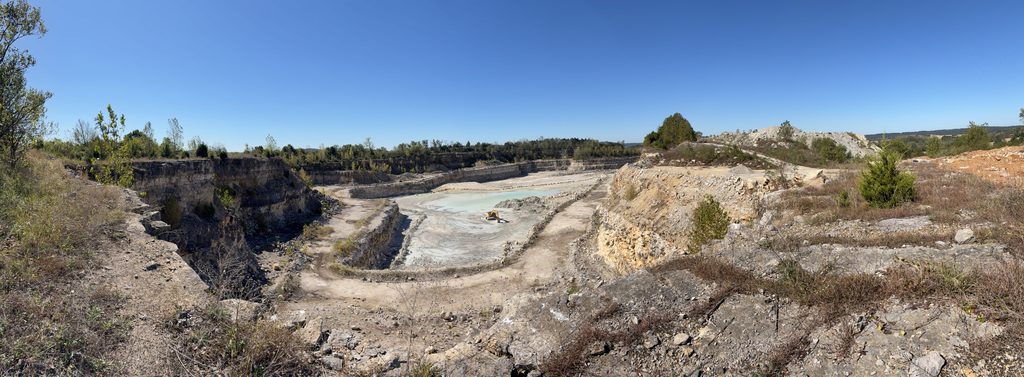
Panoramic photo of the main quarry from the northeast corner. The track hoe is removing a shale bed from the quarry floor.
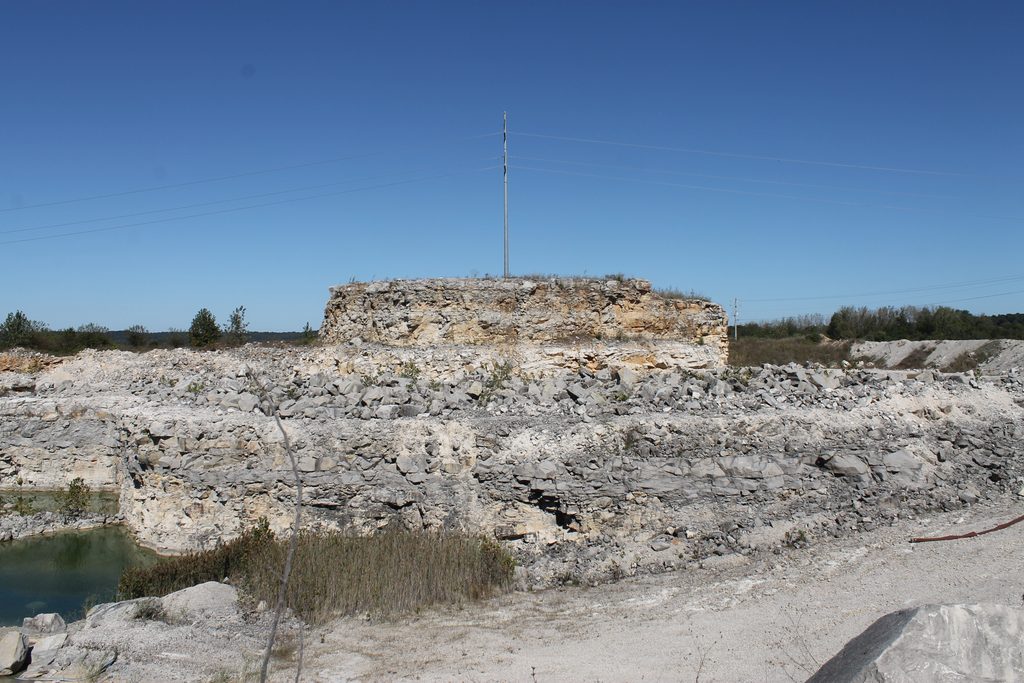
An “island” surrounding a powerline pole. There is ground access behind it, but most inspections are carried out by helicopter.
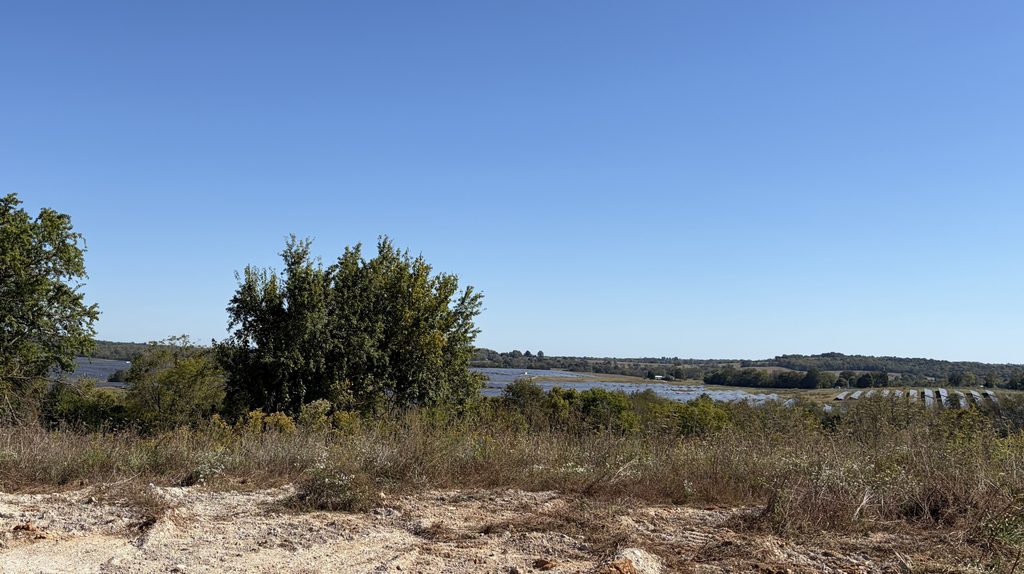
Solar farm next to the quarry – when I first saw it, I thought it was a lake! The red clay here has chert with drusy quartz. Unimpressive as minerals go, but they sparkle in sunlight!
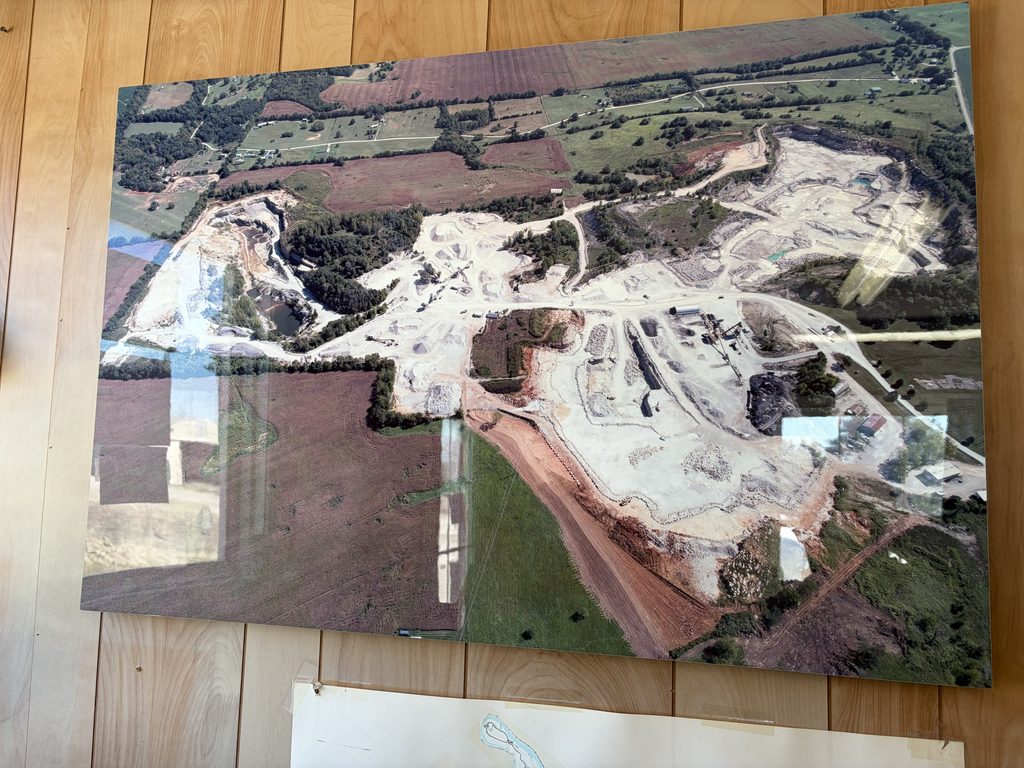
Aerial photo of the Irvington Quarry in the scale house. The north pit is to the left, the active quarry is on the upper right.
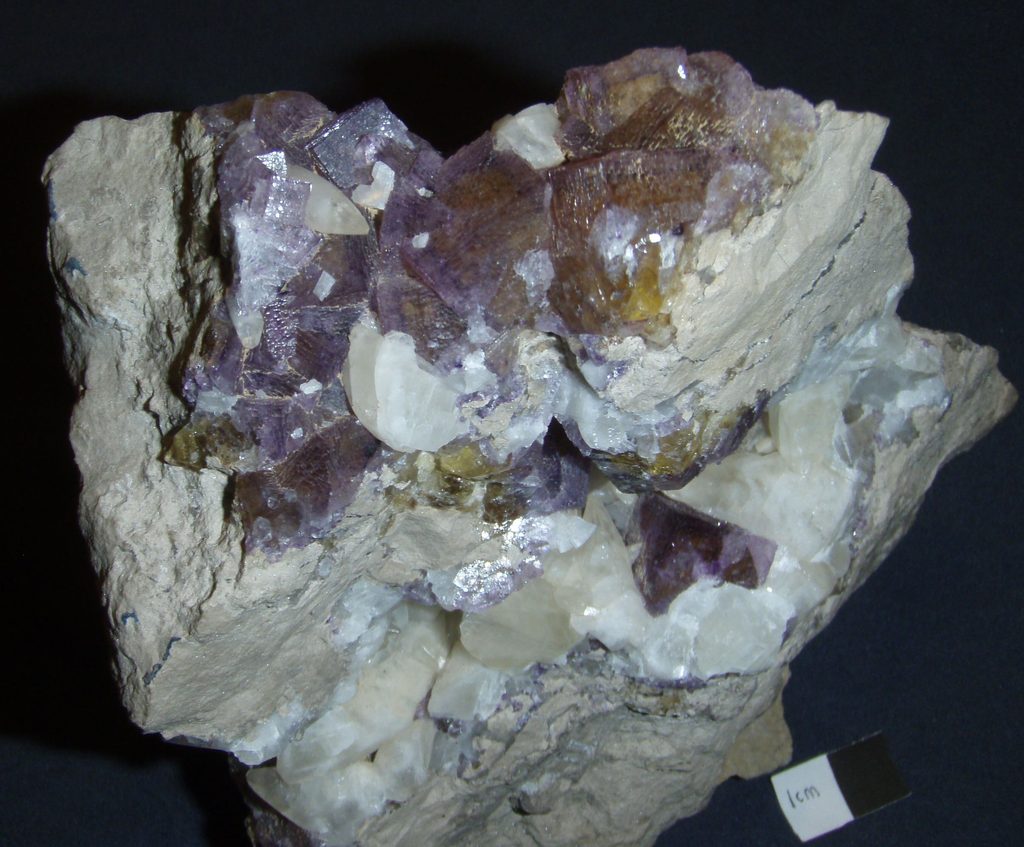
An example of fluorite and calcite from the lower pit, collected in 1988.
Jim Lobb and I drove to northeastern New Jersey to attend the annual Franklin-Ogdensburg Mineral Society show, visit the Franklin Mineral Museum and the Sterling Hill Mine & Museum. This is the first time I’ve traveled to New Jersey as a destination, rather than through it on my way elsewhere.
Jim’s mission was to increase his knowledge of Franklin-Sterling Hill (FSH) minerals, both for personal benefit and to help me with the FSH collection at the Ben E. Clement Mineral Museum. There was a special collection for sale on the morning we arrived. He joined about two dozen other collectors looking to upgrade their collections.
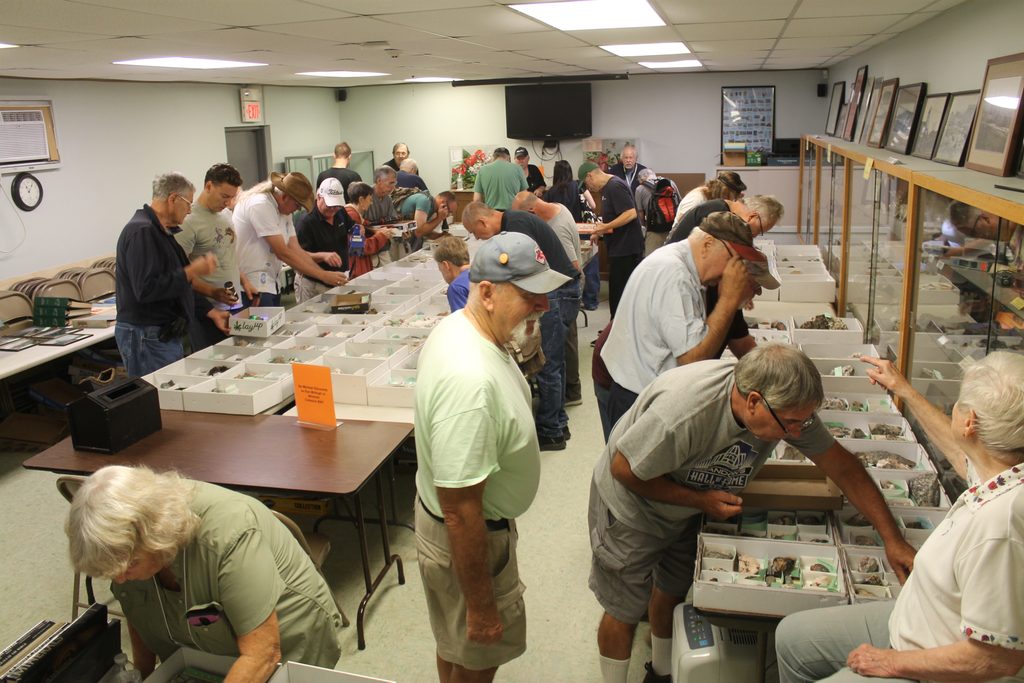
The Don McHugh collection sale attracted a lot of interest. This is the museum’s classroom.
My goal was purely educational: To compare the two museums with other mineral museums I have visited and look for connections and partnership possibilities with the Clement Museum in Marion, Kentucky, where I volunteer. The Franklin Museum is closer to the Clement Museum in size and scope.
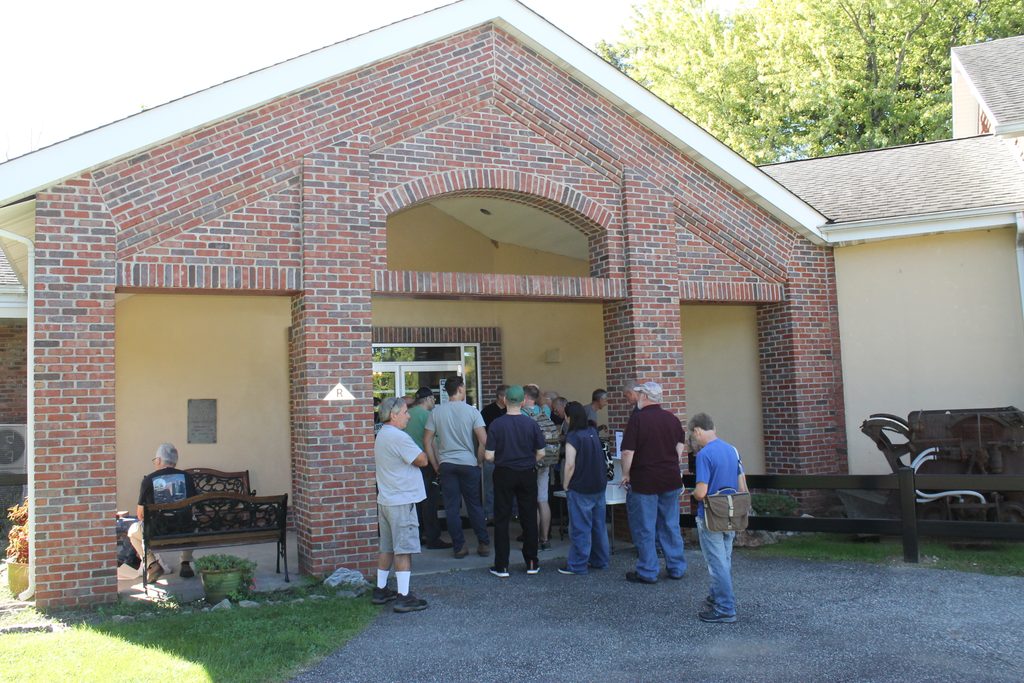
The entrance to the Franklin Mineral Museum.
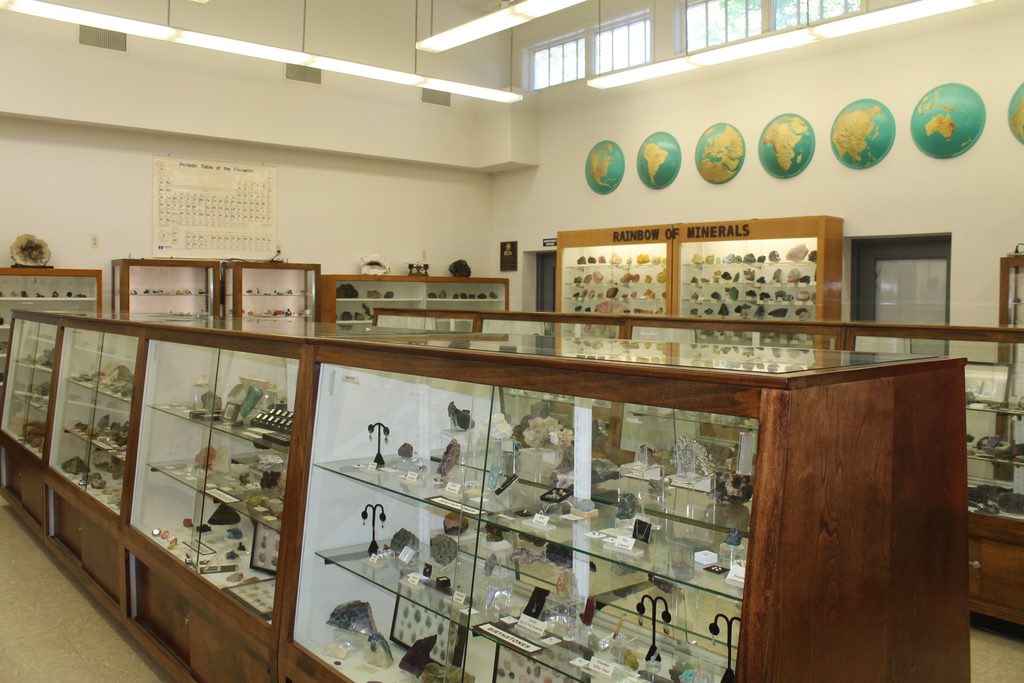
The Franklin Mineral Museum has nice displays in several rooms. One is dedicated to FSH minerals, others include a fluorescent display, minerals of the world, and fossils of the world. For school groups, this allows students to scatter. Children get a scavenger hunt pamphlet that covers the objects in every room. (Except the bathroom!)
Minerals of the World exhibit room
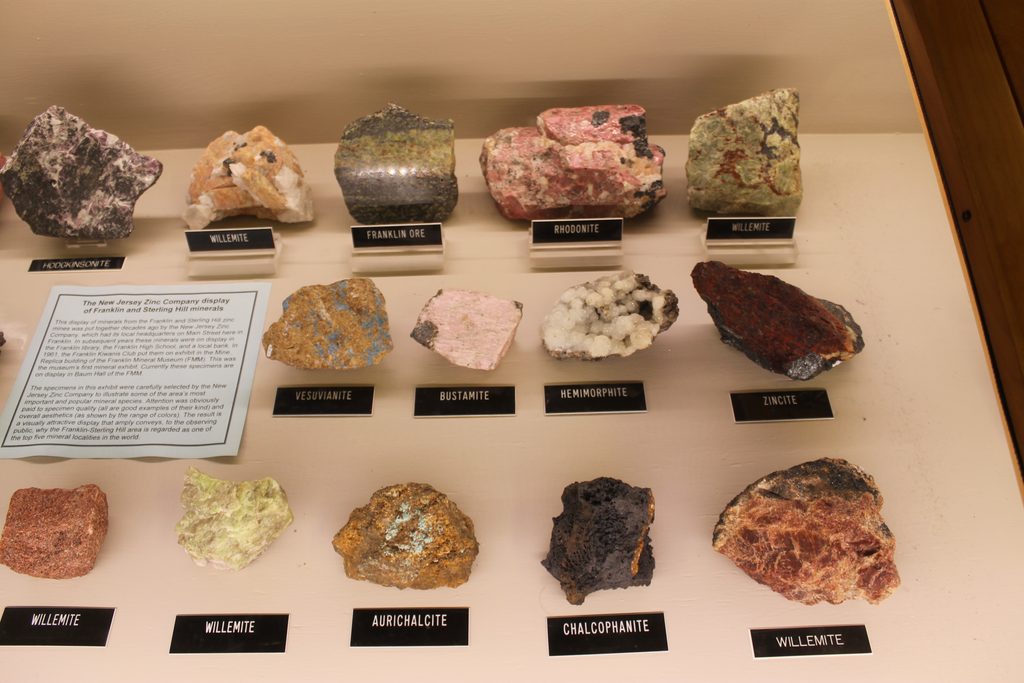
Part of a display of minerals from the local zinc mines.
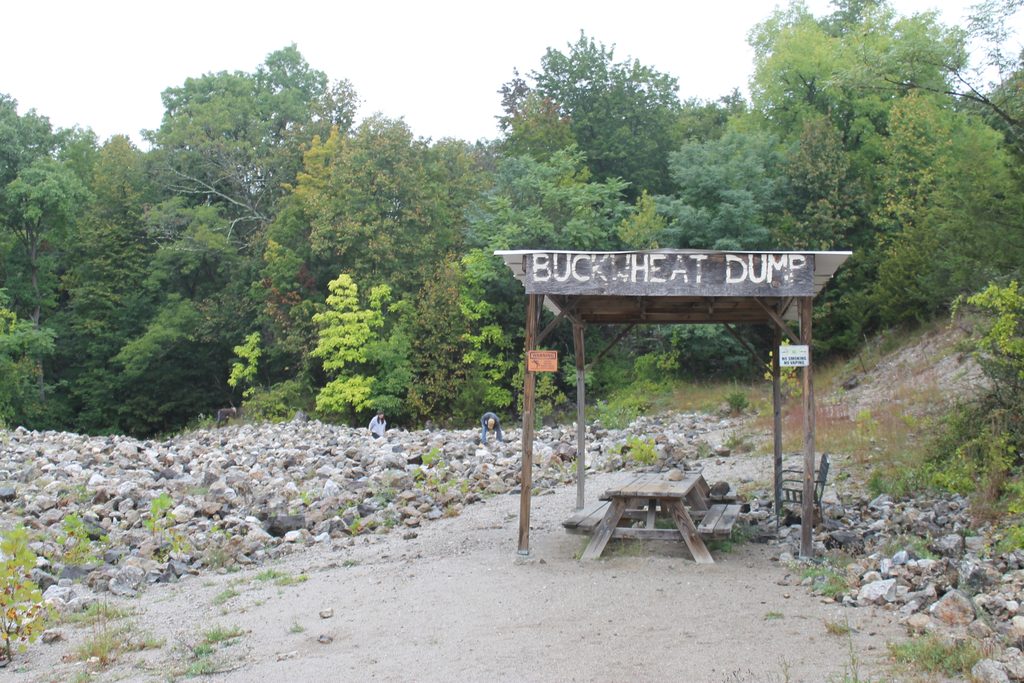
The Buckwheat mine dump is open to collecting, for a fee. They have a “dark shed” to look at rocks collected with a UV light. They offer occasional night digs, where collectors bring shortwave lights to find goodies.
The Buckwheat mine dump with several collectors. This is a partial view of the collecting area.
The Sterling Hill Mine operated continuously from 1854 to 1986, and was one of the largest zinc mines in the world. When it closed, sizeable ore reserves remained, but local taxes made it unprofitable for the company. Ore was mined as deep as 2,800-feet below the surface.
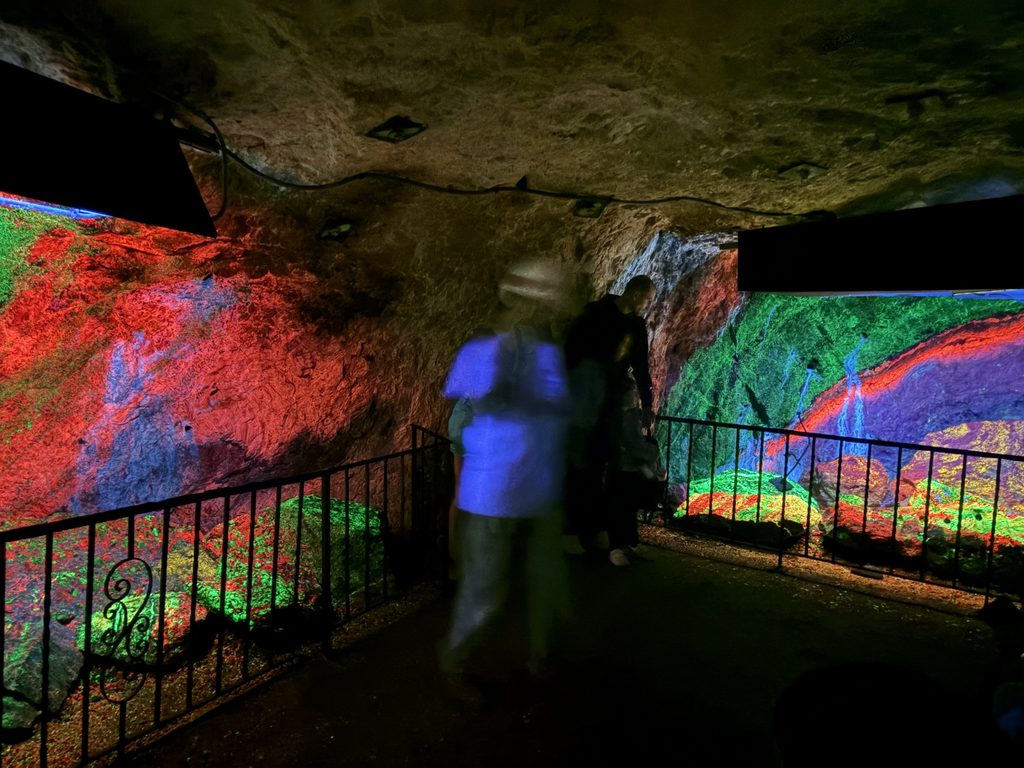
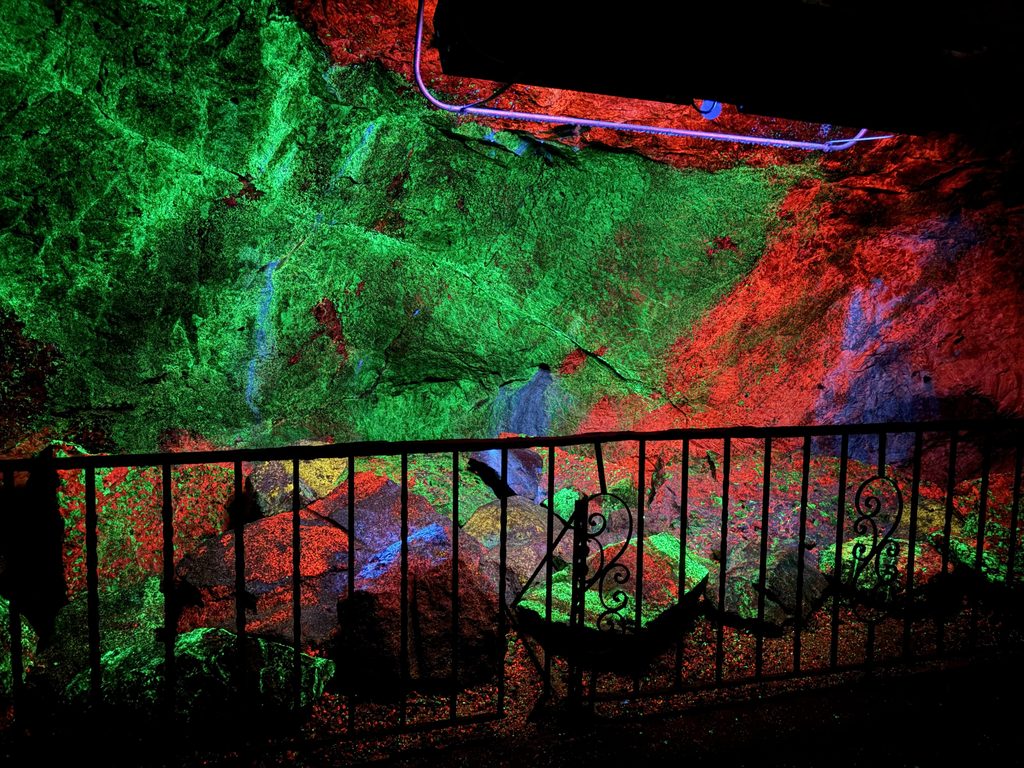
Underground tours are offered; it’s all walking, no hopping into mine cars! Most famous is the Rainbow Room, where shortwave UV lights provide a light show.
Rainbow Room in the Sterling Hill Mine.
Rainbow Room in the Sterling Hill Mine in shortwave UV. Green is willemite (zinc ore), red is calcite.
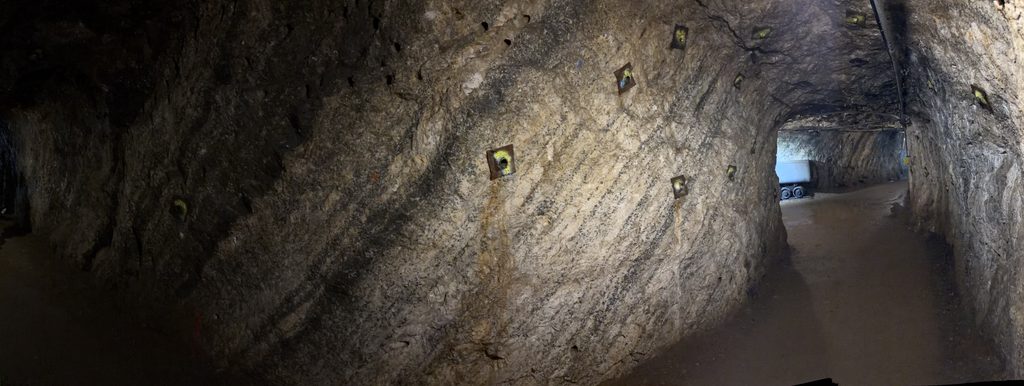
Panorama of Sterling Hill Mine under “normal” light – not colorful at all!
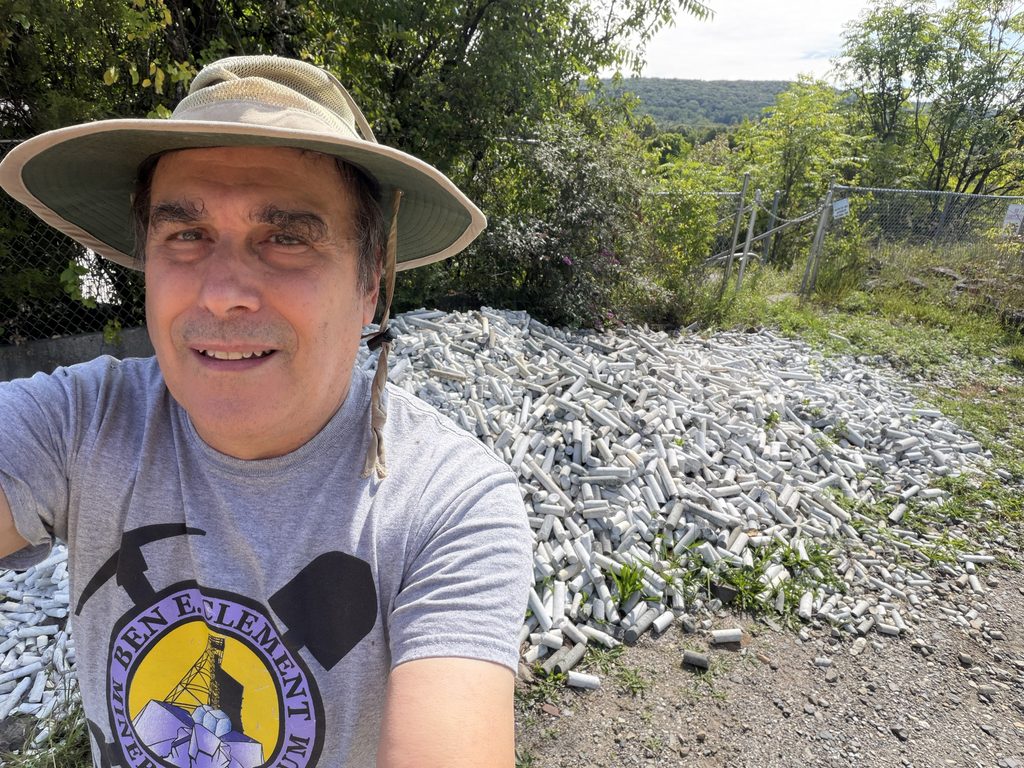
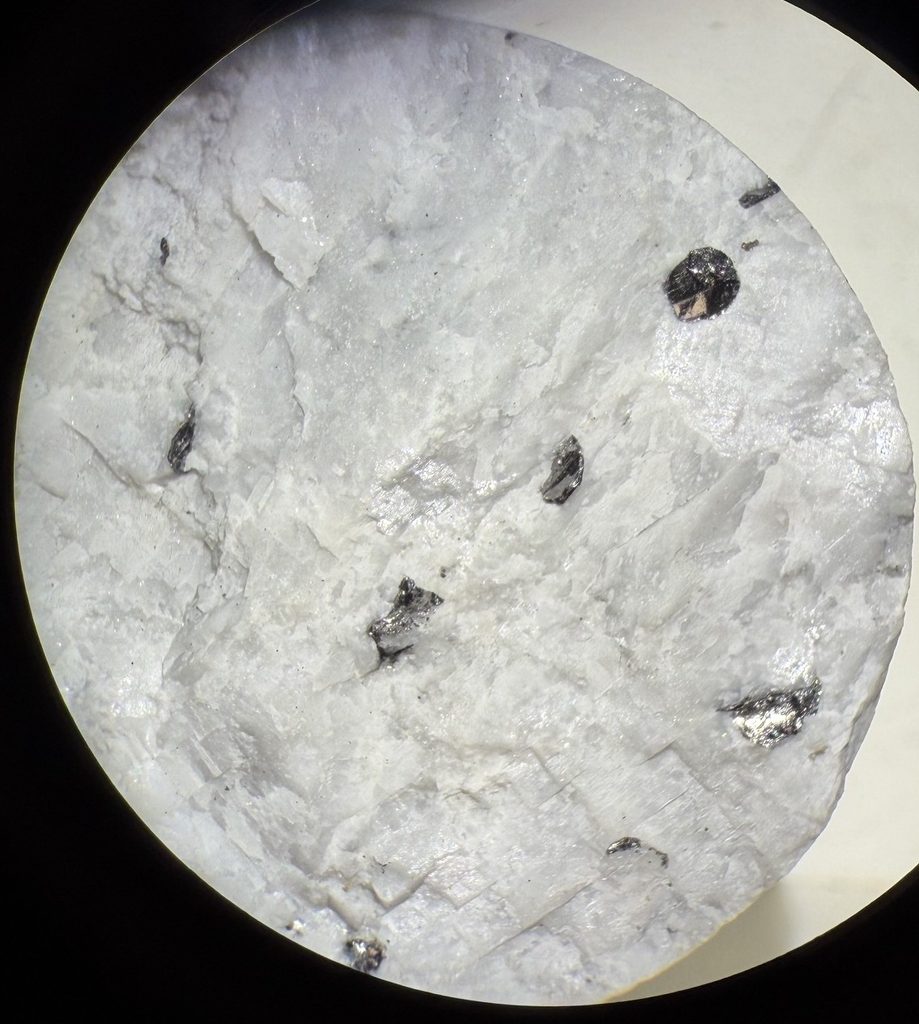
The collecting piles at the Sterling Hill Mine are much smaller, but according to Jim, contain more types of minerals than the Buckwheat dump. They dropped a load of drill cores (which I collect) and I had fun examining them. Mostly white Franklin Marble with small graphite crystals inside.
I’m standing next to the core dump, dominated by cores of the Franklin Marble. I collected one that was drilled from 2,600-feet underground.
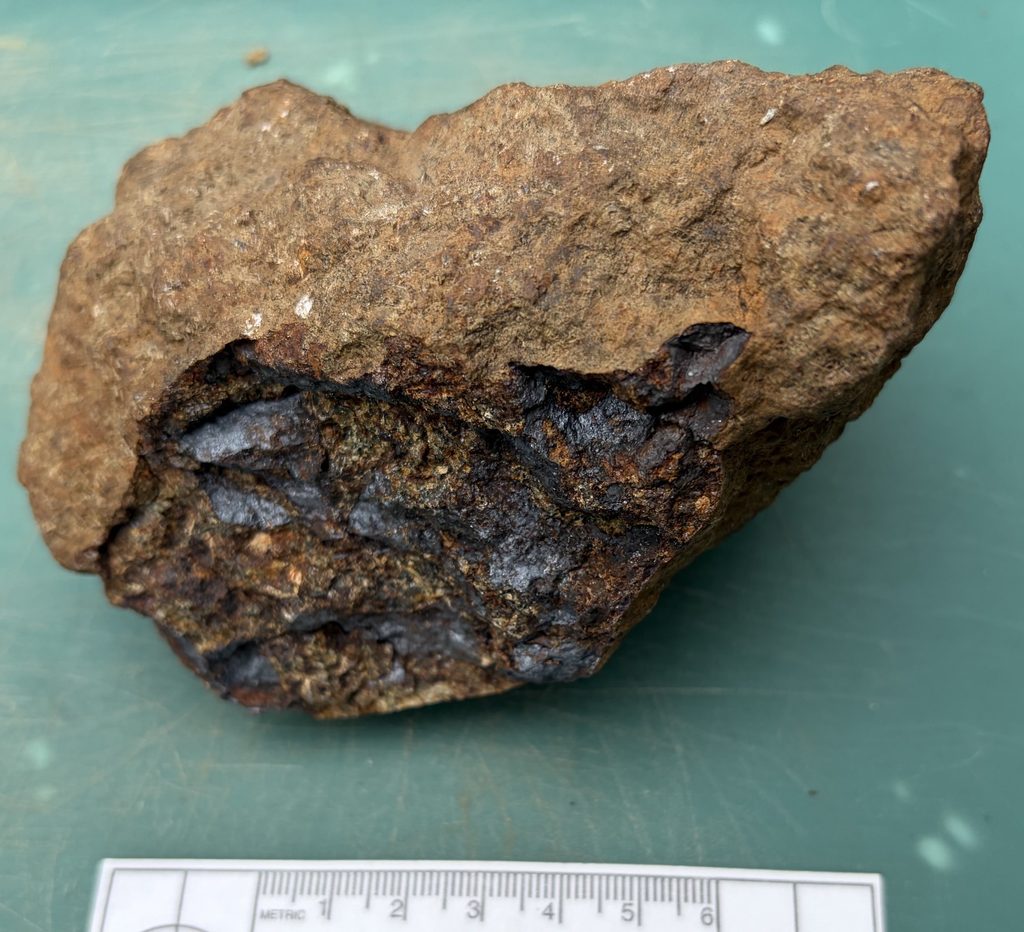
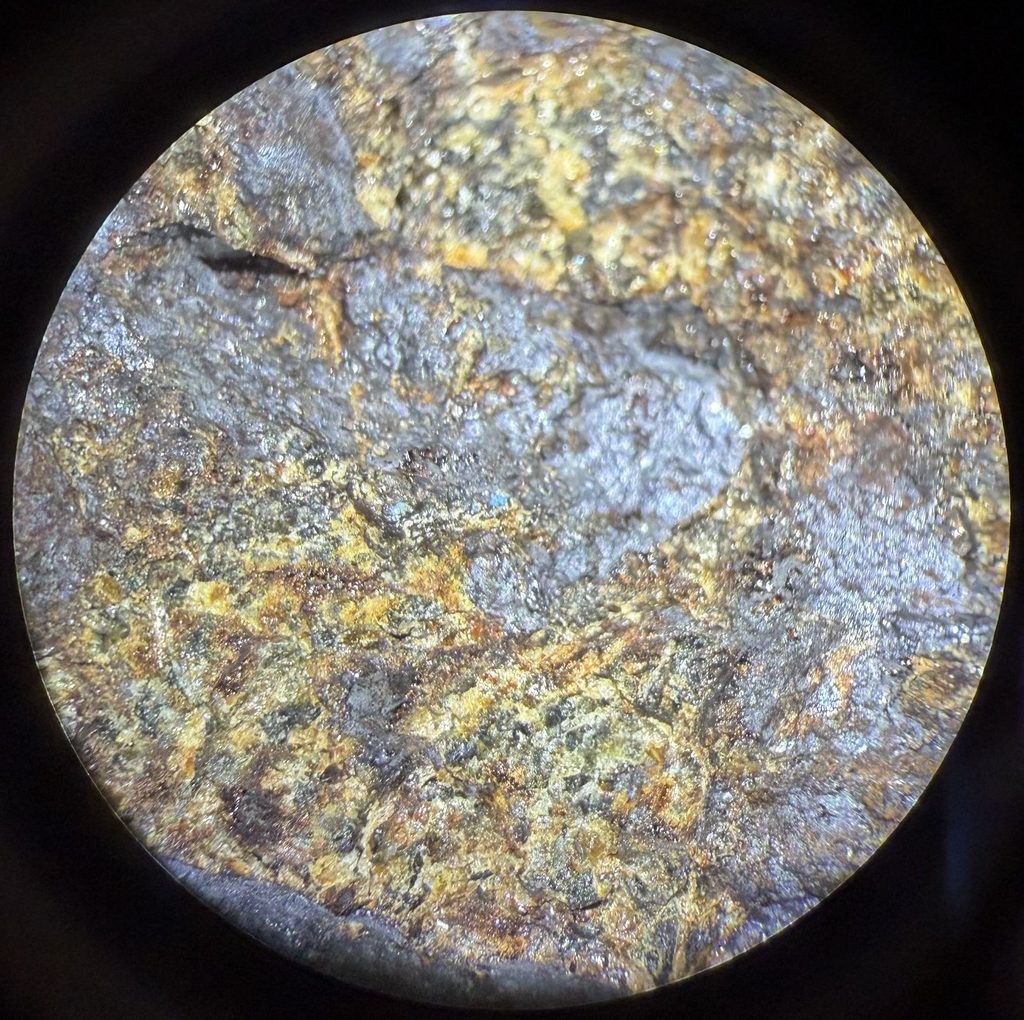
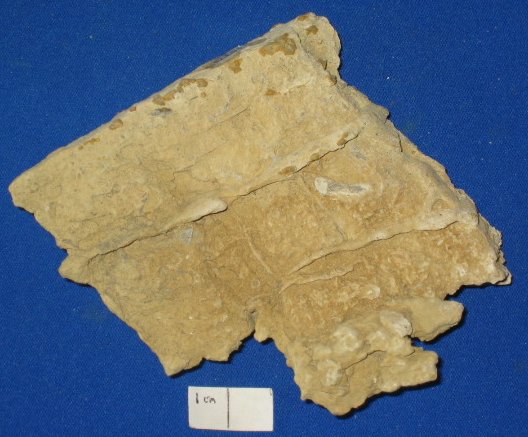
I found a brown lump that was much less dense than the others on the collecting piles. I broke it with a hammer and found a bluish and yellow interior. Weird. I showed it to Earl Verbeek, curator of the Franklin Mineral Museum. It stumped him! I spent the evening studying it will a 10x loupe, UV lamp, and Jim’s fluorescent mineral book. The yellow crystalline mineral fluoresced a weak magenta. The only mineral that matches is meionite, a scapolite mineral. The bluish mineral looks closer to black with magnification and looks like chalcophanite I’ve got from the Ojuela and Gold Hill mines.
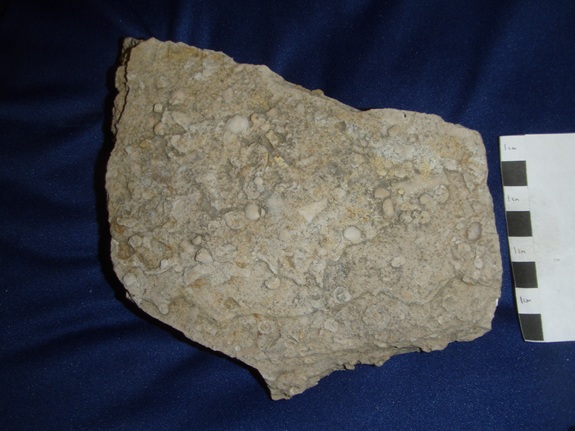
Mystery rock from the Sterling Hill mine collecting pile. My guess: bluish-black is chalcophanite and the yellow is meionite (because it fluoresces magenta). Stay tuned!
Mystery rock from the Sterling Hill mine collecting pile through a microscope. The small blue mineral in the center is another mystery. FOV is ~2 cm
Graphite crystals in white marble in a diamond drill core. Coring is done to determine whether mining should continue and in which direction. FOV = 3.5 cm
All in all, the trip was very interesting. My interest in fluorescent minerals is a small part of my general interest in geology and minerals. In other words, I don’t collect minerals for their fluoresces. I prefer “white light” specimens. Consequently, except for some cores and the mystery rock, I brought home very little. For anyone who likes fluorescent minerals, the Franklin-Sterling Hill mines are hallowed ground.
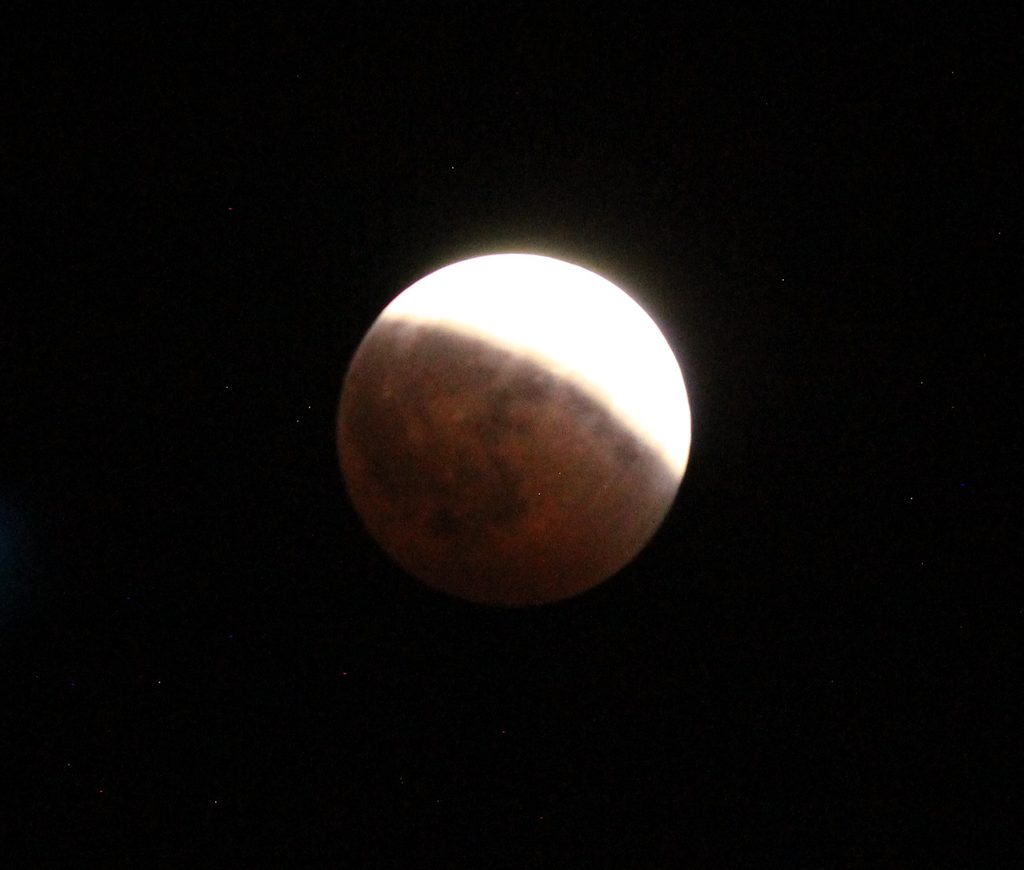
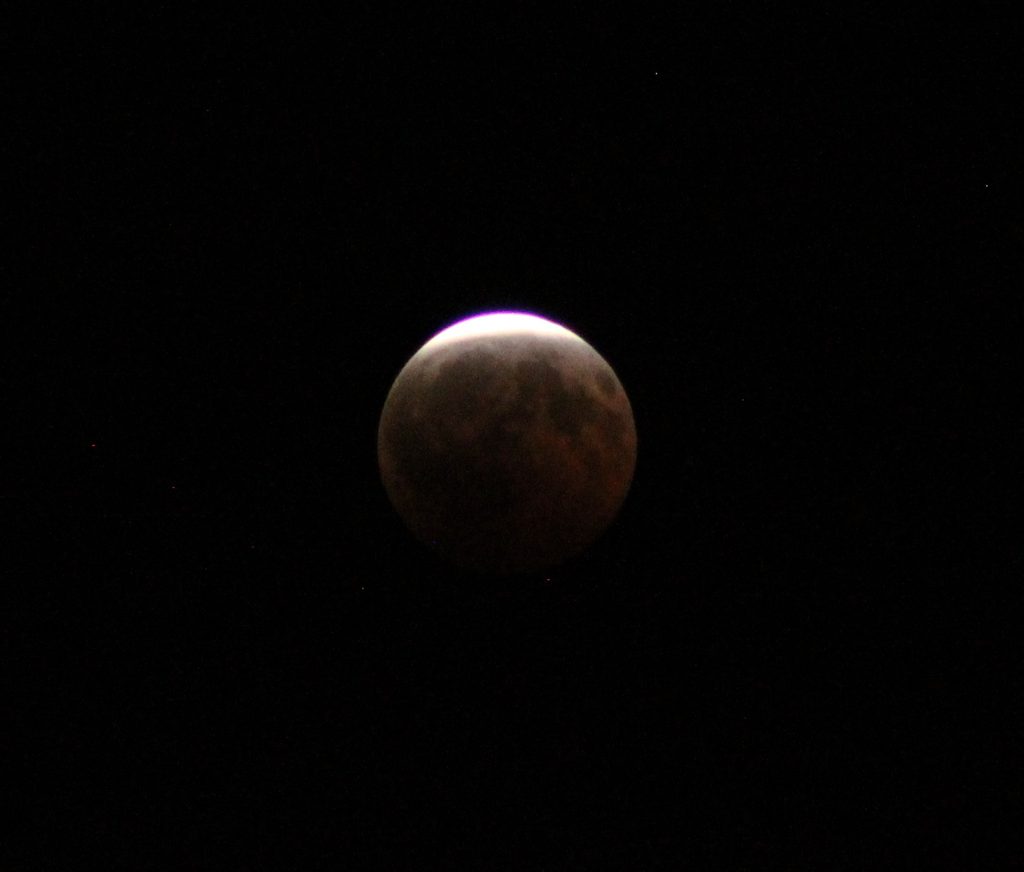
August 27, 2026 marked the best lunar eclipse in several years. Those in 2027 will not be as good. I joined my stargazing friends Mike Lynch and Will Olliges along Whittington Parkway on the old University of Louisville Shelby Campus. The good thing about lunar eclipses, light pollution isn’t a big issue.
Mike and I took pictures as the eclipse proceeded while Will gazed naked eye and with binoculars. I used two different 300 mm lens, one was Emily’s and the other mine. I quit when the lens began to fog up – after maximum eclipse.
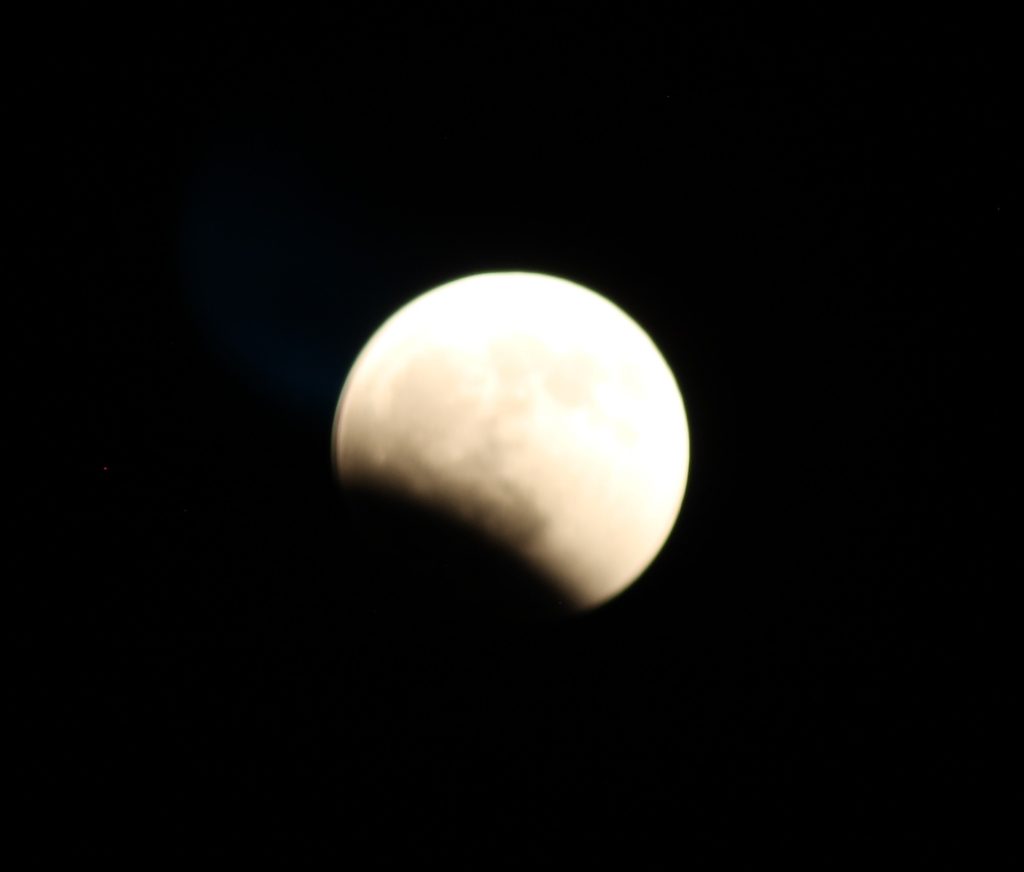
Using Mike’s binocs, when the moon was about 50% covered, my brain played a trick on my making the moon appear spherical rather than disk shape. (The moon is too far away to look spherical with our binocular vision.) I believe the effect was due to the brightness on the top, the hazy shadow of Earth’s atmosphere in the lunar surface coupled with the darkness and reddish sliver on the southern edge of the moon.
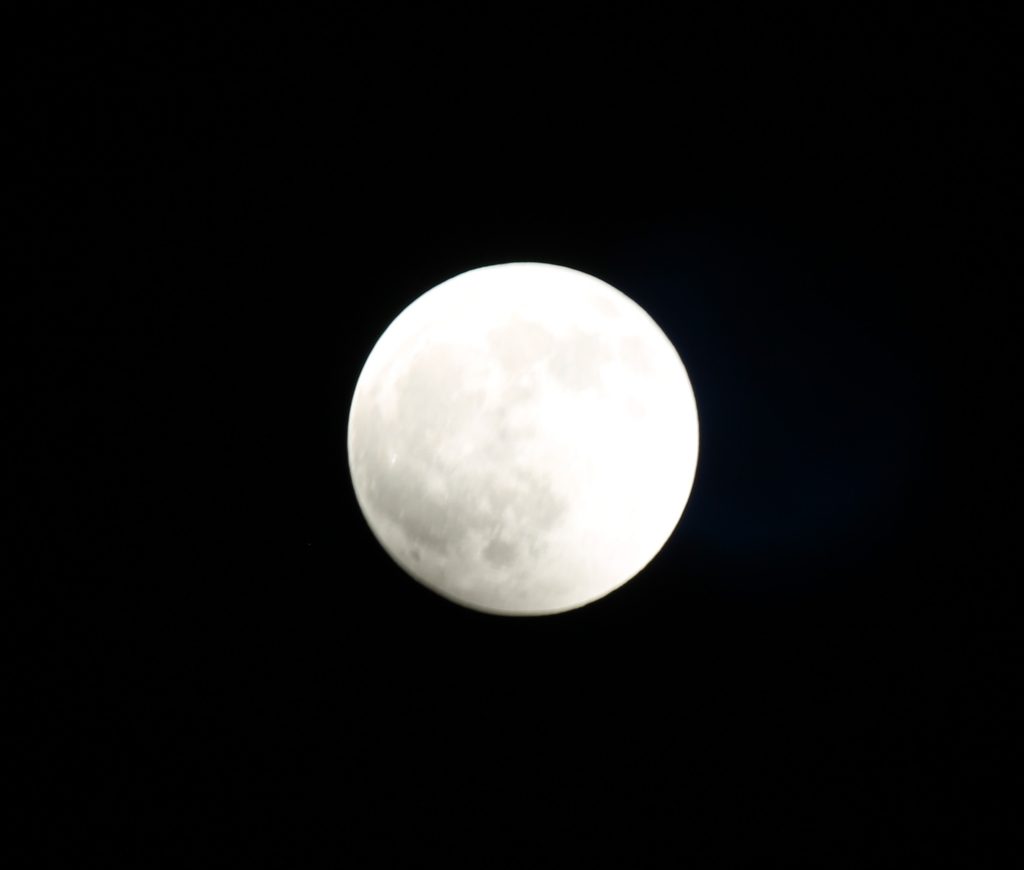
Here are a few of my photographs from about 10:30 to a bit after midnight.
Beginning of the lunar eclipse – about 10:34.
The moon is about 25% covered. Not the fuzzy border from the shadow of Earth’s atmosphere.
This was the eclipse when the moon looked spherical. The subtle shades are not possible with a camera.
About maximum eclipse – 96% covered at 12:13 AM.Edit
If you are going to visit a quarry to collect fossils or minerals, it helps to have a checklist of what to bring. Quarry access is considerably more restrictive today than it was 30 or 40 years ago, but it is ultimately up to the quarry owner. Collecting is not dangerous when you follow safety guidelines and use the correct tools for the right rock.
Before we begin – The quickest way for a person or club to be banned from a quarry is to leave tools behind. They can damage rock-crushing equipment, causing thousands of dollars in damage. Make your tools easy to spot from a distance!
There is an art to successfully removing minerals and fossils from a large rock. Patience is the most important part. Learn from experienced collectors. Expect the rock to break wrong most of the time.
This is not an end-all of collecting tools, but these are the essentials when in a quarry. Let’s review what you need to bring:
Permission – mandatory. Don’t go into a quarry without permission. Even inactive and closed quarries have an owner. Trespassing reduces the opportunity that permission might be granted to an insured organization. Sign visitor log-in books as required.
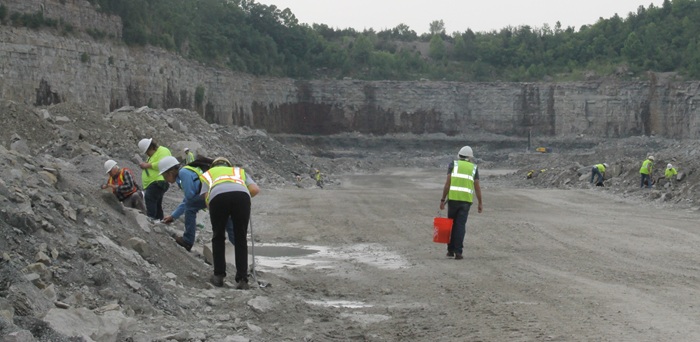
Hard hat – mandatory in active quarries. Get an adjustable helmet to fit snugly. You don’t want it to slide over your face when you look down or fall to the ground when you look up! A chinstrap is often helpful, but not essential. Hard hats are designed to absorb the impact if a small rock falls from a height and lands on your head. Not a boulder, mind you, just a small rock. You shouldn’t be collecting immediately below a highwall (cliff face), anyway.
Heavy boots – steel-toed boots are best to protect your feet from being crushed by a shifting rock, a dropped chisel, etc. You want a good tread for traction in mud, dust, or smooth rock surfaces. Avoid shoes with exposed toes, sides, or heels at all costs!
Gloves – heavy-duty gloves work well when you are turning over or scrambling on rocks. They can shift, pinching or crushing your fingers. The main purpose is to reduce the risk of cutting your hand on edges of rocks or when using a hammer and chisel. It also reduces blistering if you swing a hammer a lot.
Sturdy clothes – Jeans or other heavy-duty clothes are recommended. Avoid wearing loose-fitting clothes or clothes that can be snagged. Never go into a quarry with short pants – even in the summer. Long-sleeve shirts are a good idea as well. The less skin exposed, the better.
Fluorescent vests/shirts – required in active quarries. They provide visibility. You need to be seen. Those with pockets are handy. Yellow and orange are the most common fluorescent colors, but pink and light green may be used.
Eye/ear protection – if you are going to be breaking rock, these are mandatory. No specimen is worth losing your eyesight over! Full coverage is best, but when you sweat, your eyes will sting! Another option is a screen facial cover, as you see for chainsaw users. Rocks can fly in odd directions, and ricocheting is to be expected. Ear plugs are a good idea if you will be hammering or around others, or around noisy equipment, such as rock-crushing plants. Some quarries have banned the use of hammers, which makes collecting more difficult. Find out before you go.
Hammer – rock or masonry hammers are good for light trimming. Sledgehammers are essential for reducing larger rocks. They come in all sizes and weights. Heft it and take some practice swings before you buy one. Get a hammer that you can use comfortably. Solid metal casts with the handle and hammer are the safest. Claw and ballpeen hammers are not designed to hit rock. Metal can flake off and cause serious injuries. Only use hammers designed for rock.
Chisels – the newer chisels with hand guards are ideal. If you don’t have a hand guard, buy the thickest gloves you can get. Different chisels have different uses, so talk to experienced collectors to find out which chisels best serve a particular rock you will be working with. Spray-paint your chisels and other metal tools using fluorescent colors.
Tool belt – handy for carrying a small hammer, chisels, and wrapping material. For larger tools, milk crates, five-gallon plastic buckets, and small backpacks or gym bags can be used. Long tools have to be carried by hand or, if possible, left in your vehicle until needed.
Specimen care – Bring adequate wrapping material and storage boxes/containers. Better to have too much than not enough! Newspaper, paper towels, toilet paper, and rags can be used depending on the size and condition of the fossil or minerals you collect. I often stuff a rag into a crystal pocket before trying to remove it to keep crystals from flying off or rock flakes and dust from damaging them. Egg cartons, cardboard flats, small plastic storage bins, milk crates, and buckets can be used to hold specimens. Don’t overload them. Park as close to your collecting spot as is safely possible. Secure everything in your vehicle so you won’t have an “in-car avalanche” if you slam the brakes on the way home.
Food & Water – it is always a good idea to carry adequate food and water for the duration of your visit. In warm weather, quarries can be extremely hot, whether you are in the pit or walking the subsoil surface on the surrounding property. Heat exhaustion can be a real threat. One should drink at least a quart of water per hour of the visit. I emptied a half-gallon jug of water in two hours when it was 85 – 90 degrees. Quarries tend to reflect light and can be 10 – 25 degrees warmer than the air temperature outside the pit.
Health Concernsand First Aid – Make sure others are aware of potential health problems that can be elevated by physical activity in warm weather. Be aware of problems induced by medications (i.e., increased sun sensitivity). An easily accessible, portable first aid kit should be carried in every vehicle. Remember, injuries in a quarry may not be treatable by a typical first aid kit. Have gauze, splints, and eye wash in your supplies. Make sure any medicines are not expired after being left in the car for several years.
Trash – Haul it out with you. Don’t leave food wrappers, drink cans/bottles, wrapping material for rocks, cardboard flats, etc. lying around the quarry. The quarry workers might be slobs, but as guests we can’t be.
Responsibility for yourself and your family – Remember, when a quarry owner or manager lets an individual or club into a site, they are personally responsible for you whether or not they are present. Think before you act. Do not get into a situation that might lead to legal action down the road. Even if you sprain your ankle or hurt your back, leave the quarry out of it. If an ambulance run is made to pick up an injured rock hound, the quarry will face fines of thousands of dollars or more from MSHA, the federal mine safety agency. That will ensure that no one ever gets in again.
Thank your host – Quarry personnel take on the responsibility for your safety when visiting an active operation. Sometimes they come in on their day off. Employees may accept a gratuity, like a gift card; others may not. I’ve given garden plants to the owners. Others might bring a specimen from elsewhere, such as a Brazilian agate, an Ordovician Moroccan trilobite, or a polished cephalopod.
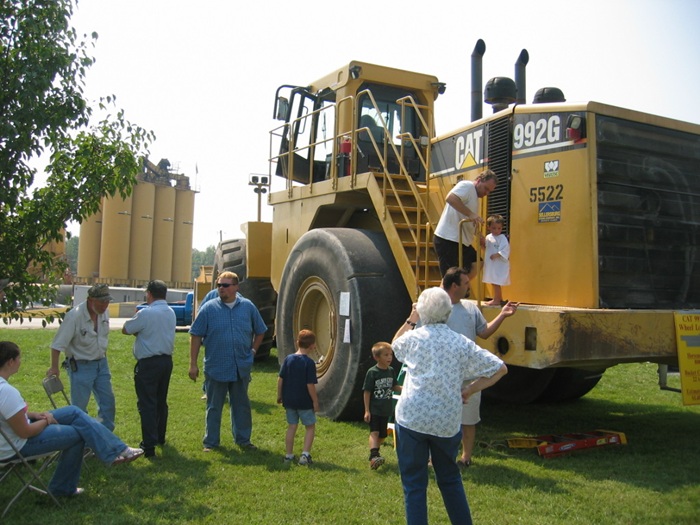
Front-end loader with people for scale. This equipment can easily kill collectors in active quarries; that’s why safety rules must be followed to the letter.
Writer’s conferences and workshops are widespread around the U.S. because there are a plethora of authors. According to Kate Snyder, owner of The Plaid Elephant, a children-focused bookstore in Danville, Kentucky, four million books were published last year. Of those, only a half million were through publishing companies. The rest were self-published. I wonder how many self-published books were by people who know about editing, cover design, and other aspects that make a book a good read.
This was the fifth conference organized by the Bluegrass Writers Coalition. (I joined last summer; membership is free). The format was a keynote speaker, one morning concurrent session (I went to a panel on “Research, The Foundation of Your Non-fiction Masterpiece.) It was followed by a fantastic lunch and two concurrent sessions in the afternoon. (I went to “Mastering Online Marketing” with Matt Jones and Shelf Appeal: How to Catch a Bookseller’s Eye” with Kate Snyder.) It wrapped up with an hour-long Q&A with all the panelists and speakers.
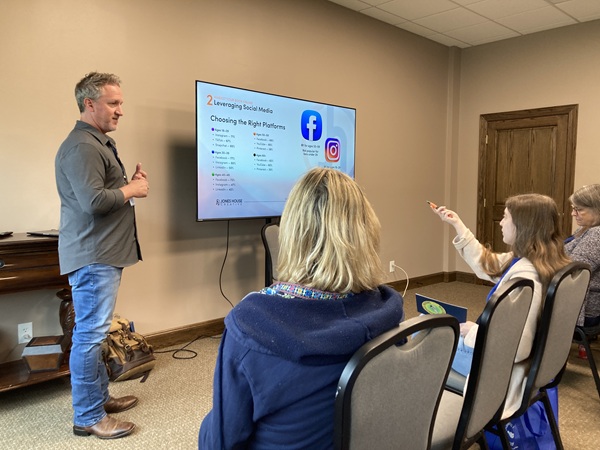
Matt Jones of Tulsa, Oklahoma, led a session on online marketing.
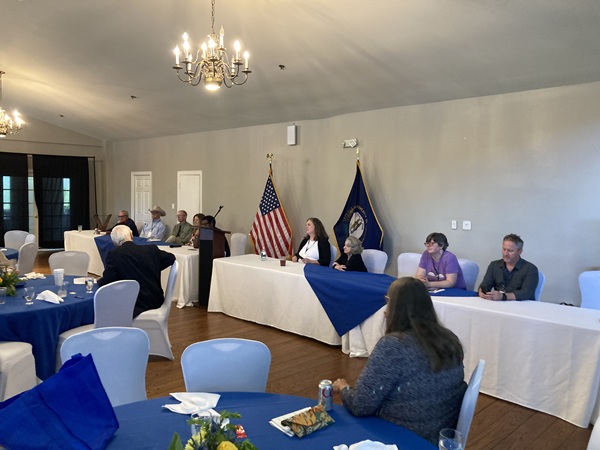
The presenters at the Q & A session held the last hour of the conference.
Throughout my career in museums and parks, professional development has been critical. Getting a degree is NOT the end of education; it’s a time to transition to non-formal learning. It behooves (I love that word!) anyone who wants to live a full life to keep their gray matter active. Stop learning, and the slow decline of life is sure to begin.
The bibliography lists over 180 articles and books published since 1980. Theme-based, it had a linear format, which meant a lot of scrolling! Now, the articles are compiled under the same four topics: Astronomy, Education & Nature, Gardening, and Geology.
In addition, I’ve embedded links to articles on fossils, minerals, and education scattered across my website. I will scan more articles and post them, especially those on Mineral News and the MAPS Digest (fossils). I intend to scan my older Astronomy magazine articles that are out of print, as well. With so many, it will take a while.
If you see an article in the bibliography you would like me to scan and post, drop an email to alangoldsteinwriter1@gmail.com. I will try to oblige.
Today, I stand atop Jeptha Knob. My name is Jim Gilford, and I’m here to solve an act of violence. Mano a mano? No. Naturaleza a naturaleza, nature versus nature. Shelby County was brutalized before the first human set a foot on the land, and I’m here to solve the long-buried mystery.
I’m not your typical detective. I am a rockhound because I love to sniff out crimes against the Earth. My friends call me a geological gumshoe in hiking boots.
Mantled in farms and forests, Jeptha Knob is Shelby County’s highest point. Why is it here? Lord knows I’ve passed the knob on Interstate-64 countless times traveling between Louisville and Frankfort. My high-mileage Ford pickup truck is one of thousands that traverse the edge of the hill, going to and fro every day. Four wheels humming the song where rubber meets the road.
Drivers must think about everything in the world but ancient Kentucky. I’d bet my favorite trilobite that most focus on the future: where they are going, or what they will do upon reaching their destination. A few might be ruminating about where they have been, or problems they left behind. My thoughts are deeper. Millions of years deeper.
The Commonwealth has many geological secrets, questions that I have longed to answer. I’ve always suspected that Jeptha Knob, a “hairy” hill decorated with cell towers, must have an interesting history.
My investigation begins with a dig that needs no shovel. I mine university libraries and the internet for articles and maps written by long-past geologists. By learning what they knew, I can draw my own conclusions.
What I unearth is two competing interpretations. If only I were a fly on the wall listening to a decades-old conversation when it happened. True, I’d be a long-dead fly by now. I can easily envision two scientists espousing their hypotheses, back and forth, in a scholarly version of Wimbledon, and imagine it went something like this:
“It’s volcanic,” the professor states with confidence. He wears a stiff black jacket with a red bow tie and stands behind a polished walnut desk decorated with carefully scattered maps. His thick fingers drum the surface in a tattoo of impatience. An ample belly mimics his theory, threatening to emerge from his jacket like a magma chamber rising to Earth’s surface, shirt buttons potential volcanic bombs.
“But there’s no igneous rock there,” counters the geologist from the front of the desk. Dressed in dusty blue coveralls with a rock hammer hanging from his belt, the man is tall and wiry, with skin as rough as Kentucky’s landscape. His shoes look as worn as an old barn.
“True. But maybe it’s buried deep beneath the roots of the Knob.”
“No. Drilling has revealed nothing. I believe it fell from the heavens as a giant meteorite, like the crater in Arizona,” replies the geologist, looking at an electric globe lamp hanging from the ceiling as if it is going to drop on his head.
The professor cups his clean hands. “There’s no crater.”
The field scientist mirrors the professor cupping his hands with dirt-filled fingernails. “It’s ancient. The crater has eroded over the eons.” He wriggles the shape away.
I realize their theories can be investigated because they left written documentation. I don’t have to believe one over the other. My task is to sniff out clues. There’s only so much one can get by reading and poring over maps. Direct evidence may allow me to learn the answer. I love a good challenge.
On this October day, I make time to flex my skills as an amateur field geologist. The reason for all those cell towers is simple: signals can be broadcast far and wide. The view from the top of the knob is incredible, even if trees and buildings interrupt the panorama. The air is redolent with the aroma of falling leaves and freshly mowed hay. I can taste autumn.
With its fields and woods, houses, barns, and roads, Jeptha Knob’s landscape is no different than most of rural Kentucky. My goal is to tease out the secret, one hidden beneath a tableau of gold, scarlet, and burgundy hues. I must hunt for bare spots in the heavy vegetation to find… rocks. They will provide the clues.
Ambling down the hill, traversing one of the dry rivulets, I kneel and pick up a chunk of tawny chert. The sharp-edged rock is decorated with tiny shells called brachiopods, our State Fossil. The mysteries of paleontology began in Europe, hundreds of years ago, when people climbed the Alps and found fossils on their peaks. Although these early mountaineers knew nothing about geology, their presence fit nicely with Noah’s flood.
Jeptha Knob is a blip on the Earth compared to the Alps, but the wonder of finding fossil sea creatures up here, a thousand miles from the ocean, remains unspoiled by knowledge of how marine mud ended up here. As a rockhound, I am aware of the technology that paleontologists use to date rocks and the fossils within.
My eyesight, failing as I age, makes it necessary to memorize the three-point font geological time chart in my wallet. What I do recall is that the fossils I’ve collected are about 443 million years old. That is ancient beyond measure, but not the oldest fossils in the Commonwealth. The weight of history in my hand is greater than one pound. This wonder only increases my appetite to know more. It is but one piece of my geological jigsaw puzzle.
I must reconnoiter further to seek clues. Farther down the hill, I find horizontal shale layers upended. A force of nature from above or below levered the strata. Somewhere close is a fault line, a fracture in the bedrock. Kentucky is a state with many faults. This isn’t a trite political statement, but a geological observation. While most are normal faults, those within Jeptha Knob are anything but.
Exploration shows different-looking rocks mere footsteps apart, suggesting that an obscured fault line must be here. I wish I could see the hill in its entirety, as bald as my grandfather’s head, unsullied by groundcover. In my mind’s eye, a naked knob appears, with shale and limestone splintered by radiating and curved faults. It’s as if Mother Nature hurled a mountain-sized rock at Shelby County, shattering the land into a hundred pieces. Or did it give a punch from below? That’s the debate, why I’m here today.
Evidence of a cataclysm is scant. It takes a trained eye to eke out details. I hope my eyes and my brain are sharp enough. With a fossil here, a smidgeon of bedrock there, the knob would be more obvious if it were unrooted and moved to Utah or New Mexico, where bare hills abound. But it’s my secret to reveal.
Following a meandering deer trail, I think back to a time when this hill was covered by virgin chestnut, maple, oak, and hickory. They bore girths I couldn’t begin to encircle, even with a rock hammer in each hand.
Surely the First People would have wondered about this round hill rising from a gently undulating landscape. Did they cross it, or find it easier to walk around? Perhaps they climbed the knoll to seek chert to knap into tools? Did they give it a name?
Questions I can’t answer continue to fill my head. Did elephantine mammoths and mastodons pass here tens of thousands of years ago? How much rock was eroded and carried away over the eons? Did this hill exist during the Age of Dinosaurs? Or is it recent? I have too many questions.
I clear my head, catch my breath, and sip from my water bottle. There’s a convenient tree stump to sit. From my chair, I distract myself from the past and listen to catalogue the sounds carried by the autumn breeze. A “chip, chip” comes from my left, a few hundred feet away, hidden in the forest underbrush. A chipmunk announces an intruder to its companions. It might be me.
Rustling overhead comes from a grandfather red oak. I gaze at a furry gray squirrel galivanting over a gnarled branch, gathering fresh acorns for winter. The chiseling of a pileated woodpecker comes from a deadfall not a hundred feet away. I smile at the antics of this crow-sized bird of red, black, and white, thankful that I don’t have to use my rock hammer to find a meal of grubs. The growling downshift of a big rig reminds me that I’m not alone in the wildness; the interstate highway is at the bottom of the hill.
I pull out my loupe to examine a fossil that I haven’t packed away. It’s a section of disks from the stalk of an ancient sea lily – an animal related to starfish. It was anchored to the seafloor as firmly as a stalk of golden corn in the field at the bottom of the hill. Perhaps it perished when Jeptha Knob was created, as surely as a stalk of corn survives a powerful tornado.
Any fossil preserved in Kentucky’s bedrock tells a story whispered to those who are willing to listen and interpret. I hear the quiet voice that survived weathering and erosion through time immemorial. This is Kentucky before it had a name; from an age so vast, millennia become microseconds on our galaxy’s pocket watch. Millions of years have no meaning to people when a century seems like an eternity.
It requires an “inner” eye or an active imagination. What do I see?
A vibrant cerulean ocean where the only movement is the clouds scudding across a crystalline sky and waves undulating, bringing oxygen to the creatures hidden below. Plankton follows the meandering currents, living and dying, unaware that they will become the power for modern society, petroleum. They will be transformed into ubiquitous plastic, forming pernicious new “plankton” that finds its way into all living things. Life begets life, death begets death.
Plunging into saltwater, I see corals, boulders cloaked with tiny tentacles, and live sea lilies – brittle stars riding strands of beads. Squids, in long cone-shaped shells, are fingering the seafloor for tasty snails and clams. Big roly-poly-like trilobites scuttle across the bottom, scooping up morsels in gray mud. Gardens of seaweed, waving back and forth with the currents, greet me as I float by. Okay. The sea is not familiar up close. It is a place of peace with the same solace I find whether snorkeling in Laurel Lake or the Florida Keys.
What about the sky? Darkness without city lights allows me to view so many stars that I get lost in the firmament. A crescent moon hovers near the horizon, larger than any I have ever seen. A crème color dances like sprites on the waves. I sing to myself, “I see a bad moon setting.”
An unfamiliar dappled glow spans the sky: a ring. Earth has a ring? It is pitiful compared to Saturn’s, and it’s not made of sparkling ice. Perhaps an asteroid has crumbled above, forming a coarse gray necklace overhead. It lies too close to exist for long. As if to emphasize its brief life, a blazing fireball shoots across the sky in yellow and red. It fizzles out before it can plummet into the sea. Earth’s gravity will pull down the bigger rocks, and they will make a big splash… or splat.
It’s D-Day. Or should I say J-Day, the day one of two natural forces creates Jeptha Knob. Will it be a volcanic eruption? I sit and wait on a blue and white surfboard in a wetsuit. I don’t have to worry about sharks nibbling on my fingers and toes. They don’t exist yet. A sea without fish. How weird is that?
A gorgeous sunrise greets me like an old friend. The rocks of doom above fade but don’t disappear. I paddle aimlessly, looking at the horizon, flat in every direction. Haze rises off the water. It’s a saline scent not found in any body of water in the Commonwealth.
If there are any islands, they must be scattered and low. The rocks should be barren. Plants will appear on land soon, in a million years or two. Perhaps there is some moss, liverworts, or a green goo encrusting rocks that will never be preserved; another secret lost to time.
High in the western sky is a flash. The sea brightens as a new sun, a ball of fire descends like Helios on a trail of yellow, green, and blue sparks. I hold out my hand, shielding my eyes as this “sun” dives into the expansive sea. A few seconds later, there’s a deafening rumble, before the sea erupts in an explosion putting Krakatoa to shame. Streaks of white shoot high into the stratosphere, followed by a roiling mushroom cloud of steam and dust. The first shockwave pushes mist from the wave crests at hypersonic speed. I sit, unaffected.
My gut tightens into a knot. The worst is yet to come. I stand up on the surfboard, ready as the calm sea laps around me. I watch the expanding cloud and the sea at the horizon. A line of haze thickens as the roar of the asteroid impact vibrates through my bones. A wall of water, a tsunami, rises. The churning sea climbs to touch the clouds.
I bend my knees and lean forward. I lift with the water and pick up speed. Within seconds, I’m surfing across Kentucky. Hanging ten hundreds of feet above, I view the sea spread out before me, a patchwork of blues in shades of aqua and turquoise. In minutes, I pass what will be Bardstown, Elizabethtown, and Leitchfield. It doesn’t matter which direction I choose; Kentucky is completely flat and covered by saltwater. The Appalachians don’t exist.
I feel water on my face and stick out my tongue. Do I detect a little salt?
Reality returns, and Jeptha Knob is once again under my feet. An autumn rain dampens my clothes but not my spirit. It won’t spoil my day, for I have surfed across Kentucky in time and space.
There were no igneous rocks beneath Jeptha Knob that I could take for granite. Not a trace was found as I gathered limestone and shale from one side of the hill to the other. I didn’t see a volcano erupt.
This rockhound gumshoe concludes, after much research, careful field studies, and reasoning with a vivid imagination, that the geologist who hypothesized the asteroid impact was correct.
It came from space.
A rockhound must snoop on. I’m comfortable concluding that I can check off this mystery in Kentucky’s history. But rest on my laurels? Never. I hear of another geological crime scene near Fort Knox. The evidence includes oil, gas, and geodes!
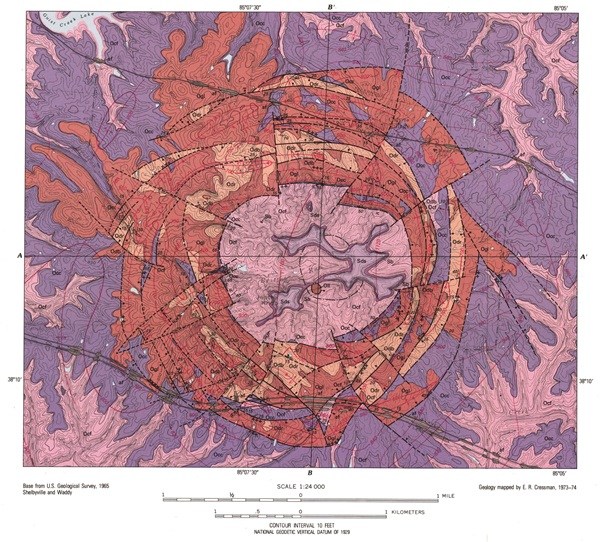
Map of Jeptha Knob, Shelby Co., Kentucky. The radial and radiating dashed likes represent faults. The double solid line at the bottom is Interstate 64, the single line toward the top is Highway US 60.
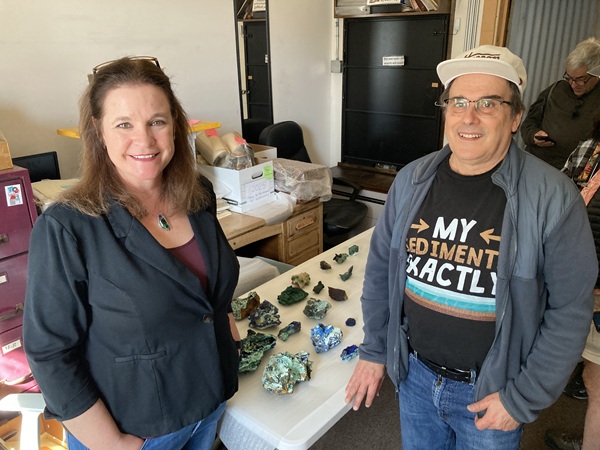
I visited this museum on February 8 as one of the highlights of my week-long visit to Tucson for the various mineral and fossil shows. I facilitated the transfer of a large collection of Bisbee copper minerals from the Kentucky Science Center to the Bisbee Mining & History Museum. The KSC collection dates from the early days of Bisbee mining; the museum folks indicate most specimens are from the Holbrook Mine, with several from the Czar Mine. Here are a few photos from the visit.
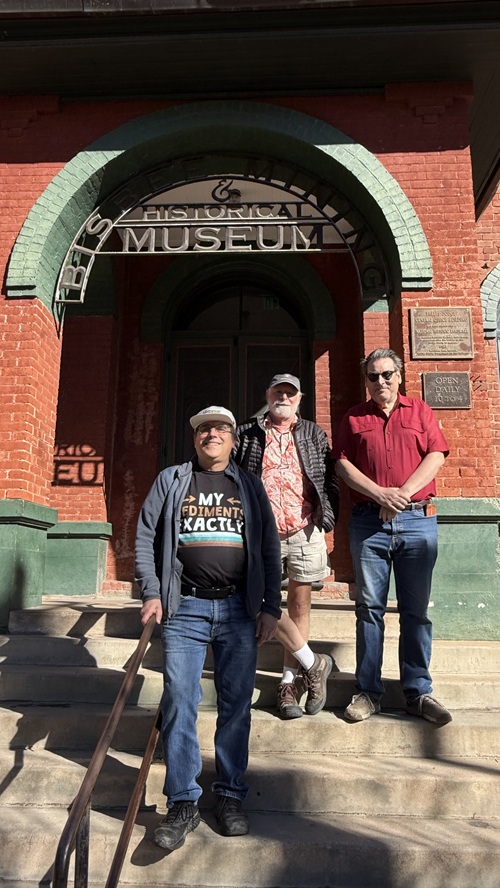
Alan Goldstein, Ed Jacoby, and Dave Eicher stand at the entrance to the museum.
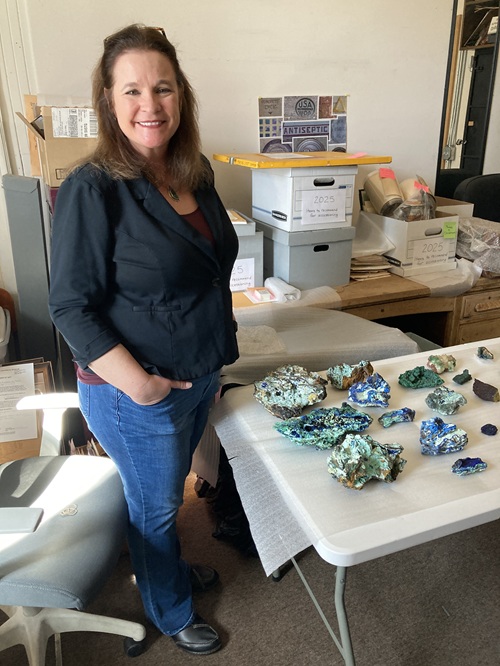
Annie Larkin, the museum director, poses with a few of the KSC Bisbee minerals. Most are still waiting to be cleaned.
Annie Larkin, the museum director, and I stand with the KSC minerals in the two rows between us. The other minerals are from their collections.
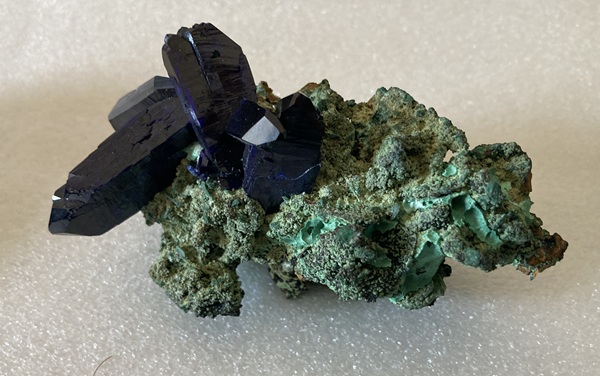
An azurite specimen from Bisbee, about 3″ across, for the Tucson Show display.
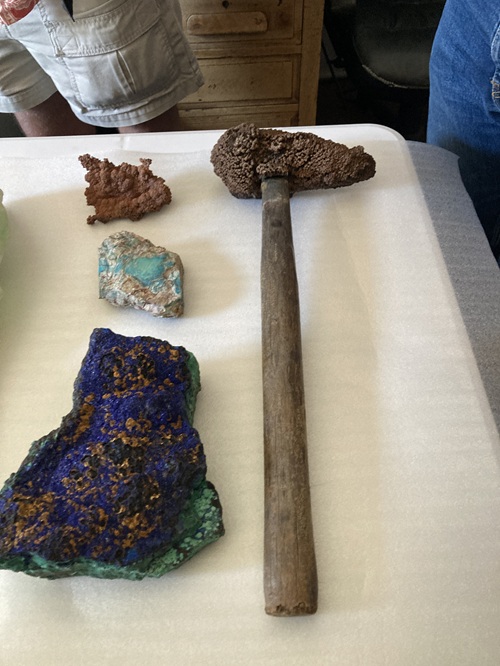
A hammer coated with post-mine (obviously!) native copper deposited by groundwater. Native copper is not found in the deposits at Bisbee. Other specimens include azurite on malachite, turquoise, and another late-native copper.
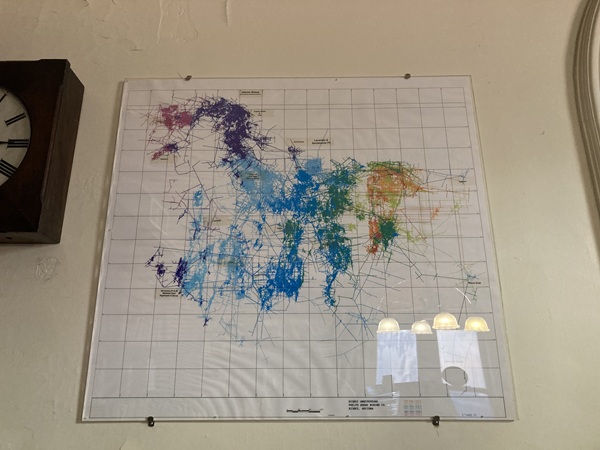
A color-coded map of the copper mines around Bisbee. There are about 2,000 miles of tunnels! (Most are flooded.) The colors represent different mines. The last underground mine shut down in 1975.
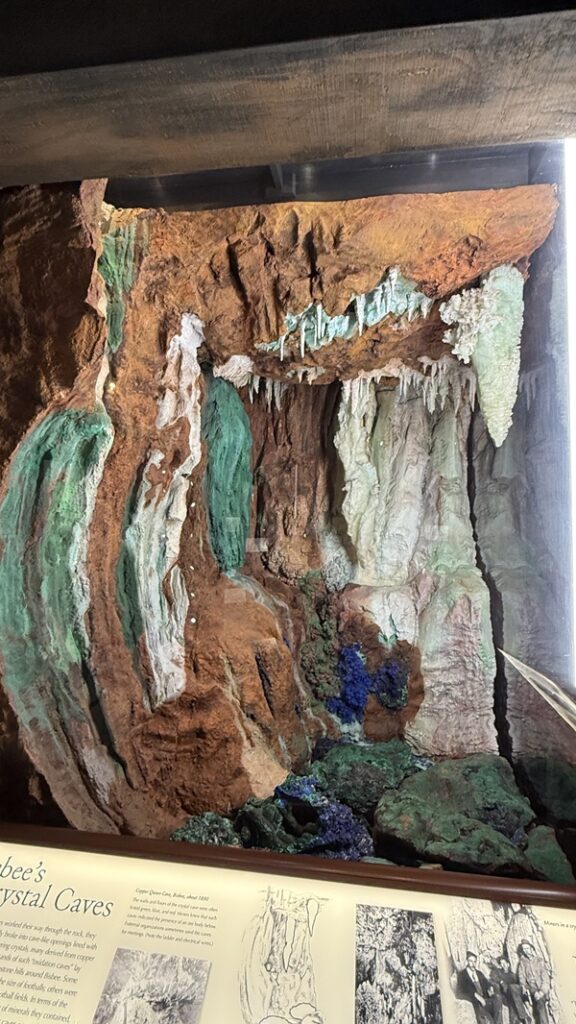
Exhibit to give visitors an idea of the beauty of the caves inside the mountains. Nothing like around Kentucky!
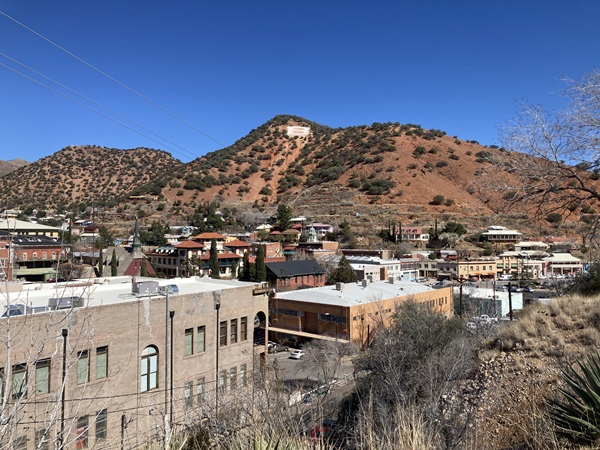
Bisbee as seen from US 80 overlook. This town was built with brick to encourage permanence of miners and families with businesses to support everyone.
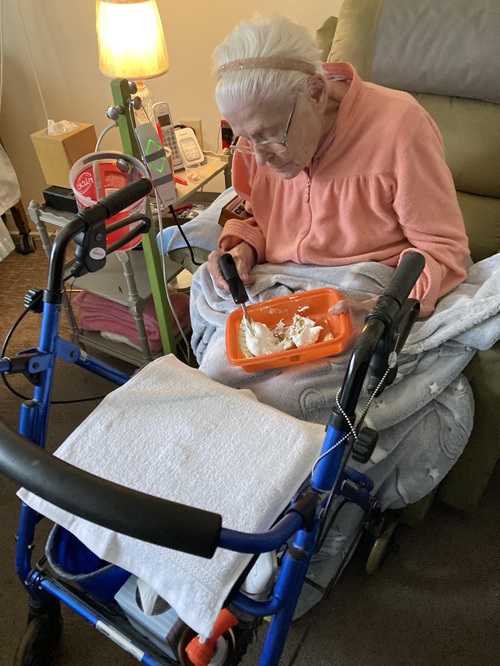
My mother-in-law, Martha Meyer, passed away on December 13 at 99. She was a woman who didn’t have a mean bone in her body. She lived in her second-floor condo until last December.
Photo above: Martha Meyer demolishing Emily’s pumpkin pie about two weeks before she passed.
I met her when I started dating Debbie in 1986. After her husband, Herb, passed away, she accompanied us on quite a few vacations from coast to coast. She contributed financially, allowing us to do more than would have been possible on our family’s budget.
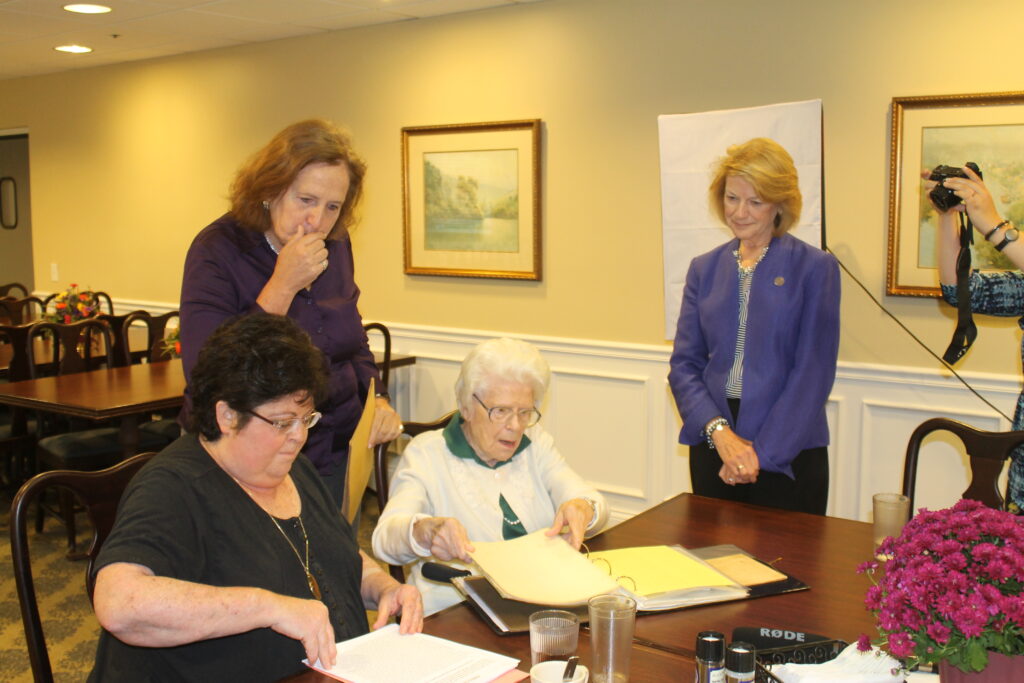
Debbie introduced her to the public relations person at Asbury University, a religious college in Wilmore, KY. Martha’s great uncle loaned the university money to rebuild after the 1905 fire destroyed most of the campus. He was a mason and helped with the construction of the new buildings – all of which still stand over 100 years later (photo below). The university honored her as a matriarch and treated her like a queen. She had an “aw shucks” attitude, overwhelmed by the attention.
Photo above: Martha looking at scrapbook with Debbie and Asbury folks look on.
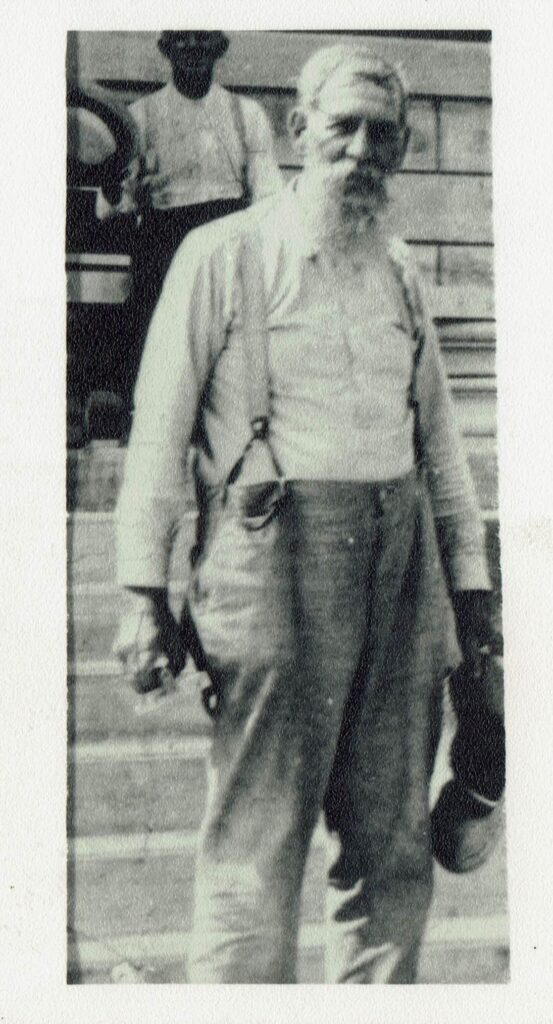
Photo above: “Grandpa” Askin’s (Martha’s great uncle) with a masonry trowel in hand, standing before an Asbury College building he helped build in about 1913.
I retired from the Falls of the Ohio State Park on the 32nd anniversary of my being hired. (That’s Nov. 8, 1993.) Over the last 31 years, I filled a niche that included education, collections (as in specimens and artifacts, not money), developed the volunteer program, writing, special events and programs, and more.
The Falls of the Ohio is one of those unique places on our planet. It’s a one-of-a-kind location where you can walk on a Devonian sea floor (I call it dry snorkeling) when the river is low. My self-taught interest in corals enabled me to identify most of the ~150 species documented in the Devonian around the Falls. That’s the greatest in diversity, equal only to the Eifel Valley in Germany, which is the same age.
This website explores the wondrous diversity on my “Fossils” pages. Now that I’ve got more free time, I will flesh out the contact with more species photographs. I will explore fossils in blogs and articles. And yes, I will add content in astronomy, writing, family history, and more. So welcome to what I hope to be an informative collection of resources across a spectrum of interests.
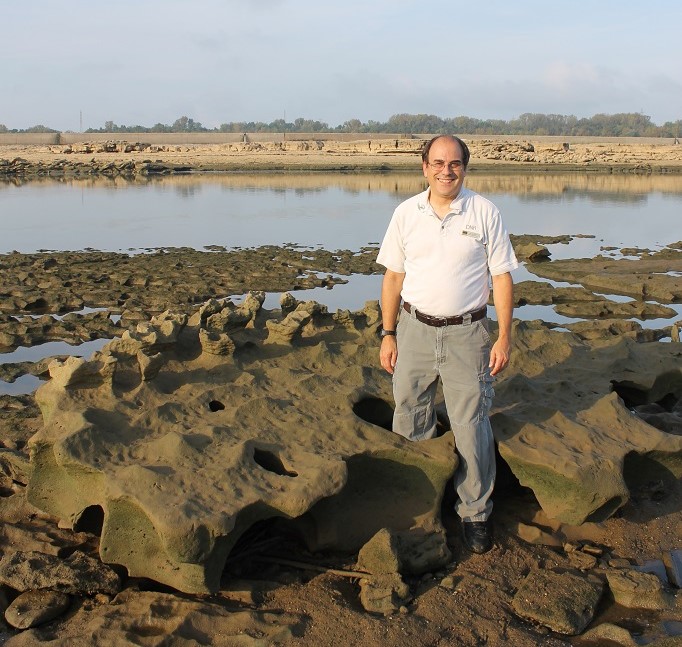
I’m standing at ‘chicken rock,’ a Devonian boulder only accessible a couple of days a year at the Falls of the Ohio.
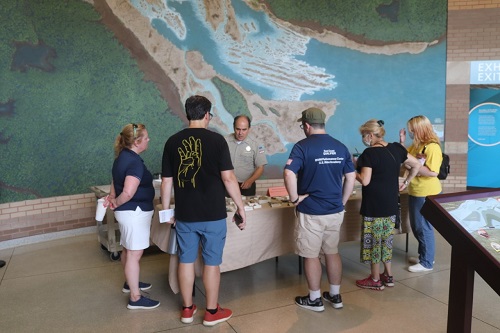
Meet the Paleontologist and Paleontology Explorer were designed to introduce visitors to a wide variety of paleontology-themed programs beginning in 2015. I hope Dale Brown continues it until my replacement is hired. After that, who knows?
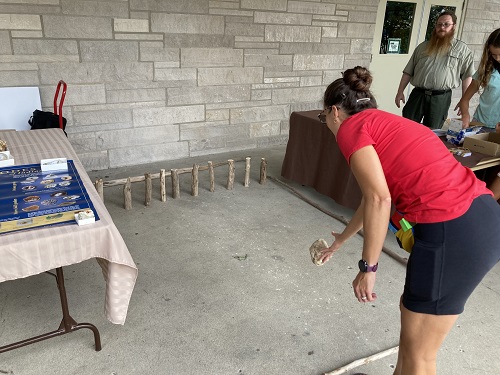
What can you do with those heavy, solid geodes? How about geode bowling? This activity was invented for the Indiana State Fair and adopted for Digging the Past. Rather than knock them all down, one just has to topple one driftwood pin to get a prize.
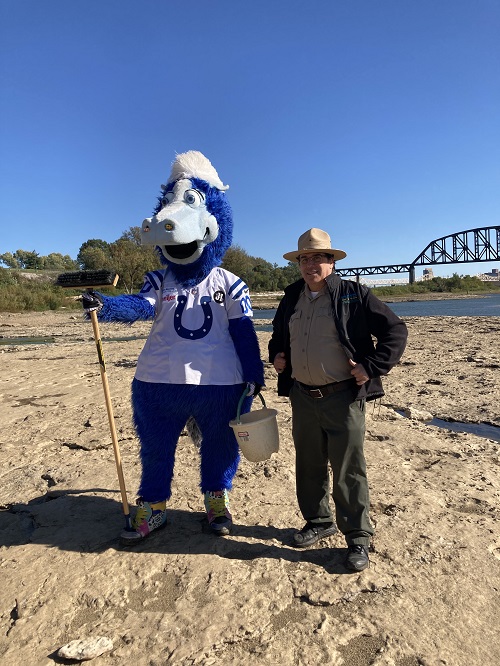
I met all sorts of interesting people over the last 40 years (almost 8 at the museum/science center in Louisville). Certainly, one of the most colorful was ‘Bluey’, the Indianapolis Colts mascot. On Christmas Day, 1993, I gave a tour of the new Interpretive Center to Diane Sawyer and her mother. Walter Cronkite visited on my day off… oh, well.